CAT 50 Day Streak – Day 38
30 questions across VARC, DILR & QA · +3 for a correct answer · −1 for a wrong MCQ · no negative marking for TITA
VARC · Verbal Ability & Reading Comprehension
There have been two recent remarkable events concerning national security law in the United Kingdom. The first was a prosecution that collapsed. The case was about alleged spies in the offices of members of parliament. The allegation was that two individuals were passing sensitive information to China. That prosecutions collapse is not by itself remarkable: cases get pulled all the time. But the circumstances of how this matter came to an end are rather odd.
The official reason is that the prosecution felt it no longer had sufficient evidence for a realistic prospect of prosecution, but this makes no sense. There was sufficient evidence to bring the charges in the first place, and the evidence base did not change. The second remarkable event was the government's publishing three witness statements given at various times by its deputy national security adviser. This was evidence to be placed before the court to support the prosecution. For such documents to be placed directly into the public domain is extraordinary.
This ploy helped the government in the face of political criticism. The statements show a government assisting the prosecution by providing relevant evidence. The documents counter accusations by the opposition that the government pressed the Crown Prosecution Service (CPS) to drop the case. We do not have all the relevant information, and that is not unusual. The case is about national security, and so we can expect there are things we are not told. There may have been interventions from ministers or officials, but we simply do not know.
But based on the information available, there is a mystery. And as long as there is this mystery, there will be political and media interest—and public speculation. The director of public prosecutions (DPP), who heads the CPS, has not helped himself by his clumsy public handling of the case. His letter to members of parliament on the decision to drop the prosecution raises more questions than it answers. In that letter, the DPP blamed two things. First, he blamed a recent High Court case for narrowing the applicable law, but the case he meant was not in the High Court and it did not narrow the law. Second, he blamed the government for not providing the evidence then required, but the published witness statements show the CPS did get that evidence.
The excuses offered by the DPP are unconvincing and even look like post-facto rationalisations. It is difficult, if not impossible, to see the supposed reasons as explaining why the case was dropped. A close look at the published witness statements indicates that the CPS may have made other errors. The first witness statement points to the CPS having asked for evidence for an offence under the National Security Act 2023, which requires the prosecution to show that the information was “prejudicial to the safety or interests” of the United Kingdom. But the defendants were not charged under that statute, which was not in force at the time of the relevant offences. They were instead charged under the old Official Secrets Act 1911, which requires evidence of the information being of use to “an enemy.”
The author dismisses the DPP’s excuses and points to “other errors”. The CPS asked for evidence under the 2023 Act’s “prejudicial” test, but the defendants were charged under the 1911 Act, which has a different test. That mismatch is the strongest explanation the passage offers.
B: the statements show the CPS did get the evidence. C: possible interventions are explicitly unknown (“we simply do not know”). D: the case the DPP cited was not in the High Court and did not narrow the law.
The 1911 Act “requires evidence of the information being of use to ‘an enemy’”. D states that requirement.
A is the 2023 Act’s test. B is a fact about timing, not a legal standard. C (“actively working for a foreign power”) is never mentioned.
The author’s explanation depends on the two Acts having different tests, so that the CPS chased the wrong one. If the standards were legally identical, seeking evidence under the 2023 wording would be no error at all, and the explanation falls apart.
A brings in a different cause but doesn’t touch the error itself, and the author already allowed for possible interventions. B contradicts a factual claim (that the case was not in the High Court) rather than the core reasoning. D casts doubt on the evidence but doesn’t remove the mismatch between the two Acts.
The mystery is why the case was dropped. Both reasons the DPP gave (the court case and missing government evidence) are contradicted by the facts, and his letter “raises more questions than it answers”.
A: the document release is described as a political ploy, not a mystery. C: how the accused got the information is never discussed. D: whether one Act should replace the other is not raised.
The passage ends on its point: “The difference between us was luck.” Some soldiers died in their sleep while the author survived. A captures this.
B: the saying is about low probability, not bravery. C stresses alertness, but the soldiers who died were asleep, which makes the point about chance, not vigilance. D credits training, which the passage never mentions.
- As has been widely remarked, horror films are enjoying rare popularity at the moment.
- Look at Sinners, in which blues musicians batter vampires, a rare blockbuster not based on other material.
- Or the fairytale-tinged Weapons, popular enough to top the US box office for the entire month of August.
- There’s always been a market for spooky cinema, but over the last decade or so, what was previously a cult concern has gone mainstream in a big way, reaching new heights in 2025.
The order runs like this:
- 1: Horror films are enjoying rare popularity.
- 4: How it happened: from cult concern to mainstream, peaking in 2025.
- 2: “Look at Sinners”, the first example.
- 3: “Or … Weapons”, the second example.
- Stanford scientists have discovered a different way of ascertaining our future expiration dates: the “inflammatory-ageing clock”
- One of the immune system’s primary tools is acute inflammation.
- On the other hand, long-term, system-wide inflammation is “bad.”
- Importantly, it is a short-term response that lasts only as long as needed for the immune system to finish its job.
- This is a “good” process because it is the body’s localized, protective response to things like tissue damage, invasive microbes, or metabolic stress.
The coherent paragraph is 2 → 5 → 4 → 3:
- 2: Acute inflammation is a primary immune tool.
- 5: “This is a ‘good’ process”, a localised protective response.
- 4: “Importantly”, it is short-term.
- 3: “On the other hand”, chronic inflammation is “bad”.
Sentence 1 announces a research finding (an “inflammatory-ageing clock”). The other four explain good versus bad inflammation, and sentence 1 has no link into or out of that contrast.
Once identity is defined as “the internal sense a person has of who they are”, the sentence explains why a well-developed sense of self matters. The next sentence gives the contrast: an “unclear, disorganised and unstable” sense of self leaves deep questions.
At blanks 1 and 2, “sense of self” would come before identity is introduced. At blank 4 it would interrupt the description of what an unstable identity looks like.
- It is also said that he took his name from the fact that the priestess of Pythian Apollo had predicted his birth on a trip made by his father to Delphi.
- According to the oracle at Delphi, Pythagoras would tell the truth in his life.
- Pythagoras’ mysterious personality was noticeable during his teaching.
- The Pythian oracle also proclaimed that he would benefit humanity.
- For the same reason, his mother was renamed Pythaida from Parthenida, which was her original name.
The coherent paragraph is 1 → 5 → 2 → 4:
- 1: His name came from the Pythian priestess predicting his birth.
- 5: “For the same reason”, his mother was renamed Pythaida.
- 2: The Delphic oracle said he would tell the truth.
- 4: “The Pythian oracle also” said he would benefit humanity.
Sentence 3 is about his personality as a teacher. The other four are all about the Delphic oracle and his name.
- Connecticut, which is often known as the Constitution State, is an engaging blend of historical depth, economic power, and natural beauty situated in the northeastern United States.
- Despite being small in size, Connecticut is still one of the most densely populated areas of the US.
- Being one of the original 13 colonies, its roots run deep in the formation of the nation, marking a different place for it in American history.
- Let’s delve more into the aspects of Connecticut.
- Explore its strategic location, historical tapestry, vibrant population, and commitment to education and sustainability.
- Let's see what makes this New England gem a truly unique and influential state.
The order runs like this:
- 2: Historical depth: one of the original 13 colonies (follows A’s “historical depth”).
- 1: Despite its small size, it is densely populated.
- 3: “Let’s delve more into the aspects”.
- 4: “Explore its…”, listing those aspects, which leads into F.
DILR · Data Interpretation & Logical Reasoning
12 employees of a company namely Arpita, Chanda, Ekta, Gargi, Lavanya, Nikhil, Om, Rohit, Sakshi, Tarun, Uday and Yogi live in 12 different localities of city namely Badarpur, Chhatarpur, Dwarka, Greater Kailash, Hauz Khas, Janakpuri, Mayur Vihar, Nirman Vihar, Punjabi Bagh, Rohini, Shahdara and Vasant Kunj not necessarily in the same order. They joined the company in the same year but in different months.
The person who joined the company in March lives in Janakpuri. Four people joined the company between those who live in Rohini and Greater Kailash. Tarun joined the company just before the person who lives in Greater Kailash. Om joined the company 3 months before Tarun did. Nikhil lives in Nirman Vihar and joined the company after Rohit, who lives in Chhatarpur (not necessarily the very next month). The first person among them to join the company lives in Punjabi Bagh. Om did not join the company before Rohit and Nikhil. Sakshi joined the company 4 months after Chanda did. Chanda’s joining was preceded by Om and followed by Yogi. Uday joined the company in May and does not live in Rohini or Shahdara. Among Arpita and Lavanya, Arpita joined the company earlier and neither of these two lives in Punjabi Bagh or Greater Kailash. Ekta joined just after the person who lives in Vasant Kunj. The persons living in Shahdara, Dwarka and Badarpur joined the company in three consecutive months in the given order. The last person among them to join the company does not live in Mayur Vihar.
- The block. Om, Chanda, Yogi joined in consecutive months, followed by Tarun (Om + 3), the Greater Kailash person (Om + 4) and Sakshi (Chanda + 4 = Om + 5). That is six consecutive months starting with Om.
- Placing Om. Rohit and Nikhil joined before Om, so Om ≥ 3. Uday (May) can’t fall inside the block, so Om = 6 or 7. With Om = 6, Greater Kailash is in October and Rohini must be in May, which is Uday’s month, but Uday isn’t in Rohini ✗. So Om = 7 (July), Greater Kailash is November and Rohini is June.
- November and January. The November (Greater Kailash) person can only be Ekta or Gargi. Ekta can’t join in January (someone must come before her), so Gargi is January (Punjabi Bagh) and Ekta is November. Ekta comes just after the Vasant Kunj person, so Tarun lives in Vasant Kunj.
- February to June. March (Janakpuri) and June (Rohini) must be Arpita and Lavanya, in that order. So Rohit is February and Nikhil is April.
- The rest. Shahdara, Dwarka and Badarpur fill July–September (Om, Chanda, Yogi). The December joiner isn’t in Mayur Vihar, so Sakshi is in Hauz Khas and Uday in Mayur Vihar.
| Month | Person | Locality |
|---|---|---|
| Jan | Gargi | Punjabi Bagh |
| Feb | Rohit | Chhatarpur |
| Mar | Arpita | Janakpuri |
| Apr | Nikhil | Nirman Vihar |
| May | Uday | Mayur Vihar |
| Jun | Lavanya | Rohini |
| Jul | Om | Shahdara |
| Aug | Chanda | Dwarka |
| Sep | Yogi | Badarpur |
| Oct | Tarun | Vasant Kunj |
| Nov | Ekta | Greater Kailash |
| Dec | Sakshi | Hauz Khas |
Uday lives in Mayur Vihar.
From the table in Q11, the Mayur Vihar resident is Uday, who joined in May.
From the table in Q11, Ekta (Greater Kailash) joined in November, and Sakshi joined just after, in December.
From the table in Q11, Nikhil joined in April and Om in July. Uday (May) and Lavanya (June) joined in between: 2 people.
From the table in Q11, Chanda (August) lives in Dwarka.
A university gives admission to a student based on their score and the board of education in which he/she passed. There are six boards – A, B, C, D, E, and F – which are considered by the university. The cut-offs for each of these boards were consecutive multiples of 5. Ten students opted for admission to the university, of which only seven were selected. The score of every selected student was equal to their respective cut-offs.
| Name | Gender | Board | Cut-off | Score | Selection |
|---|---|---|---|---|---|
| Avni | F | Yes | |||
| Beena | F | Yes | |||
| Charan | M | ||||
| David | M | 70 | |||
| Ekta | F | C | 80 | No | |
| Fatima | F | 70 | |||
| Gagan | M | A | 80 | ||
| Hina | F | 75 | No | ||
| Ishan | M | 75 | |||
| Jalaj | M | B | 75 |
The following additional information is known:
- Avni was one of the least scorers.
- Beena had a score greater than that of Charan but less than that of David.
- Ekta’s score was the highest among the females.
- Fatima and David belonged to the same board.
- Ishan was the second-highest scorer among males.
- Board ‘D’ had the lowest cut-off.
- There were two students from each board, except for ‘C’ and ‘F’.
- No student scored less than 60, and only one student scored 65.
Detailed solution coming soon.
- Cut-offs. Ekta scored 80 but was not selected, so board C’s cut-off is above 80, i.e. 85. Beena is selected, below David’s 70 and above Charan, so Beena = 65. Avni, one of the lowest, = 60 = board D. The six cut-offs are 60, 65, 70, 75, 80, 85.
- David and Fatima (70). They share a board, and C and F each have only one student. If their board’s cut-off were above 70, too many students would miss selection. So their board is E = 70, which leaves F = 65.
- Beena (65) is therefore in board F.
- Others. Hina (75, not selected) needs a cut-off above 75, so she is in A with Gagan. Ishan (75) must be in B with Jalaj, and Charan goes to D with Avni.
| Board | Cut-off | Students |
|---|---|---|
| A | 80 | Gagan, Hina |
| B | 75 | Jalaj, Ishan |
| C | 85 | Ekta |
| D | 60 | Avni, Charan |
| E | 70 | David, Fatima |
| F | 65 | Beena |
Board F: Beena.
From the table in Q17, Charan and Avni are both in board D.
From Q17, board E (David and Fatima) has a cut-off of 70.
From Q17: Avni 60, Beena 65, Ekta 80, Fatima 70 and Hina 75. Average = 350/5 = 70.
QA · Quantitative Ability
The third-year hike is 25% of the salary at that point: 66000/0.25 = 2,64,000.
The salary before the second hike = 2,64,000/1.2 = 2,20,000. Second-year hike = 20% of 2,20,000 = Rs. 44000.
Split the sum into 7 parts matching the powers: a/2 + a/2 + 3b/4 + 3b/4 + 3b/4 + 3b/4 + 4c = 42. By AM ≥ GM the product is greatest when all seven parts equal 6, i.e. a = 12, b = 8, c = 1.5.
a2b4c = 144 × 4096 × 1.5 = 2432 × 212 × 3/2 = 21533.
Equal interest every year means equal effective annual rates. 8% per half-year gives (1.08)2 − 1 = 0.1664, so the second scheme’s rate is 16.64%.
The hypotenuse is 2 × 15 = 30. For a right triangle, r = (a + b − c)/2, so a + b = 42.
a2 + b2 = 900 gives ab = (1764 − 900)/2 = 432. The legs are the roots of t2 − 42t + 432 = 0: 24 and 18.
Smallest side = 18 cm.
Since [x + 2] = [x] + 2, let n = [x]: n2 + 2n + 4 − 7 = 0, so (n + 3)(n − 1) = 0 and n = 1 or −3.
So x ∈ [1, 2) ∪ [−3, −2): two whole intervals, giving infinitely many solutions.
Prices: cow 14000, goat 6000, sheep 4000. Monthly upkeep: cow 400, goat 800, sheep 1000.
Cows: 18 × (14000 + 800) = 2,66,400. Goats: 12 × (6000 + 2400) = 1,00,800. Sheep: 15 × (4000 + 5000) = 1,35,000.
Dividing by 1800 gives 148 : 56 : 75.
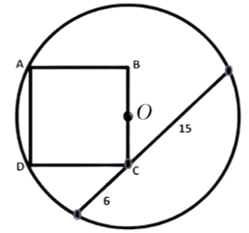
Let the side be s, with O on BC. Since OA = OD, O is the midpoint of BC, so OC = s/2 and R2 = s2 + (s/2)2 = 5s2/4.
For the chord through C: 6 × 15 = R2 − OC2 = 5s2/4 − s2/4 = s2.
Area = s2 = 90.
−b2 + 8b − 15 = −(b − 3)(b − 5) must be positive, so 3 < b < 5 and b = 4, which makes the expression equal 1.
Likewise −(a − 5)(a − 7) > 0 gives a = 6, and the expression equals 1. Both logs are log 1 = 0 ✓.
a + b = 10.
The list has 50 × 51/2 = 1275 terms, so the median is the average of the 637th and 638th terms.
The numbers 1 to 35 fill the first 630 positions, and 36 fills positions 631 to 666. Both middle terms are 36, so the median is 36.
Let one man, woman and child do m, w and c of the work per day. Then 18m + 15w = 1/15, 18m + 16c = 1/18 and 15w + 12c = 1/30.
Solving: c = 1/1260, m = 1/420 and w = 1/630.
8m + 9w = 8/420 + 9/630 = 1/30, so they need 30 days.
Correct: 0 · Wrong: 0 · Accuracy: 0%
Keep the streak alive. See you tomorrow for Day 39.