CAT 50 Day Streak – Day 36
30 questions across VARC, DILR & QA · +3 for a correct answer · −1 for a wrong MCQ · no negative marking for TITA
VARC · Verbal Ability & Reading Comprehension
Physics is in crisis. For the past century or so, we have explained the universe with two wildly successful physical theories: general relativity and quantum mechanics. Quantum mechanics describes how things work in the incredibly tiny world of particles and particle interactions. General relativity describes the big picture of gravity and how objects move. Physicists want to produce a theory of “quantum gravity” that replaces general relativity and quantum mechanics, while capturing the extraordinary success of both.
One of the most prominent mathematical approaches to quantum gravity is loop quantum gravity, which proposes that the fabric of space and time is made of a network of extremely small discrete chunks, or 'loops.' A remarkable aspect of loop quantum gravity is that it appears to eliminate time entirely. A number of other approaches also seem to remove time as a fundamental aspect of reality.
So, we know we need a new physical theory to explain the universe, and that this theory might not feature time. Suppose such a theory turns out to be correct. Would it follow that time does not exist? It’s complicated, and it depends on what we mean by exist. Theories of physics don’t include any tables, chairs, or people, and yet we still accept that tables, chairs, and people exist. Why? Because we assume that such things exist at a higher level than the level described by physics. We say that tables, for example, 'emerge' from an underlying physics of particles whizzing around the universe.
But while we have a pretty good sense of how a table might be made out of fundamental particles, we have no idea how time might be 'made out of' something more fundamental. So, unless we can come up with a good account of how time emerges, it is not clear we can simply assume time exists. Time might not exist at any level.
Saying that time does not exist at any level is like saying that there are no tables at all. Trying to get by in a world without tables might be tough, but managing in a world without time seems positively disastrous. Our entire lives are built around time. We plan for the future, in light of what we know about the past. We hold people morally accountable for their past actions, with an eye to reprimanding them later on. We believe ourselves to be agents (entities that can do things) in part because we can plan to act in a way that will bring about changes in the future.
The discovery that time does not exist would seem to bring the entire world to a grinding halt. We would have no reason to get out of bed.
There is a way out of the mess. While physics might eliminate time, it seems to leave causation intact: the sense in which one thing can bring about another. Perhaps what physics is telling us, then, is that causation and not time is the basic feature of our universe. If that’s right, then the agency can still survive. For it is possible to reconstruct a sense of agency entirely in causal terms. This suggests that time does not exist and may have no direct impact on our lives, even while it propels physics into a new era.
The last paragraph says that while physics might eliminate time, “it seems to leave causation intact”, and that “causation and not time is the basic feature of our universe”. That is the inference in B.
A: loop quantum gravity is called “one of the most prominent” approaches, never the first. C: the passage says nothing about science rejecting this idea. D is the opposite: “we have no idea how time might be ‘made out of’ something more fundamental”.
The table example sets up a contrast: “while we have a pretty good sense of how a table might be made out of fundamental particles, we have no idea how time might be ‘made out of’ something more fundamental.”
B and D treat time as emerging the same way tables do, which is exactly what the author says we can’t explain. C: the author never calls particle physics unscientific.
The argument moves through three ideas: whether time can “emerge” like tables, what losing time would mean for agency and our lives, and causation as the way out. C names all three.
A and B focus on “loops”, which are mentioned only in passing. D’s “approaches” is generic and leaves out the central questions of emergence and agency.
The author contrasts causation with time: physics may eliminate time while leaving causation intact. Causation is offered as a replacement for time, not another name for it.
A is stated in paragraph 2. B matches the closing line about physics entering a new era. C matches “this theory might not feature time”.
- Researchers worked with 20 patients who were undergoing intracranial recording of brain activity to guide surgery for the treatment of their drug-resistant epilepsy.
- They looked at how the patients' brain activity was affected when shown film clips containing different types of cognitive boundary transitions thought to trigger changes in how a memory is stored and that mark the beginning and end of memory files in the brain.
- Researchers have identified two types of cells in our brains that are involved in organizing discrete memories based on when they occurred.
- This finding improves our understanding of how the human brain forms memories and could have implications for memory disorders such as Alzheimer's disease.
The order runs like this:
- 3: The headline finding: two types of memory-organising cells.
- 4: “This finding” and why it matters (memory disorders).
- 1: The method: 20 epilepsy patients with intracranial recording.
- 2: “They looked at” brain activity during film clips.
The paragraph builds a case: research is ancestrally imbalanced, variant frequencies differ across populations, and so a variant found in one group may be absent in another. The sentence is the conclusion that follows: including under-studied groups improves discovery. It belongs at the end.
At blank 1 the imbalance hasn’t been raised yet. At blanks 2 and 3 the sentence would interrupt the explanation before the “Therefore” step it depends on.
- UNESCO has had time to plan for the agenda that Guterres wants to implement.
- The agency must also ensure it can continue to do important work across its three big portfolios: education, science and culture.
- UNESCO is the main UN agency advocating for open science.
- It has established guidelines for using artificial intelligence in education.
The order runs like this:
- 1: UNESCO has had time to plan for Guterres’s agenda.
- 2: “The agency must also” keep its three portfolios (education, science and culture) running.
- 3: An example of that work: it is the main UN advocate for open science.
- 4: “It has” also issued AI guidelines for education.
Ménard claims zinc is “not necessarily climate-unfriendly”. The sentence gives the first reason: it is light-coloured and reflects solar energy. The next sentence adds the second (ventilation and insulation can climate-proof it).
At blank 1 the sentence would come before the claim it supports. Blanks 3 and 4 sit in the discussion of heritage architects and the UNESCO designation, where reflectivity is out of place.
- The process of mental health requires its own set of specific skills.
- People may visualize mental health as a place one arrives at or a treasure one possesses.
- Life, goes the saying, is like a diamond—hard and beautiful.
- Many are experiencing the hardness of it quite acutely these days, in the form of stress, dread, and fatigue.
- Much of our success in navigating these difficult times depends on our mental health.
The coherent paragraph is 3 → 4 → 5 → 2:
- 3: Life is like a diamond, hard and beautiful.
- 4: Many feel “the hardness of it” acutely now.
- 5: Navigating “these difficult times” depends on mental health.
- 2: People picture mental health as a place or a treasure.
Sentence 1 jumps to mental health as a process needing specific skills. Nothing in the paragraph prepares that shift; it would need a contrast such as “But in fact…” to follow sentence 2.
Light takes time to reach us, so farther galaxies show the Universe at earlier stages, which lets us measure how it evolved. D captures this.
A contradicts the travel time of light. B gets both halves wrong: even the nearest galaxy is seen as it was 2.5 million years ago, and light never comes from the future. C contradicts the conclusion that we “can also measure how the Universe evolved”.
DILR · Data Interpretation & Logical Reasoning
Bluemi is an electronics company operating out of six showrooms S1, S2, S3, S4, S5 and S6. It deals in five major varieties of electronic goods – Mobiles, Tablets, Laptops, Smartwatches and Speakers. The table depicts the sales by showroom (in Rs. Crores).
| Showroom | S1 | S2 | S3 | S4 | S5 | S6 |
|---|---|---|---|---|---|---|
| Sales (In Rs. Cr) | 27 | 49 | 19 | 31 | 102 | 72 |
The pie chart depicts the category-wise breakdown of sales for Bluemi products.
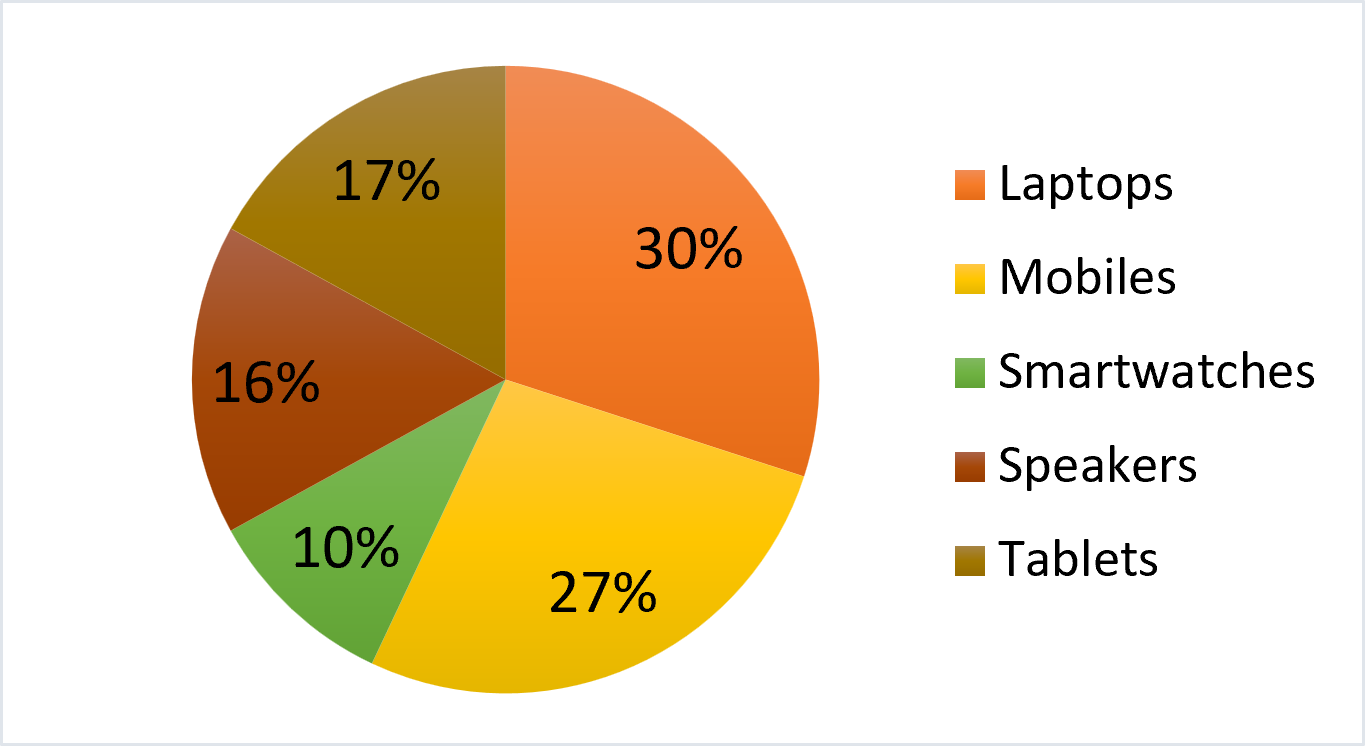
Total sales = 27 + 49 + 19 + 31 + 102 + 72 = 300 Cr. Category sales:
| Category | Share | Sales (Rs. Cr) |
|---|---|---|
| Laptops | 30% | 90 |
| Mobiles | 27% | 81 |
| Tablets | 17% | 51 |
| Speakers | 16% | 48 |
| Smartwatches | 10% | 30 |
The two mobile-only showrooms together must sell less than 81 Cr. Only S1 + S3 = 46 qualifies, since any pair including S5 exceeds 81. So S5 sells 81 − 46 = 35 Cr of mobiles.
Non-mobile share of S5 = (102 − 35)/102 ≈ 66%.
Those four showrooms sell only the two categories, so the two categories’ totals must equal the four showrooms’ combined sales.
Using the category values in Q11, the possible pair sums are 171, 141, 138, 132, 129, 120, 111, 99, 81 and 78. A four-showroom total is 300 minus the two excluded showrooms. The only match is Laptops + Mobiles = 171 = S2 + S3 + S4 + S6 (49 + 19 + 31 + 72).
As a check, the other three categories total 30 + 48 + 51 = 129 = S1 + S5 ✓. One of the two categories must be Laptops.
From Q12, the four showrooms are S2, S3, S4 and S6. S1 (with S5) is not among them.
A category sold equally puts one-sixth of its total in every showroom. Per-showroom shares: Smartwatches 5, Speakers 8, Tablets 8.5, Mobiles 13.5, Laptops 15 Cr.
S3 sells only 19 Cr, so the shares of all equally sold categories must fit within 19. Even the three smallest add to 5 + 8 + 8.5 = 21.5 > 19. Two fit, for example Smartwatches + Speakers = 13. The maximum is 2.
The country of Mekrane contains four areas for radar detection: R, S, T, and U. Each detection area is circular and falls completely within Mekrane.
Part of R intersects T; part of S also intersects T; R does not intersect S. U is completely within R and also completely within T.
Four planes, J, K, L, M, are over Mekrane, such that each plane is in at least one of the four areas.
- J is in area S.
- K is not in any detection area that J is in.
- L is not in any detection area that M is in.
- M is in exactly one of the areas.
- Possible regions. R only, S only, T only, R∩T (outside U), U (which means R, T and U together), and S∩T. S never meets R or U.
- K in exactly two areas. That means R∩T or S∩T. K can’t be in S (J is in S), so K is in R∩T.
- Consequence. K is in T, so J can’t be in T. J is within area T cannot be true. B, C and D are all possible.
U lies inside both R and T, so any plane in U is in three areas at once. M is in exactly one area, so M cannot be within U.
A: M can be in R only. B: K can be in U if J is in S only. D: L can be in R only (with M elsewhere).
M is in T only, so L can’t be in T. The only two-area regions are R∩T and S∩T, and both include T. So L cannot be within exactly two areas.
A: J in S∩T with K in R only works. B: L in R only works. C: K in R∩T with J in S only works.
Three areas means L is in U (so also in R and T). M then avoids R, T and U, leaving S only.
A: J is in S, which overlaps at most T, so J can be in two areas at most ✗. B: J in S∩T, with K in R only, works ✓. C: K can’t share S with J ✗. D: M can’t be in R ✗.
Three different faces of a cube are painted in three different colours — crimson, olive and azure. This cube is then cut into 1331 smaller cubes.
1331 = 113, so each face is 11 × 11. There are two ways to arrange three painted faces:
- All three meet at a corner. Each face loses two edges to the other painted faces: 3 × 10 × 10 = 300.
- Two opposite faces plus one between them. Each opposite face loses one edge: 2 × 11 × 10 = 220. The middle face loses two opposite edges: 11 × 9 = 99. Total 319.
The maximum is 319.
Azure–olive cubes lie along the edge shared by the azure and olive faces.
- Azure and olive are opposite faces. They share no edge, so N = 0.
- All three faces meet at a corner. The shared edge has 11 cubes, but the one at the corner also has crimson, so N = 10.
- Azure and olive are adjacent, with crimson opposite one of them. Crimson doesn’t touch their shared edge, so N = 11.
N can be 0, 10 or 11: 3 values.
QA · Quantitative Ability
From A (36 L): P = 16, Q = 20. From B (40 L): Q = 12, R = 28. Tank C (76 L): P = 16, Q = 32, R = 28.
Removing 38 L (half) leaves P = 8, Q = 16, R = 14. Adding 38 L of R gives R = 52.
Q : R = 16 : 52 = 4 : 13.
Write 3x + 2y = x + x + x + y + y. By AM ≥ GM, (x + x + x + y + y)/5 ≥ (x3y2)1/5 = (215)1/5 = 8.
So 3x + 2y ≥ 40, with equality when x = y = 8. The least value is 40.
Let the downstream speed be D and the upstream speed U, so the stream speed is s = (D − U)/2. Then 20/D + 20/U = 7, and the log drifts 12 km in the time the boat goes 20 km down and 8 km back: 20/D + 8/U = 12/s.
D = 10 and U = 4 satisfy both: 2 + 5 = 7 ✓, and with s = 3, 2 + 2 = 4 = 12/3 ✓.
Downstream speed = 10 km/h.
Let the circumradius be R. The centroid O is also the circumcentre, so PA2 + PB2 + PC2 = 3(PO2 + R2) = 3(R2 + R2) = 6R2.
For an equilateral triangle, r = R/2, so r2 = R2/4. The ratio is 6R2 ÷ (R2/4) = 24.
622 − 1 is odd and leaves remainder 2 when divided by 3, so 2 and 3 are not factors.
62 − 1 = 35 divides 622 − 1, so 5 and 7 are factors. Checking the next primes: 622 leaves 3 mod 11, 4 mod 13, 8 mod 17 and 4 mod 19, so none of those divide it. By Fermat’s little theorem, 622 ≡ 1 (mod 23), so 23 is a factor.
Sum = 5 + 7 + 23 = 35.
Let C be the price he pays per marked kg. He actually receives 1.2 kg, so his true cost is C/1.2 per kg and profit % = 1.2X/C − 1.
Raising the price by 80 adds 10 percentage points: 1.2 × 80/C = 0.10, so C = 960. But a = 1.2X/960 − 1 still depends on X, and nothing else fixes X. So a% of X cannot be determined.
73 + log7 5 = 73 × 7log7 5 = 343 × 5 = 1715.
Take the work as 60 units: Amal 2, Bimal 4 and Kamal 3 units per day. Working together (9 per day) takes 60/9 = 20/3 days.
In pairs, one 3-day cycle is 6 + 7 + 5 = 18 units. Three cycles (9 days) give 54, and day 10 (Amal + Bimal, 6 units) finishes the work exactly. Time = 10 days.
Extra time = (10 − 20/3) ÷ (20/3) × 100 = 50%.
Ball surface = 4π(2.1)2 = 4 × 22/7 × 4.41 = 55.44 sq cm.
Each dimple (r = 0.2 cm) removes a flat circle of πr2 and adds a hemisphere of 2πr2, a net gain of πr2 = 22/7 × 0.04 ≈ 0.1257. For 200 dimples: ≈ 25.14 sq cm.
Exposed area ≈ 55.44 + 25.14 ≈ 80.5 sq cm.
Combining the fractions: (a − b)/[(x − a)(x − b)] = 1/c, so x2 − (a + b)x + ab − c(a − b) = 0.
The sum of the roots is a + b = 0, so a = −b. Product = ab − c(a − b) = ab − c(−2b) = ab + 2bc.
Correct: 0 · Wrong: 0 · Accuracy: 0%
Keep the streak alive. See you tomorrow for Day 37.