CAT 50 Day Streak – Day 35
30 questions across VARC, DILR & QA · +3 for a correct answer · −1 for a wrong MCQ · no negative marking for TITA
VARC · Verbal Ability & Reading Comprehension
In a blog on ‘Epistemic Relativism’ (2021), Francis Fukuyama writes: ‘We who live in modern liberal societies have necessarily accepted a certain degree of moral relativism.’ Fukuyama does not comment on whether this is a good or bad thing, but chastises postmodernist writers who espouse relativism regarding ‘assertions of fact concerning the outside world’. Fukuyama identifies the rise of epistemic relativism with writers who followed Friedrich Nietzsche, but these themes are present in Outlines of Pyrrhonism. Bracketing from the question of chronology, is Fukuyama right that relativism is a problem?
A quick reply is that sceptics eschew the term relativism. Sceptics do not maintain that truth changes depending on time or place. In 1933, the German philosopher Martin Heidegger believed in the inner truth and greatness of the National Socialist cause. Heidegger is a relativist but not a sceptic.
To the larger point that epistemic relativism is a problem, sceptics maintain that they do have criteria to make decisions about facts in the world or how to treat other people. These are, according to Sextus, ‘the guidance of nature, the compulsion of the feelings, the tradition of laws and customs, and the instruction of the arts’. For Sextus, nature and culture are the soil from which our ethical dispositions grow. Sceptics may be kind to children, help their neighbours, and build institutions that reflect the values of their culture.
And there are many examples of cruel dogmatists.
In one of Sextus’ surviving manuscripts titled Against the Ethicists, he addresses the question of what a sceptic will do if a tyrant commands a forbidden act. The sceptic ‘will choose one thing, perhaps, and avoid the other by the preconception which accords with his ancestral laws and customs’ and will ‘bear the harsh situation more easily compared with the dogmatist’. Aha! For critics of scepticism such as Martha Nussbaum, this seems like evidence that sceptics are passive in the face of injustice. They don’t even know whether they will fight tyrants!
Rising to Sextus’ defence, the political scientist John Christian Laursen argues that sceptics can grow up in cultures that believe in watering the tree of liberty with the blood of tyrants, and sceptics can have a burning hatred for tyrants. Sceptics can possess energy, commitment, and concern about the political order. ‘One can be committed without a chain of truths to support one’s actions.’ And, of course, dogmatists can also support tyrants who murder people who disagree with them.
Fukuyama wants people to agree on facts about the outside world. But intelligent people can look at those supposed facts in a variety of ways. Grass is green. Except at night, when it appears black. Sceptics can make arguments like that for a long time. Sceptics encourage us to live our lives in less frustrating ways than demanding something that humans do not and may not ever possess: truth.
A relativist holds that truth varies with time, place or perspective; Heidegger believed in the “inner truth” of a cause. Sceptics reject that view and doubt that humans can possess truth at all, which the closing line makes clear. C captures this difference.
A: sceptics don’t claim truth is constant; they doubt we can have it. B: sceptics do have criteria for deciding about facts in the world. D: the passage separates the two explicitly (“Heidegger is a relativist but not a sceptic”).
The grass example (green by day, black at night) shows a sceptic arguing over a supposed fact with no definitive resolution. The author adds that sceptics “can make arguments like that for a long time”.
A: Fukuyama “does not comment on whether this is a good or bad thing”. C is Sextus’ claim, which the author reports rather than endorses. D is the critics’ charge, which the author rebuts through Laursen.
The author defends sceptics against the charges of relativism and passivity, and closes by saying sceptics help us live “in less frustrating ways”. That is an endorsement of scepticism.
B: culture appears as one of Sextus’ criteria, not as the author’s stated position. C contradicts the closing doubt about truth. D: committed belief in a cause is what the dogmatist examples illustrate.
D is the author’s own sweeping claim that scepticism offers a less frustrating way to live. It also asserts that humans may never possess truth. This broad, value-laden conclusion is where the author could be accused of overselling scepticism.
A and B are neutral descriptions of what sceptics hold. C quotes Sextus, not the author’s own claim.
- Imagine setting off a single domino and watching as one by one, each piece tumbles effortlessly.
- This idea might sound simple, yet it’s incredibly potent when applied to understanding new words and phrases.
- It’s a principle that not only applies to physical dominos but also to our everyday language and interactions.
- Just as one domino can initiate a chain reaction, learning a new term can unlock a series of connections and insights in your language journey.
- This simple action captures the essence of the domino effect, a powerful concept that shows how one small move can lead to significant changes.
- And today, we’re focusing on one such term: the domino effect.
The order runs like this:
- 4: “This simple action” (toppling the domino in A) captures the domino effect.
- 2: “It’s a principle” that also applies to language.
- 1: “This idea” is potent for learning new words.
- 3: Just as one domino starts a chain, one new term unlocks connections, which leads into F’s “one such term”.
“These visions and pontifications” needs an antecedent, and that is the “extreme, matter-of-fact proclamations about the future” called “an idle daydream”. After that dismissal, the sentence adds a second unsettling point: these daydreams are actually changing the real world.
At blanks 1 and 2 the proclamations haven’t been mentioned yet. At blank 3 the sentence would split the proclamations from the author’s verdict on them (“This isn’t a business plan”).
- There is, however, a third type of reason why philosophical writing is often inaccessible, and it is that the author consciously intends it to be so.
- These commentators did accept that intentional obscurity can be commendable if it is designed to stimulate the reader to learn through grappling with the text.
- This was recognised by the scholars of Ancient Greece and Rome, and those of the Middle Ages, who commented on the treatises of Plato and Aristotle.
- They symbolised this sort of obscurantism with the cuttlefish, which discharges ink to cloud the water around it.
- These commentators criticised writing in which the intentional obscurity was designed to prevent readers from understanding or refuting it.
The coherent paragraph is 1 → 3 → 5 → 4:
- 1: A third reason for inaccessible writing: deliberate obscurity.
- 3: “This was recognised” by ancient and medieval commentators.
- 5: “These commentators criticised” obscurity meant to block understanding or refutation.
- 4: “They symbolised this sort of obscurantism” with the cuttlefish.
Sentence 2 praises a commendable kind of obscurity. The paragraph is a single line of criticism, and “this sort of obscurantism” in 4 has to point straight back to the criticised kind in 5.
- The shift suggests that gathering people’s online data for targeted advertising is not going away.
- The internet industry shuddered last year when Apple introduced privacy measures for the iPhone that threatened to upend online tracking and cripple digital advertising and Google pledged similar privacy actions.
- And it is having the unintended effect of reinforcing the power of some of tech’s biggest titans.
- But in less than a year, another type of internet tracking has started taking over.
The order runs like this:
- 2: Apple’s and Google’s privacy moves threatened online tracking.
- 4: “But in less than a year”, a new kind of tracking took over.
- 3: “And it” (the new tracking) is reinforcing the big tech titans.
- 1: “The shift” shows that data gathering for ads isn’t going away.
The author grants that representation matters (a person’s stake in the country is tied to seeing themselves in the culture) but objects “mostly” on proportion: we make “too big a deal” of it. B keeps both the main point and the concession.
A drops the caveats. C says representation itself “has gone too far”, but the complaint is about how much we fuss over it. D focuses on the author’s personal priority list and misses the proportion argument.
- Instead, most students, I believe, want to search for moments of solidarity with people from different backgrounds despite the pressures placed upon them to turn their life stories into cultural capital.
- But I do not understand how the trauma algorithms that currently exist at elite institutions advance any of these conversations.
- I just think there is a way in which the denial of one’s hardships constitutes a far more insidious form of dishonesty.
- We should talk about privilege and systemic racism and the ways in which the history of violence against Black, Latino, Native American, and Asian people in this country still shapes their lives today.
- A compassionate society, especially one with as much inequality as the United States, should talk about discrimination and the very real ways some people’s lives are harder than others.
The coherent paragraph is 5 → 4 → 2 → 1:
- 5: A compassionate society should talk about discrimination.
- 4: “We should talk about” privilege and systemic racism.
- 2: “But” trauma algorithms at elite institutions don’t advance “these conversations”.
- 1: “Instead”, students want moments of solidarity.
Sentence 3 is about denying one’s own hardships as a form of dishonesty. The paragraph is about how institutions handle conversations about inequality, and nothing in it sets up that point.
DILR · Data Interpretation & Logical Reasoning
Glassy, a bar in a city, serves beers of only 3 brands - Kingfisher, Budweiser and Carlsberg. Last Friday, not all the customers necessarily drank beers, but those who did had at least one of the 3 brands. Further, some of the observations were as follows:
- The number of customers who drank only Carlsberg was twice the number of customers who drank only Budweiser.
- The number of customers who drank both Carlsberg and Budweiser was 24 more than twice the number of customers who drank only Budweiser and Kingfisher.
- The number of customers who drank only Kingfisher and Carlsberg was 28.
- For every 3 customers who drank only Kingfisher, there was 1 customer who drank only Carlsberg and Budweiser.
- For every 3 customers who drank Carlsberg, there was 1 customer who drank Budweiser and Carlsberg.
- For every 3 customers who drank Budweiser, there was 1 customer who drank Kingfisher and Budweiser.
- Variables. Only K = k, only B = b, only C = 2b, only C&B = x, only B&K = y, only K&C = 28, all three = t. From the ratio clue, k = 3x.
- Carlsberg ratio. 2b + x + 28 + t = 3(x + t), which gives b = x + t − 14.
- C&B clue. x + t = 24 + 2y, so b = 10 + 2y.
- Budweiser ratio. b + x + y + t = 3(y + t), which gives x = 2t − 10, and then y = (3t − 34)/2.
- Everything in terms of t. k = 6t − 30, b = 3t − 24, only C = 6t − 48, and beer drinkers = (39t − 202)/2. For y to be a non-negative whole number, t must be even and at least 12.
| t (all 3) | Only K | Only B | Only C | Only C&B | Only B&K | Only K&C | Drinkers |
|---|---|---|---|---|---|---|---|
| 12 | 42 | 12 | 24 | 14 | 1 | 28 | 133 |
| 14 | 54 | 18 | 36 | 18 | 4 | 28 | 172 |
| 16 | 66 | 24 | 48 | 22 | 7 | 28 | 211 |
| 18 | 78 | 30 | 60 | 26 | 10 | 28 | 250 |
With t = 12 and no non-drinkers, the minimum number of customers is 133.
Detailed solution coming soon.
From the table in Q11, t = 18 gives exactly 250 beer drinkers. Everyone could have drunk beer, so the minimum number of non-drinkers is 0.
From the table in Q11, exactly two brands = only C&B + only B&K + only K&C. That is 43 (t = 12), 50 (t = 14), 57 (t = 16), 64 (t = 18), 71 (t = 20), and so on. Of the options, only 50 appears.
From Q11, only K − only C = (6t − 30) − (6t − 48) = 18, whatever the value of t.
Tendulkar played 10 innings in which his scores were 27, 32, 37, 46, 52, 57, 62, 76, 78, and 143, not in this order. An interesting thing was noticed, that after each innings, his average was an integer. When asked about the hints to figure out the runs scored by him in different innings, he gave just two more hints:
- His average after 7th and 9th innings was the same. After no other innings, he had that same average.
- He did not score more than 50 in his first two innings.
- Innings 10. The total is 610. The sum after 9 innings must be divisible by 9, and 610 ≡ 7 (mod 9), so innings 10 ≡ 7 (mod 9). That makes it 52. S9 = 558, average 62.
- Innings 8 and 9. S7 = 7 × 62 = 434, so innings 8 + 9 = 124 = 46 + 78. Both orders work: 480/8 = 60 and 512/8 = 64.
- Innings 7. S6 = 434 − s7 must be divisible by 6, so s7 is 32 or 62. If s7 = 62, the 6th-innings average would also be 62, which breaks hint (i). So s7 = 32 and S6 = 402.
- Innings 1–6. By hint (ii), innings 1 and 2 are 27 and 37 (S2 = 64). Then s3 must make S3 divisible by 3, so s3 = 143. Divisibility by 4 gives s4 = 57, by 5 gives s5 = 76, and s6 = 62.
| Innings | 1 | 2 | 3 | 4 | 5 | 6 | 7 | 8 | 9 | 10 |
|---|---|---|---|---|---|---|---|---|---|---|
| Score | 27 / 37 | 37 / 27 | 143 | 57 | 76 | 62 | 32 | 46 / 78 | 78 / 46 | 52 |
| Average | 27 / 37 | 32 | 69 | 66 | 68 | 67 | 62 | 60 / 64 | 62 | 61 |
Average after the 6th innings = 402/6 = 67.
From the table in Q16, innings 3, 4, 5, 6, 7 and 10 are fixed. Innings 1–2 and 8–9 can each be swapped. The answer is 6.
From the table in Q16, the 4th innings score is 57.
From the table in Q16, his highest score of 143 came in the 3rd innings.
From Q16, the 8th innings is 46 or 78. With 78: (434 + 78)/8 = 512/8 = 64.
QA · Quantitative Ability
182 + 242 = 900 = 302, so the two radii drawn to an intersection point meet at a right angle. The half-chord is the altitude of this right triangle onto the hypotenuse: 18 × 24/30 = 14.4.
Common chord = 2 × 14.4 = 28.8 cm.
Mridul divided (sum − missed number) by N and got 1445/24, so N is a multiple of 24. The true average (N + 1)/2 must be a little above 60, so N = 120.
The true sum is 120 × 121/2 = 7260. His sum is 120 × 1445/24 = 7225. The missed number is 35.
N − 35 = 120 − 35 = 85.
The roots of x2 + 2x − 24 = 0 are 4 and −6.
At x = 4: 192 − 16a − 296 + p = 0, so p − 16a = 104. At x = −6: −648 − 36a + 444 + p = 0, so p − 36a = 204.
Subtracting: 20a = −100, so a = −5 and p = 24. a + p = 19.
Take the tank as 180 units: A = 15, B = 12 and C = 10 units per minute.
All filling: 37 units per 3-minute cycle. After 4 cycles (12 min) the tank holds 148. A brings it to 163 and B to 175, and C needs half a minute for the last 5 units. Time = 14.5 min.
C draining: 17 units per cycle. After 9 cycles (27 min) the tank holds 153. A brings it to 168 and B fills it exactly at 29 min. (Earlier cycles never reach 180, since the peak in cycle 9 is 163.)
Delay = 29 − 14.5 = 14.5 minutes.
Steps in 10 minutes = 10/2 × (108 − 18) = 450, which is 60% of the total, so the total is 750. 80% is 600 steps.
Steps in n minutes = n/2 × (108 − 2(n − 1)) = n(55 − n) = 600. So n2 − 55n + 600 = 0, giving n = 15 or 40. She first reaches 80% at 15 minutes.
- Four consecutive integers can add up to a perfect square.
- Four consecutive integers can add up to a perfect cube.
n + (n + 1) + (n + 2) + (n + 3) = 4n + 6, which leaves remainder 2 on division by 4.
A perfect square leaves remainder 0 or 1 on division by 4. A perfect cube is either odd or a multiple of 8, so it leaves 0, 1 or 3. Neither can leave 2, so neither I nor II is possible.
If k cities connect to every other city, they need C(k, 2) roads among themselves plus k(20 − k) roads to the rest.
k = 8: 28 + 96 = 124 ≤ 130 ✓. k = 9: 36 + 99 = 135 > 130 ✗. The largest possible number is 8.
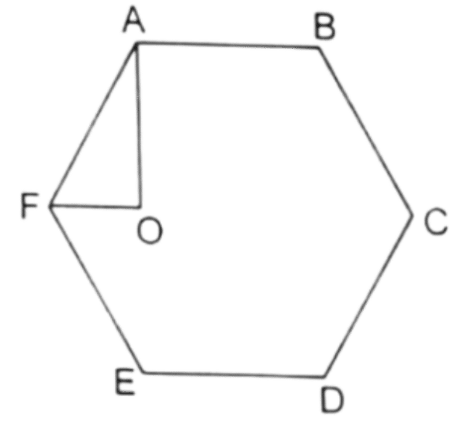
Let the side be s. In triangle AOF, ∠AFO = 60°, so FO = s/2 and AO = (√3/2)s. Area of AOF = ½ × s/2 × (√3/2)s = √3s2/8.
Trapezium ABCF is half the hexagon: ½ × (3√3/2)s2 = 3√3s2/4.
Ratio = (3/4) ÷ (1/8) = 6.
A bigger sweater takes 5 × 1.4 = 7 days. Smaller order: 40 × 5 = 200 days. Bigger order: 30 × 7 = 210 days.
The bigger sweaters take 10/200 × 100 = 5% more time.
xy2 = 10. Let u = y2, so x = 13 + 3u and (13 + 3u)u = 10, i.e. 3u2 + 13u − 10 = 0. The positive root is u = 2/3, so x = 15.
xy = 15 × √(2/3) = 15√6/3 = 5√6.
Correct: 0 · Wrong: 0 · Accuracy: 0%
Keep the streak alive. See you tomorrow for Day 36.