CAT 50 Day Streak – Day 33
30 questions across VARC, DILR & QA · +3 for a correct answer · −1 for a wrong MCQ · no negative marking for TITA
VARC · Verbal Ability & Reading Comprehension
What causes a helix in nature to appear with either a dextral (right-handed, or clockwise) twist or a sinistral (left-handed, or counterclockwise) twist is one of the most intriguing puzzles in the science of form. Most spiral-shaped snail species are predominantly dextral. But at one time, handedness (twist direction of the shell) was equally distributed within some snail species that have become predominantly dextral or, in a few species, predominantly sinistral. What mechanisms control handedness and keep left-handedness rare?
It would seem unlikely that evolution should discriminate against sinistral snails if sinistral and dextral snails are exact mirror images, for any disadvantage that a sinistral twist in itself could confer on its possessor is almost inconceivable. But left- and right-handed snails are not actually true mirror images of one another. Their shapes are noticeably different. Sinistral rarity might, then, be a consequence of possible disadvantages conferred by these other concomitant structural features. In addition, perhaps left- and right-handed snails cannot mate with each other, having incompatible twist directions. Presumably an individual of the rarer form would have relative difficulty in finding a mate of the same hand, thus keeping the rare form rare or creating geographically separated right- and left-handed populations.
But this evolutionary mechanism combining dissymmetry, anatomy, and chance does not provide an adequate explanation of why right-handedness should have become predominant. It does not explain, for example, why the infrequent unions between snails of opposing hands produce fewer offspring of the rarer than the commoner form in species where each parent contributes equally to handedness. Nor does it explain why, in a species where one parent determines handedness, a brood is not exclusively right- or left-handed when the offspring would have the same genetic predisposition. In the European pond snail Lymnaea peregra, a predominantly dextral species whose handedness is maternally determined, a brood might be expected to be exclusively right- or left-handed—and this often occurs. However, some broods possess a few snails of the opposing hand, and in predominantly sinistral broods, the incidence of dextrality is surprisingly high.
Here, the evolutionary theory must defer to a theory based on an explicit developmental mechanism that can favor either right- or left-handedness. In the case of Lymnaea peregra, studies indicate that a dextral gene is expressed during egg formation; i.e., before egg fertilization, the gene produces a protein, found in the cytoplasm of the egg, that controls the pattern of cell division and thus handedness. In experiments, an injection of cytoplasm from dextral eggs changes the pattern of sinistral eggs, but an injection from sinistral eggs does not influence dextral eggs. One explanation for the differing effects is that all Lymnaea peregra eggs begin left-handed but most switch to being right-handed. Thus the path to a solution to the puzzle of handedness in all snails appears to be as twisted as the helix itself.
The author says that if the two forms were exact mirror images, any disadvantage of a sinistral twist “is almost inconceivable”. One partial explanation for sinistral rarity is that the shapes differ, which could carry disadvantages. If they were true mirror images, that explanation would disappear and dextral predominance would be even harder to explain.
A would match the simple genetic expectation and remove an anomaly, making the puzzle smaller. C: dominance is never discussed. D would strengthen the structural explanation, again making the puzzle smaller.
Paragraph 3 lists what the evolutionary mechanism cannot explain. Lymnaea peregra is the concrete case: broods that should be all one hand sometimes include snails of the opposite hand, and sinistral broods show “surprisingly high” dextrality.
A: the evidence for the developmental theory (gene expression, cytoplasm injections) comes in paragraph 4. B: the example exposes the inadequacy rather than resolving it. C: nothing says the phenomenon is common or well understood; the passage calls the whole subject a puzzle.
The mechanism relies on chance (difficulty finding a mate) and anatomy. Its stated failures are specific inheritance patterns: crosses produce fewer of the rarer form, and broods that should be uniform contain snails of the opposite hand. Chance and anatomy can’t explain these brood-level anomalies.
A: the mechanism explicitly considers that the snails are not mirror images. B: the passage never says sinistral snails have “so many” disadvantages. D distorts the text: the issue is the offspring of mixed unions, not why right-handedness is commoner in those species.
The mechanism depends on the gene being expressed “during egg formation; i.e., before egg fertilization”. That timing is what makes handedness maternally determined. If the protein appeared only after fertilization, the core of the mechanism would fail.
B concerns another species, while the mechanism is described for Lymnaea peregra. C is compatible with the idea that eggs start left-handed and most switch. D: a sinistral species without the dextral gene is what the mechanism would predict.
- Pliny wrote that within his lifetime, only a single stalk was discovered.
- Some think it was driven to extinction, others that it’s still hiding in plain sight as a Mediterranean weed.
- With just a handful of stylised images and the accounts of ancient naturalists to go on, the true identity of the Romans’ favourite herb is a mystery.
- But today, silphium has vanished – possibly just from the region, possibly from our planet altogether.
The order runs like this:
- 4: Names silphium and says it has vanished.
- 1: Even in Pliny’s lifetime, only a single stalk was found, showing how early it became scarce.
- 3: With only images and old accounts, its true identity is a mystery.
- 2: The competing theories (extinct, or hiding as a weed) spell out that mystery.
The sentence begins “If our evolution is a cosmic lottery”. It follows directly from the last sentence about evolution as a filter that needs “an almost comical series of accidents”. The lottery image sums up that run of luck, and “unclaimed tickets” (microbial life that never made the leap) echoes “microbial life could be common”.
Blanks 1–3 sit in the discussion of abiogenesis and Earth’s conditions, before evolution is mentioned.
- There is, however, a third type of reason why philosophical writing is often inaccessible, and it is that the author consciously intends it to be so.
- These commentators did accept that intentional obscurity can be commendable if it is designed to stimulate the reader to learn through grappling with the text.
- This was recognised by the scholars of Ancient Greece and Rome, and those of the Middle Ages, who commented on the treatises of Plato and Aristotle.
- They symbolised this sort of obscurantism with the cuttlefish, which discharges ink to cloud the water around it.
- These commentators criticised writing in which the intentional obscurity was designed to prevent readers from understanding or refuting it.
The coherent paragraph is 1 → 3 → 5 → 4:
- 1: A third reason for inaccessible writing: deliberate obscurity.
- 3: “This was recognised” by ancient and medieval commentators on Plato and Aristotle.
- 5: “These commentators criticised” obscurity meant to stop readers understanding or refuting the text.
- 4: “They symbolised this sort of obscurantism” with the cuttlefish clouding the water.
Sentence 2 praises a commendable kind of obscurity. The paragraph builds a single line of criticism, and “this sort of obscurantism” in sentence 4 must point straight back to the criticised kind in sentence 5. Placing 2 anywhere breaks that chain.
The passage makes two points. Persistent inflammation affects the brain and mental health (depression, Alzheimer’s and more), and the immune response itself is vital for survival. C keeps both.
A calls cytokines simply “destructive”, though the passage says they help eliminate pathogens and repair tissue. B overstates with “primary cause”. D contradicts the passage, which calls sickness behaviour beneficial in the acute phase.
The first sentence announces that the book opens with Zarathustra failing to connect with his audience. The missing sentence then sets the scene: the crowd gathered for a tightrope walker. Next, “Out of nowhere appears Zarathustra” into that scene. The tightrope also sets up his closing “rope stretched over an abyss” line.
At blank 1 the scene would come before the paragraph says which book and scene it describes. At blanks 3 and 4 Zarathustra is already speaking, so introducing the setting there is too late.
- Today, Coleridge is far more often remembered as a poet than a philosopher.
- His philosophy languished while his verse rose.
- Coleridge’s poetry resonated with the psychedelia of the 1960s and a general cultural shift that emphasised the value of the imagination and a more holistic view of the human place within nature.
- The almost-total eclipse of British idealism by the rise of analytic philosophy saw a general decline in Coleridge’s philosophical stock.
The order runs like this:
- 4: Analytic philosophy eclipsed British idealism, and Coleridge’s philosophical stock fell.
- 2: “His philosophy languished while his verse rose”, summing up the contrast.
- 3: Why the verse rose: it resonated with 1960s culture.
- 1: The result “today”: he is remembered mainly as a poet.
DILR · Data Interpretation & Logical Reasoning
Six friends played a game of rolling dice. There were 4 rounds. Each person rolled a different number in each round, and each round resulted in all six numbers rolled by different persons.
- For each of Preethi, Vivek and Anita, the numbers rolled in the four rounds were in A.P. The sums of the four numbers rolled by Preethi, Vivek, and Anita were also in A.P.
- The sums of four numbers rolled by Avinash, Radha and Navdeep were also in A.P., with a common difference of 1, not necessarily in that order.
- The numbers rolled by Preethi in R2, Vivek in R4 and Anita in R3 were the same.
- Vivek rolled a higher number in R3 as compared to what he rolled in R2.
The following table provides partial information about the numbers rolled by them:
| R1 | R2 | R3 | R4 | |
|---|---|---|---|---|
| Preethi | 6 | 4 | ||
| Radha | 2 | |||
| Anita | 4 | |||
| Navdeep | 5 | |||
| Avinash | 3 | 5 | ||
| Vivek | 1 |
- Preethi. R1 = 6 and R4 = 4 can’t be the ends of an integer AP in round order, so the four numbers form an AP as a set. A 4-term AP from 1–6 containing 4 and 6 must be {3, 4, 5, 6}, sum 18.
- Vivek. He rolled 1, so his set is {1, 2, 3, 4}, sum 10.
- Anita. The sums of Preethi, Vivek and Anita form an AP, so with 18 and 10 the third must be 14. Anita’s set is {2, 3, 4, 5}.
- Common number. Preethi R2 ∈ {3, 5}, Vivek R4 ∈ {2, 3, 4} and Anita R3 ∈ {2, 3, 5}, so all three are 3. Then Preethi R3 = 5. Vivek R3 > R2 gives Vivek 1, 2, 4, 3. Anita’s R2 can’t be 2 (Vivek has it), so Anita is 4, 5, 3, 2.
- Others. All 24 rolls add up to 84, and 84 − 42 = 42 = 13 + 14 + 15. Radha’s R3 and R4 must be 1 and 6 in some order, so her R2 = 4 and her sum = 13. Only Avinash = 15 and Navdeep = 14 fit, in two arrangements.
| R1 | R2 | R3 | R4 | Sum | |
|---|---|---|---|---|---|
| Preethi | 6 | 3 | 5 | 4 | 18 |
| Radha | 2 | 4 | 1 / 6 | 6 / 1 | 13 |
| Anita | 4 | 5 | 3 | 2 | 14 |
| Navdeep | 5 | 6 / 1 | 2 | 1 / 6 | 14 |
| Avinash | 3 | 1 / 6 | 6 / 1 | 5 | 15 |
| Vivek | 1 | 2 | 4 | 3 | 10 |
(The “x / y” cells are the two possible arrangements.) Avinash’s sum is 15 either way.
From the table in Q11, Vivek rolled 1, 2, 4, 3, so his R3 roll was 4.
From the table in Q11, Radha’s R2 roll was 4 in both arrangements.
From the table in Q11, the totals are 18, 13, 14, 14, 15 and 10. Anita and Navdeep both total 14.
From the table in Q11, Radha, Navdeep and Avinash each roll a 6 in both arrangements. Anita rolled only 2, 3, 4 and 5.
12 candidates appeared for a test that had five questions. The correct answer for each question was either 'True' or 'False'. The candidates gave different answer sets. That is, no two candidates answered all five questions in the same manner. 1 mark was awarded for a right answer and 0 for a wrong answer. Six of the candidates, Alex, Ben, Corey, Dan, Edwin and Fin, got equal marks and were selected as they secured the highest marks among the 12 candidates. George, Harry and Ivan were among the rest six who failed to get selected. The table below gives their responses. T – True, F – False.
| Q1 | Q2 | Q3 | Q4 | Q5 | |
|---|---|---|---|---|---|
| George | T | F | F | F | F |
| Harry | F | T | T | T | F |
| Ivan | T | T | T | F | T |
- Six equal top scores. The six selected candidates have different answer sets with the same score k. Only C(5, k) answer sets score exactly k. C(5, 5) = 1 and C(5, 4) = 5, both fewer than 6, so k ≤ 3.
- George + Harry. They answered Q1–Q4 oppositely, so between them they get exactly 4 of those right. Both answered F on Q5, so together they score 4 or 6.
- Pinning k. Both scored below k ≤ 3, so each has at most 2 and their total is at most 4. So their total is exactly 4, each scored 2, and k = 3. (This also means the correct answer to Q5 is True.)
Ben is one of the six selected, so he scored 3.
Detailed solution coming soon.
Detailed solution coming soon.
Detailed solution coming soon.
Detailed solution coming soon.
QA · Quantitative Ability
After salaries (45%), the remaining 55% is split 6 : 9 = 2 : 3, giving Manish 22% and Nikhil 33%.
Totals: Manish 25 + 22 = 47%, Nikhil 20 + 33 = 53%. The difference of 6% = 2,25,000, so the profit = 37,50,000.
Annual salaries = 45% × 37,50,000 = 16,87,500. Monthly = 16,87,500 ÷ 12 = ₹ 1,40,625.
Split at the critical points −1, 0, 1 and 2:
- x ≥ 2: LHS = 1 + 3(x − 1) − 2(x − 2) = x + 2, true for every x ≥ 2 ✓
- 1 ≤ x < 2: LHS = 5x − 6 = x + 2 gives x = 2, outside the interval ✗
- 0 ≤ x < 1: LHS = −x = x + 2 gives x = −1, outside ✗
- −1 ≤ x < 0: LHS = x = x + 2, impossible ✗
- x < −1: LHS = −x − 2 = x + 2 gives x = −2 ✓
Solution: x = −2 ∪ [2, ∞).
9000 = 23·32·53, 12600 = 23·32·52·7, 19800 = 23·32·52·11.
Common factors are the factors of the HCF, 23·32·52 = 1800. Number of factors = 4 × 3 × 3 = 36.
The two paths meet at a right angle, so they form the legs of a right triangle with hypotenuse 510 m. In 3 s the bullets travel 24k and 45k: (24k)2 + (45k)2 = 5102, so 51k = 510 and k = 10. The speeds are 80 m/s and 150 m/s.
After the collision, the first bullet still moves at 80 m/s and the second at 150 × 0.4 = 60 m/s. Each turns 90°, so they still move at right angles to each other.
After 5 s: 400 m and 300 m along perpendicular directions, so the distance = √(4002 + 3002) = 500 m.
Let the total be T. If A = ½(T − A), then A = T/3. Likewise B = T/5 and C = T/9.
T must be divisible by LCM(3, 5, 9) = 45. Then Dipika = T − 15 − 9 − 5 = 16 (a whole number) ✓. The least total is 45.
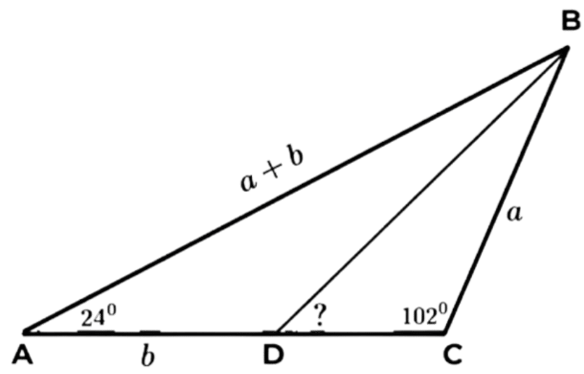
Mark point E on AB with AE = b, so EB = a = BC. Triangle ADE is isosceles with apex angle 24°, so ∠AED = 78° and ∠BED = 102°.
Triangles BED and BCD have BE = BC, a common side BD, and equal obtuse angles ∠BED = ∠BCD = 102°, so they are congruent. Hence ∠DBC = ∠DBE = ½(180° − 24° − 102°) = 27°.
∠BDC = 180° − 102° − 27° = 51°.
The reciprocals form an AP with t20 = 1 and t30 = −17, so d = −18/10 = −1.8 and tn = 1 − 1.8(n − 20).
The AP decreases: t19 = 2.8, t20 = 1, t21 = −0.8. The largest HP term is the reciprocal of the smallest positive AP term, which is 1. Largest term = 1.
Let the profit percentages be 4p, 2p and 5p. A and B have the same cost, so 29/27 = (1 + 4p)/(1 + 2p), giving p = 4%. The profits are 16%, 8% and 20%.
SP of C = 440 × 1.2 = 528 = 22k, so k = 24. SP of A = 696, SP of B = 648, and the common cost of A and B = 696/1.16 = 600.
Total cost = 600 + 600 + 440 = 1640. Total SP = 696 + 648 + 528 = 1872. Profit % = 232/1640 × 100 = 14.15%.
V = (πh/3)(R2 + Rr + r2) = (π × 30/3)(400 + 200 + 100) = 7000π cm3 = 7000 × 22/7 = 22000 cm3 = 22 litres.
Cost = 22 × 48 = Rs. 1056.
Multiply by 2 and rearrange: [(x − 1) − 2√(x − 1) + 1] + [same for y] + [same for z] = 0.
That is (√(x − 1) − 1)2 + (√(y − 1) − 1)2 + (√(z − 1) − 1)2 = 0. Each square must be 0, so x = y = z = 2.
5x + 3y + 2z = 10 + 6 + 4 = 20.
Correct: 0 · Wrong: 0 · Accuracy: 0%
Keep the streak alive. See you tomorrow for Day 34.