CAT 50 Day Streak – Day 32
30 questions across VARC, DILR & QA · +3 for a correct answer · −1 for a wrong MCQ · no negative marking for TITA
VARC · Verbal Ability & Reading Comprehension
There are various reasons why collapse could benefit human welfare. States often demanded tax in the form of grain. Without tax collectors passing by, people often had more to eat. More than that, without the pressure to grow tax crops, they often diversified their diet to include more animal protein, which beget stronger bones. A flight away from cities towards rural areas also meant less circulation of infectious disease. Finally, a more complex reason in at least some cases is a survivor effect. Some collapses did lead to population declines: sometimes death (which was obviously bad for those citizens) but, as we’ll see later, also because people moved.
Either way, this meant that workers sticking around became scarcer and more valuable labour: they could bargain with their employers for better wages. Which is why we see both heights and wages rise after the Black Death in the 14th century. Women’s heights appear to have decreased, but this is likely due to an earlier onset of menarche (the first menstrual cycle, which slows growth). Earlier menarche often occurs when girls experience better living conditions with more resources, counterintuitively resulting in lower long-term height. Hence the decreasing height of women is likely an indicator that they too were benefitting after the Black Death.
Perhaps the most neglected reason for post-collapse health boosts is that most states of the past were predatory, fuelling enormous inequality and impoverishing the masses. One review of 28 premodern states, from the time of Rome to 1947, found that they were on average more than three-quarters towards the theoretical maximum level of wealth inequality. That maximum is a situation in which one person owns all the surplus resources while everyone else is left with meagre subsistence (just enough to survive and reproduce). The most reliable effect of collapse was to level these wealth inequalities.
All this helps to explain why the adoption of agriculture and states were an enormous blow to human health. Not only did human height shrink but bones got weaker, teeth filled with more holes, and new infectious diseases such as influenza and the plague began as people were crammed together with animals. Men today are on average still shorter than their ancestors during the stateless ice age (or at least the male skeletons we’ve found in Europe; evidence elsewhere is sparse, but we have little reason to think that Europeans were especially tall).
Improved welfare after a state breaks down is not a purely ancient phenomenon either. That is clear when we look at the case of the collapse of Somalia in 1991. The Barre regime that had previously ruled the country fell apart; local warlords and traditional groups took the reins of governance. While there was increased conflict, it was not a nightmare for human wellbeing. Instead, almost every quality-of-life indicator in the country, from infant mortality to extreme poverty, improved. This wasn’t just Somalia experiencing a region-wide improvement due to better technology and aid. Its improvements significantly outstripped those of its intact, stable neighbours.
Falling heights for women would seem to contradict the claim that welfare improved. The author heads off that objection by explaining it as earlier menarche, which comes from better living conditions. The conclusion is that women “too were benefitting”.
B and D are the opposite: the author says women benefitted as well. C: the paradox is explicitly resolved, not left open.
The author only reports that quality-of-life indicators improved after the collapse, and even notes “increased conflict”. Nowhere does the author claim warlord rule is a superior form of government.
A matches “it was not a nightmare for human wellbeing”. B matches “not a purely ancient phenomenon either”. C matches the point that Somalia’s gains outstripped those of its stable neighbours.
The maximum is defined as “one person owns all the surplus resources while everyone else is left with meagre subsistence (just enough to survive and reproduce)”. B mirrors this exactly.
A is extreme inequality but not the maximum, since the 99% still hold 10%. C describes predatory taxation, not the inequality limit. D describes the levelling that follows a collapse.
The core claim is that collapse can improve human welfare, and Somalia is offered as modern proof. If almost all modern collapses caused famine and disease, Somalia becomes an outlier and the central claim collapses.
A: the review covered states from Rome onward, and Asian states being less unequal doesn’t remove the other benefits. B removes only one of several reasons the author gives. D undercuts only the ice-age height comparison, a side point.
- When AI systems lack adequate exposure to a language, they have blind spots in their comprehension of human experience.
- What’s even more concerning is the imbalance between how many people speak a language in the physical world and how much that language is represented in online data.
- For example, data from Common Crawl, one of the largest public sources of training data, reveals stark inequalities.
- It contains more than 300 billion web pages spanning 18 years, but English dominates with 44 per cent of the content.
The order runs like this:
- 1: The general claim: too little exposure to a language creates blind spots in AI.
- 3: “For example”, Common Crawl data shows stark inequalities.
- 4: “It” (Common Crawl) has 300 billion pages, 44% of them in English.
- 2: “What’s even more concerning” escalates to the mismatch between speakers and online presence.
Blank 3 comes right after the statistic on the wealthiest 1 per cent, so the sentence follows naturally: if the richest cut their footprint, everyone benefits. The next sentence asks what happens if they “instead” fund geoengineering, which needs this first option to contrast with. “Here, the promise of global benefit is less certain” then echoes “the entire world would benefit”.
At blanks 1 and 2 the richest haven’t been introduced yet. At blank 4 the sentence would separate the geoengineering question from its answer.
- The question is easier to grasp by looking at fields in which formal systems have long played a central role.
- There is no single physical theory that explains everything.
- Physics, for instance, has relied on formalisation for centuries.
- But what, exactly, does it mean to formalise something like ethics?
- Still, many have tried to formalise ethics by treating certain moral claims not as conclusions but as starting points.
The coherent paragraph is 4 → 1 → 3 → 2:
- 4: The question: what does it mean to formalise ethics?
- 1: “The question” is easier to grasp by looking at fields built on formal systems.
- 3: “Physics, for instance”, has relied on formalisation for centuries.
- 2: Even so, no single physical theory explains everything.
Sentence 5 jumps to a specific method people have used to formalise ethics. The paragraph is still clarifying what formalisation means through the physics analogy, and “Still” has no claim about ethics to push against.
The author has two points. The feds should stop pushing “tangential cultural agendas” and focus on help, but the anti-camping condition is right because it bears directly on homelessness. B captures both.
A: addiction and mental illness are described as rampant, not as the main cause, and nothing limits funding to rehabilitation. C: the author rejects some rules (the gender conditions), so it is not “all”. D: the author explicitly supports a legal restriction on camping.
- In 2013, together with his student Gerald Carter, Wilkinson set out to gauge the relative importance of friendship, based on the reciprocal exchange of meals versus that based on genetic kinship, in driving blood sharing.
- Over the years, and then the decades, a much clearer picture of friendship among vampire bats has emerged.
- So, blood sharing is more powerful than gene sharing.
- After testing the waters, as Wilkinson and his colleagues describe it, the bats then took friendship to the next level and began the exchange of blood meals.
- Friendship was 8.5 times more important!
The coherent paragraph is 2 → 1 → 5 → 3:
- 2: Over decades, a clearer picture of vampire-bat friendship emerged.
- 1: In 2013, Wilkinson and Carter compared friendship with kinship as drivers of blood sharing.
- 5: The result: friendship was 8.5 times more important.
- 3: “So”, blood sharing beats gene sharing.
Sentence 4 describes how bat friendships develop step by step (“testing the waters”). That is a different point from the friendship-versus-kinship study, and it would break the study → result → conclusion chain.
- To avoid that unsettling implication, he introduced a variable, Λ, the Greek symbol for lambda, to balance his equation.
- According to his math, the universe should be volatile over time, either expanding or contracting.
- In November 1915, he presented the equations underlying his general theory of relativity; 15 months later, he applied those equations to, as he phrased the topic in the paper’s title, “cosmological considerations.”
- Albert Einstein, the second theorist who paved the way for the expansion discovery, did conceive of it.
The order runs like this:
- 4: It introduces Einstein by full name.
- 3: “He” presented general relativity, then applied it to cosmology.
- 2: “According to his math”, the universe should expand or contract.
- 1: “To avoid that unsettling implication”, he added lambda.
DILR · Data Interpretation & Logical Reasoning
The table below gives the marks of four students, Paul, Quinton, Ross and Sam, in three sections, namely VARC, DILR and QA. The list is sorted in ascending order of marks.
| VARC | DILR | QA |
|---|---|---|
| 4 | 12 | 16 |
| 10 | 16 | 20 |
| 12 | 20 | 24 |
| 14 | 24 | 28 |
- Paul got distinct marks in the three sections.
- Aggregate marks of Quinton and Sam are 58 and 52, respectively.
- Ross got equal marks in two sections, and his aggregate score is more than that of Paul.
- Quinton did not score 20 or 10 marks in any of the sections.
- Totals. All marks add up to 40 + 72 + 88 = 200. Quinton + Sam = 110, so Paul + Ross = 90, and since Ross > Paul, Ross > 45.
- Quinton (58, no 10 or 20). VARC ∈ {4, 12, 14}, DILR ∈ {12, 16, 24}, QA ∈ {16, 24, 28}. The only combination summing to 58 is 14 + 16 + 28.
- Sam (52). From what’s left (VARC 4/10/12, DILR 12/20/24, QA 16/20/24): (4, 24, 24), (12, 20, 20) or (12, 24, 16).
- Ross and Paul. Ross needs two equal marks (12–12, 20–20 or 24–24), Paul needs three distinct marks, and Ross must outscore Paul. Testing each Sam option leaves four valid cases.
| Case | Paul (V/D/Q) | Ross (V/D/Q) | Sam (V/D/Q) | Quinton (V/D/Q) |
|---|---|---|---|---|
| 1 | 10/12/16 = 38 | 12/20/20 = 52 | 4/24/24 = 52 | 14/16/28 = 58 |
| 2 | 10/12/16 = 38 | 4/24/24 = 52 | 12/20/20 = 52 | 14/16/28 = 58 |
| 3 | 4/12/16 = 32 | 10/24/24 = 58 | 12/20/20 = 52 | 14/16/28 = 58 |
| 4 | 4/12/24 = 40 | 10/20/20 = 50 | 12/24/16 = 52 | 14/16/28 = 58 |
Only Quinton’s marks are the same in every case, so the answer is 1.
From the table in Q11, Paul scores 12 in DILR in all four cases.
From the table in Q11, Quinton scored 14, 16 and 28. His lowest is 14.
From the table in Q11, Ross scores 52, 52, 58 or 50. The maximum is 58 (case 3: 10/24/24).
From the table in Q11, Paul scores 38, 38, 32 or 40. The maximum is 40 (case 4: 4/12/24).
From the table in Q11: in cases 1 and 2, Ross = Sam = 52, and in case 3, Ross = Quinton = 58. Only case 4 gives four different totals (40, 50, 52, 58). There Sam scored 12 in VARC.
Abhijeet, Deepak, Gitesh, Harsh, Narayan, Rishabh and Sanket play a popular video game. The game has player rating which is the average of ratings obtained in the matches played by the person. They played a tournament consisting of three games. The table below gives the ratings of these players in those games:
| Player | Game 1 | Game 2 | Game 3 |
|---|---|---|---|
| Abhijeet | 80 | 59 | 65 |
| Deepak | 77 | 56 | 70 |
| Gitesh | 52 | 67 | 85 |
| Harsh | 62 | 64 | 80 |
| Narayan | 91 | 77 | |
| Rishabh | 76 | 71 | |
| Sanket | 74 | 64 |
The rating is to be calculated in the following manner:
For instance, suppose Abhijeet had played 5 games before the start of the tournament and had a rating of 76, his rating after the tournament = {(76 × 5) + 80 + 59 + 65}/8 = 73
Gitesh’s tournament total = 52 + 67 + 85 = 204. With n games before: 79.4n + 204 = 77.5(n + 3) = 77.5n + 232.5.
1.9n = 28.5, so n = 15.
Let Harsh have played m games, so Deepak played 2m. Tournament totals: Deepak 77 + 56 + 70 = 203, Harsh 62 + 64 + 80 = 206.
Deepak: 2m·d + 203 = (2m + 3)(d − 0.5), which gives 3d = 204.5 + m.
Harsh: m·h + 206 = (m + 3)(h − 1), which gives 3h = 209 + m.
Subtracting: 3(h − d) = 4.5, so the difference is 1.5, whatever m is.
Total after 16 games = 72.5 × 16 = 1160. Total before = 72 × 13 = 936. The tournament contributed 224.
Game 1 = 224 − 76 − 71 = 77.
Sanket played 18 games before. His tournament total = 69 × 21 − 68.5 × 18 = 1449 − 1233 = 216, so game 3 = 216 − 74 − 64 = 78. Narayan also scored 78, so his tournament total = 91 + 77 + 78 = 246.
Narayan played 12 games before, at an unknown rating r. His increase = (12r + 246)/15 − r = (246 − 3r)/15, which depends on r. So it cannot be determined.
QA · Quantitative Ability
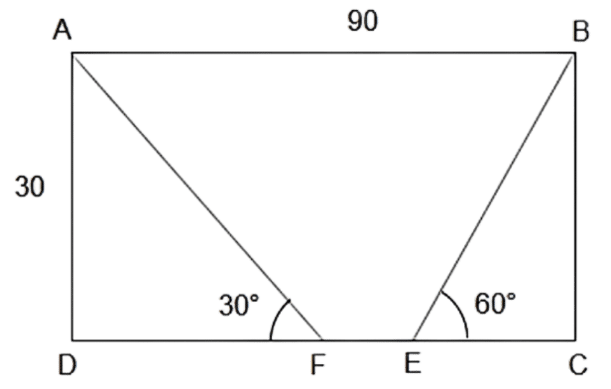
In right triangle ADF: DF = AD/tan 30° = 30√3. In right triangle BCE: EC = BC/tan 60° = 30/√3 = 10√3.
FE = 90 − 30√3 − 10√3 = 90 − 40√3.
Median = (AB + FE)/2 = (90 + 90 − 40√3)/2 = 90 − 20√3.
Say he pays for 10 shirts: cost = 6000, and he receives 12 shirts.
Selling price per shirt = 600 × 1.4 × 0.9 = 756. The bargainer pays for 7 of every 8 shirts: revenue = 12 × 756 × 7/8 = 7938.
Profit % = 1938/6000 × 100 = 32.3%.
For the logs to be defined, x and y must be positive. log3 x + log3 y = log3(xy) ≥ 14, so xy ≥ 314.
By AM ≥ GM, x + y ≥ 2√(xy) ≥ 2 × 37 = 2 × 2187 = 4374.
Equality holds at x = y = 2187, which are integers, so the least value of x + y is 4374.
An odd prime is a sum of two squares exactly when it leaves remainder 1 on division by 4. (2 = 12 + 12 is excluded because a and b must be distinct.)
Such primes below 100: 5, 13, 17, 29, 37, 41, 53, 61, 73, 89, 97. Their sum = 515.
Draw a line through one end of the shorter side, parallel to an oblique side. This cuts off a triangle with sides 13, 20 and 35 − 14 = 21.
By Heron’s formula, s = 27 and area = √(27 × 14 × 7 × 6) = 126. Height = 2 × 126/21 = 12.
Trapezium area = ½ × (14 + 35) × 12 = 294 sq cm.
Efficiencies: P = 5, Q = 4, R = 3, S = 6. Total work = 6 × 30 = 180 units.
One 6-day cycle: PQ 9, PR 8, PS 11, QR 7, QS 10, RS 9, for 54 units. Three cycles (18 days) complete 162 units, leaving 18.
Day 19 (PQ): 171. Day 20 (PR): 179. Day 21 (PS) finishes the work, so it is completed on the 21st day.
With n members, the box holds n + 6 entries, and 7 of them are Praveen’s. Drawing two without replacement: (7/(n + 6)) × (6/(n + 5)) = 7/100.
(n + 6)(n + 5) = 600 = 25 × 24, so n + 5 = 24 and n = 19.
p + q = −7 and pq = 12. So (p + q)2 = 49, and (p − q)2 = 49 − 4 × 12 = 1.
The new roots are 49 and 1: sum 50, product 49. The equation is x2 − 50x + 49 = 0.
In 20 minutes Pushkin walks 3 × ⅓ = 1 km. The dog closes this gap at 5 − 3 = 2 km/h, which takes ½ hour.
In that time the dog runs 2.5 km from home, so they meet 4 − 2.5 = 1.5 km = 1500 m from the park.
C(x, y) = 500x2 + 1000y2 − 1000xy + 40000
Due to a labour contract, the total number of items produced must be exactly 80 units. Calculate the minimum production cost.
Substitute y = 80 − x: C = 500x2 + 1000(80 − x)2 − 1000x(80 − x) + 40000 = 2500x2 − 240000x + 6440000.
The minimum is at x = 240000/5000 = 48 (so y = 32). C = 2500 × 2304 − 240000 × 48 + 6440000 = 680000.
Minimum cost = Rs. 6,80,000.
Correct: 0 · Wrong: 0 · Accuracy: 0%
Keep the streak alive. See you tomorrow for Day 33.