CAT 50 Day Streak – Day 30
30 questions across VARC, DILR & QA · +3 for a correct answer · −1 for a wrong MCQ · no negative marking for TITA
VARC · Verbal Ability & Reading Comprehension
Public goods are freely accessible to all members of a given public, each being able to benefit from it without paying for it. The reason standard theory puts forward for this anomaly is that public goods are by their technical character non-excludable. There is no way to exclude a person from access to such a good if it is produced at all. Examples cited include the defence of the realm, the rule of law, clean air or traffic control. If all can have it without contributing to its cost, nobody will contribute and the good will not be produced. This, in a nutshell, is the public goods dilemma, a form of market failure which requires taxation to overcome it. Its solution lies outside the economic calculus; it belongs to politics.
Access to a private good is controlled by its producer or owner by a variety of devices ranging from shop counters, safes, walls and fences to measures against theft, robbery, fraud, illicit copying and breach of contract. The cost of these devices and measures is the exclusion cost of the good. Every good is private or public according to whether exclusion cost is or is not incurred in making it available. A public good is distributed freely to all comers from a given public, avoiding the exclusion cost that would keep it private. This saving is the ‘productivity of publicness’.
Given sufficient imagination and clever technology, every good can be excluded at some cost. Arguably, some would be very awkward to exclude, but none is intrinsically ‘non-excludable’, i.e. doomed to be a public good. By the same token, every good, whether private or public, has many more or less imperfect substitutes that may also be private or public. Thus, contrary to received theory, a more general view tells us that while no good is intrinsically public, the higher is its exclusion cost and the more imperfect are its substitutes, the more efficient it is to provide it publicly.
There is one type of exclusion cost that is more important by far than all the rest in putting a good in the public category: it is social preference. It is intangible and is only revealed by the choices it inspires. A pure example is a children’s playground. Access to it is excludable at low cost by a fence and a ticket collector at the gate. However, society would suffer deep moral embarrassment if rich children could use the playground but poor ones could only watch them from the outside. Therefore real exclusion cost would be unbearably high, and children’s playgrounds are provided as public goods.
There are other, less pure but quantitatively far more important examples. One is free universal education. Most countries provide it to age 16, some to university degree level. In this case, technical-logistical exclusion cost would be quite low (indeed, in a broad sense negative as exclusion would permit student selection, and that would in turn lower production cost), but social ethics would not tolerate the exclusion of poor, dumb and sub-scholarship standard pupils. With education becoming a public good, affording free access, the share of public goods in the national product expands vastly.
- The moral discomfort society feels about exclusion
- The degree to which substitutes exist for that good
- The level of profit its private producers can generate
I is the “social preference” discussion: “deep moral embarrassment” makes exclusion too costly. II is “the more imperfect are its substitutes, the more efficient it is to provide it publicly”.
III: the passage never links public character to producers’ profits. It turns on exclusion cost and substitutes.
The technical exclusion cost of education “would be quite low”, but “social ethics would not tolerate the exclusion” of poor or weak pupils. That intangible social-preference cost is what makes it public.
A: no such comparison is made. B: the passage says exclusion would even lower production cost. D misuses the substitutes idea, which isn’t applied to education.
Like the playground, the antidote could easily be restricted at low technical cost. Public moral outrage, an intangible cost, makes exclusion unacceptable, so it is given freely.
A, C and D all turn on technical or financial exclusion costs (charging drivers, prosecuting copying, building fences), not social preference.
Standard theory builds the dilemma on goods being “by their technical character non-excludable”. The author rejects this: “none is intrinsically ‘non-excludable’”, “contrary to received theory”. So the dilemma rests on a flawed premise.
B: the author says every good can be excluded at some cost. C: no claim about severity rising. D: productivity of publicness is a saving, not a solution to the dilemma.
- Conditions were ripe for the development of such a party.
- Discharged from the hospital amid the social chaos that followed Germany’s defeat, Hitler took up political work in Munich in May–June 1919.
- In 1920, he was put in charge of the party’s propaganda and left the army to devote himself to improving his position within the party, which in that year was renamed the Nationalsozialistische Deutsche Arbeiterpartei (Nazi).
- As an army political agent, he joined the small German Workers’ Party in Munich in September 1919.
The order runs like this:
- 2: Hitler begins political work in Munich in May–June 1919.
- 4: In September 1919 he joins the small German Workers’ Party.
- 3: In 1920 he heads “the party’s” propaganda, and the party is renamed Nazi.
- 1: “Such a party”, the newly named National Socialist party, found conditions ripe. This moves from the chronology to the wider context.
“This shift” refers to everything happening “an hour later”, so the sentence must follow the opening line directly. It states the pre-20th-century claim, and the restaurant example then illustrates it.
At blanks 2–4 the paragraph has already given the example and restated the pre-20th-century view, so the sentence would be repetitive and “this shift” would be too far from its antecedent.
- As psychologists and behavioural economists have documented, people have various cognitive limitations.
- This premise is also descriptive of decision-making, so long as these cognitive and other scarcity limitations are duly noted.
- Mistakes are also rational, because of the resource scarcity that makes the economists’ rationality premise necessary.
- But in economics, such changes operate by affecting the relative costs of pursuing different options.
- People are prey to decision biases, irrationalities, and failures and make decision mistakes—many of which are calculated, planned, and expected.
The coherent paragraph is 1 → 5 → 3 → 2:
- 1: People have cognitive limitations.
- 5: So they make decision mistakes, many of them expected.
- 3: Such mistakes are “also rational” because of scarcity, which makes the rationality premise necessary.
- 2: “This premise” also describes decision-making once limitations are noted.
Sentence 4 talks of “such changes” affecting relative costs, but no changes are mentioned anywhere. It belongs to a different discussion.
The passage traces association from 18th-century theory, through the Mills, to Freud’s free association. Craig’s point is that free association mirrors how readers experience a poem. B captures both the evolution and the literary–psychological link.
A: the Mills built on associationism; they didn’t end it. C: Freud extended the tradition rather than rejecting it. D: the passage stresses similarity (“exactly what”), not fundamental difference.
- Artificial Intelligence significantly influences the business management software market, transforming the way businesses operate and make decisions.
- These systems analyze vast amounts of data, identify patterns, and provide actionable insights, enabling businesses to make data-driven decisions.
- Furthermore, AI enhances customer service through chatbots and virtual assistants, providing instant responses and personalized experiences to customers.
- AI-powered software automates routine tasks, freeing up valuable time for employees to focus on strategic tasks.
- The integration of AI into business management software has led to the development of intelligent systems that enhance efficiency, productivity, and accuracy in various business operations.
- The use of AI in business management software improves risk management by predicting potential risks and suggesting preventive measures.
The order runs like this:
- 4: Integration of AI has produced “intelligent systems”.
- 1: “These systems” analyse data for decisions.
- 3: AI also automates routine tasks.
- 2: “Furthermore”, AI improves customer service. F then adds risk management.
The etymology ends with “which seems innocuous”. “But is it used offensively now?” contrasts that harmless origin with present usage. The next sentences answer it with people wondering why it grates and the YouTube teacher. So it fits at blank 3.
At blanks 1 and 2 the origin hasn’t been given, so “But… now” has nothing to contrast. At blank 4 the evidence about current usage has already started.
DILR · Data Interpretation & Logical Reasoning
During a particular month, each of the seven friends met one or more of the other six friends. For any pair of friends, say, Anita and Bhoomi, if Anita met Bhoomi, then Bhoomi also met Anita. It is also known that:
- The number of friends that the seven friends met is 1, 2, 2, 3, 3, 4, and 5, not necessarily in any specific order.
- Deepa met more friends than Chhaya.
- Anita and Bhoomi did not meet each other, and among the friends that Bhoomi met, Anita did not meet exactly two friends.
- Chhaya met Ekta and two other friends, but did not meet Bhoomi.
- Gauri did not meet any friends who met Falguni.
- Anita met all the friends that Falguni met, not considering Anita and Falguni.
- Ekta met both Bhoomi and Falguni.
- Chhaya and Deepa. Chhaya met 3, so Deepa met 4 or 5.
- Ekta. Ekta met Falguni, so Anita met Ekta (Anita met everyone Falguni met). Ekta’s friends then include Anita, Bhoomi, Chhaya and Falguni, so Ekta met at least 4. Deepa and Ekta take 4 and 5.
- Deepa ≠ 5. Deepa would then meet everyone, including Falguni and Gauri, so Gauri would have met someone who met Falguni ✗. So Deepa = 4 and Ekta = 5: Anita, Bhoomi, Chhaya, Deepa, Falguni.
- Falguni and Bhoomi. If Falguni met Bhoomi, Anita would have to meet Bhoomi ✗. Bhoomi didn’t meet Anita or Chhaya, so Bhoomi’s possible friends are Deepa, Ekta and Gauri.
- Bhoomi. Anita met Ekta, so the two of Bhoomi’s friends Anita didn’t meet must be Deepa and Gauri. Bhoomi = {Deepa, Ekta, Gauri}, and Anita met neither Deepa nor Gauri.
- Falguni. Falguni’s other friends must also be Anita’s friends, so Falguni can’t meet Deepa or Gauri. Deepa needs 4: Bhoomi, Ekta, plus Chhaya and Gauri.
- Gauri. Gauri met Bhoomi and Deepa, neither of whom met Falguni, so Gauri = 2.
- Chhaya. Chhaya’s third friend is Anita or Falguni. If it were Falguni, Anita would also need to meet Chhaya, giving Chhaya 4 ✗. So Chhaya met Anita.
- Anita and Falguni. The remaining degrees are 1 and 2. If they met, Anita would have 3 ✗. So Anita = {Chhaya, Ekta} and Falguni = {Ekta}.
| Friend | Met | Count |
|---|---|---|
| Anita | Chhaya, Ekta | 2 |
| Bhoomi | Deepa, Ekta, Gauri | 3 |
| Chhaya | Anita, Deepa, Ekta | 3 |
| Deepa | Bhoomi, Chhaya, Ekta, Gauri | 4 |
| Ekta | Anita, Bhoomi, Chhaya, Deepa, Falguni | 5 |
| Falguni | Ekta | 1 |
| Gauri | Bhoomi, Deepa | 2 |
Gauri met 2 friends.
From the table in Q11, Falguni met only Ekta.
From the table in Q11, Deepa met {Bhoomi, Chhaya, Ekta, Gauri} and Ekta met {Anita, Bhoomi, Chhaya, Deepa, Falguni}. They share Bhoomi and Chhaya, so 2.
From the table in Q11, Chhaya met Anita, Deepa and Ekta. Of the options, she did not meet Falguni.
- A: Ekta met the most (5), not Deepa ✗
- B: Chhaya did not meet Gauri ✗
- C: Anita and Gauri both met 2 ✗
- D: Falguni’s only friend is Ekta herself, so they share no common friend ✓
Five students enrolled for a mock series for MAHCET, which comprised five mock tests numbered M1, M2, M3, M4 and M5, conducted in that order. However, each student wrote exactly four mocks, and each mock was written by exactly four students. Further, it is known that, for any mock, the average score of the students who wrote that mock was not more than 125. The table below provides the marks scored by each student in the four mocks that they wrote. The four mocks are labelled mock 1, mock 2, mock 3 and mock 4, which represent the first, second, third and fourth mock written by the respective student, in that order.
| Mock 1 | Mock 2 | Mock 3 | Mock 4 | |
|---|---|---|---|---|
| Manika | 105 | 118 | 115 | 135 |
| Yugal | 140 | 132 | 123 | 128 |
| Tanu | 119 | 108 | 112 | 126 |
| Harsh | 137 | 123 | 124 | 107 |
| Sakshi | 132 | 143 | 121 | 126 |
- Structure. Each student skipped exactly one mock, and each mock was skipped by exactly one student. Each mock total must be ≤ 4 × 125 = 500. All scores add to 2474, so the slack is only 26.
- M1. M1 = 633 (sum of everyone’s first score) − first score of the student who skipped M1. To stay ≤ 500, the skipper’s first score must be ≥ 133: Yugal (140) or Harsh (137).
- Yugal skips M1 ✗. M2 ≤ 500 then forces Sakshi to skip M2. Any assignment of the rest pushes M3 above 500.
- Harsh skips M1. M2 ≤ 500 forces Sakshi to skip M2. M3 ≤ 500 then needs Manika and Tanu to skip M4 and M5, so Yugal skips M3.
- M4 decides. If Manika skipped M5, M4 would be 368 + 135 = 503 ✗. So Tanu skips M5 and Manika skips M4.
| Student | M1 | M2 | M3 | M4 | M5 |
|---|---|---|---|---|---|
| Manika | 105 | 118 | 115 | — | 135 |
| Yugal | 140 | 132 | — | 123 | 128 |
| Tanu | 119 | 108 | 112 | 126 | — |
| Harsh | — | 137 | 123 | 124 | 107 |
| Sakshi | 132 | — | 143 | 121 | 126 |
| Total | 496 | 495 | 493 | 494 | 496 |
From the table in Q16, the lowest scorers are: M1 Manika (105), M2 Tanu (108), M3 Tanu (112), M4 Sakshi (121) and M5 Harsh (107). Tanu was lowest in 2 tests.
From the table in Q16, the totals are 496, 495, 493, 494 and 496. M1 and M5 both total 496.
From the table in Q16, Tanu skipped M5.
From the table in Q16, M3 = 115 + 112 + 123 + 143 = 493.
QA · Quantitative Ability
Let the speeds be a (first boy) and b (second boy), and let the first boy walk t hours before the meeting.
After meeting, each covers the other’s distance. The first boy’s 8 hours cover the second’s distance: b(t + 6) = 8a. The second boy’s 9 hours cover the first’s distance: at = 9b.
From the second equation, t = 9b/a. Substituting gives 8a2 = 9b2 + 6ab. With k = a/b: 8k2 − 6k − 9 = 0, so k = 3/2.
The distance difference is 8a − 9b = 12, i.e. 12b − 9b = 3b = 12. So b = 4 and a = 6. The faster boy goes 6 km/h.
Square both sides: x9 + 15 = x6 − 2x3 + 1. With u = x3 ≥ 1: u3 − u2 + 2u + 14 = 0.
For u ≥ 1, u3 − u2 ≥ 0 and 2u + 14 > 0, so the left side is always positive. There are 0 solutions.
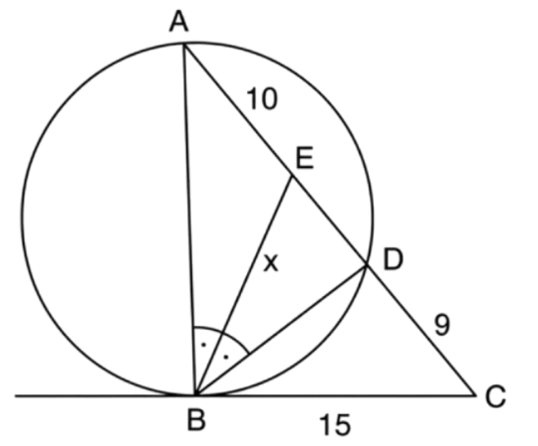
Tangent-secant: BC2 = CD × CA, so 225 = 9 × CA and CA = 25. Then AD = 16 and ED = 16 − 10 = 6.
AB is a diameter, so ∠ADB = 90°. The tangent is perpendicular to the radius, so ∠ABC = 90°. That gives AB = √(252 − 152) = 20, and the altitude BD = (20 × 15)/25 = 12.
Check with the angle bisector in triangle ABD: AE/ED = AB/BD = 20/12 = 5/3, which matches 10 : 6 ✓.
EB = √(BD2 + ED2) = √(144 + 36) = √180 = 6√5.
With h horses and c cows: people = 3h, ducks = 9h, sheep = 4c. Total = 13h + 5c.
- 41 = 13(2) + 5(3) ✓
- 59 = 13(3) + 5(4) ✓
- 61 = 13(2) + 5(7) ✓
- 47: subtracting 0, 13, 26 or 39 leaves 47, 34, 21 or 8, none divisible by 5 ✗
The total can’t be 47.
Daily work rates: 1 man = 1/72, 1 woman = 1/144, 1 child = 1/180.
The team does 4/72 + 12/144 + 20/180 = 1/18 + 1/12 + 1/9 = 9/36 = 1/4 per day. In 2 days that is 1/2, leaving 1/2.
Men needed in one day = (1/2) ÷ (1/72) = 36. Additional men = 36 − 4 = 32.
The product of the roots is 1, and every root is an integer, so each root is ±1. The sum of the roots is −8, so all eight roots are −1.
The polynomial is (x + 1)8, so a = 8C4 = 70.
Marked price M after the two discounts: M × 0.9 × 8/9 = 0.8M.
After the third discount: SP = 0.8M × 11/12 = 11M/15.
M as a percentage of SP = 15/11 = 136.36%. (The 12% loss isn’t needed for this ratio.)
r = 1.4 cm, and the cylinder part is 5 − 2.8 = 2.2 cm long.
Volume = πr2h + 43πr3 = 13.552 + 11.499 ≈ 25.05 cm3 (with π = 22/7).
Syrup = 0.3 × 90 × 25.05 ≈ 676.4, i.e. 676 cm3.
Factor: 2x2 + 7x + 5 = (2x + 5)(x + 1). With t = logx+1(2x + 5), the equation becomes (1 + t) + 2/t − 4 = 0, i.e. t2 − 3t + 2 = 0, so t = 1 or 2.
- t = 1: 2x + 5 = x + 1 gives x = −4. The base would be negative ✗.
- t = 2: 2x + 5 = (x + 1)2 gives x2 = 4, so x = ±2. x = −2 makes the base −1 ✗. x = 2 gives bases 3 and 9 ✓.
There is 1 real solution.
Let the S.I. part be x and the C.I. part be y.
S.I. at 1/3 per year for 2 years: amount = x(1 + 2/3) = 5x/3. C.I. at 1/6 per year for 2 years: amount = y(7/6)2 = 49y/36.
The total amount is 18/13 of the principal: 5x/3 + 49y/36 = 18(x + y)/13.
Multiply through by 468: 780x + 637y = 648x + 648y, so 132x = 11y and x : y = 1 : 12.
Check: x = 1 and y = 12 give 5/3 + 49/3 = 18 on a principal of 13, which is 18/13 ✓.
Correct: 0 · Wrong: 0 · Accuracy: 0%
Keep the streak alive. See you tomorrow for Day 31.