CAT 50 Day Streak – Day 29
30 questions across VARC, DILR & QA · +3 for a correct answer · −1 for a wrong MCQ · no negative marking for TITA
VARC · Verbal Ability & Reading Comprehension
What makes a successful popular science book? One could not find a better paradigm than Richard Dawkins’s 1976 best-selling classic The Selfish Gene. This book presented a quite widely, if not universally, accepted interpretation of the so-called “Modern Synthesis,” the set of ideas that has constituted much evolutionary thinking since the mid-20th century. Because the theoretical science that drove the Modern Synthesis was population genetics, the mathematical study of the evolutionary trajectories of genes, it was natural to think of evolution as a theory about genes, and Dawkins took this view to a somewhat extreme conclusion, painting evolution as genes striving to replicate themselves—a.k.a. the gene’s-eye perspective. Individual genes were seen as competing with one another to have the most positive effects on the organisms in which they resided, and thus to become more prevalent in the next generation.
This was an intriguing vision, and Dawkins presented and developed it in elegant and engaging prose, showing an exceptional talent for providing illuminating metaphors and vivid examples. The outcome was a spectacular success: over 48 years and a million copies later, Amazon tells me that it is currently the number three bestseller on the topic of evolution. As Dawkins has often told us, a well-adapted idea will tend to be selected and become more prevalent. The Selfish Gene was as well-adapted as a book can be, and it has illustrated this principle, though by deliberate print reproduction rather than biological reproduction. In the subsequent half-century, Dawkins has written several books that pretty much tell the same story as his first, and they have also been met with great success.
Dawkins’s most recent book, this summer’s The Genetic Book of the Dead: A Darwinian Reverie, is the latest iteration of these ideas. Since individual books are already indefinitely reproducible, a new version requires a new hook—a novel mutation?—and in this case, he provides it through the idea that an organism’s genome is a kind of palimpsest, layers of which can be peeled away to reveal the history of the organism’s lineage through the adaptive challenges that the genes evolved to address. The gene’s-eye view, to put it another way, is backwards-looking. Though this is a pleasant enough conceit, it is in the end a fairly trivial permutation of the original vision from The Selfish Gene.
There are, of course, many new examples, and the illustrations by artist Jana Lenzová are a delightful enhancement. The book could serve well as an introduction to some basic evolutionary ideas such as the difference between homology and analogy. Each of these gets a chapter with many entertaining examples. There are also chapters explicitly reiterating the main messages of The Selfish Gene and The Extended Phenotype; the book is appropriately palimpsest-like. The major problem is that the adaptive landscape has changed substantially since the 1970s, and Dawkins has failed to evolve. Or perhaps more disturbingly, and anticipating some similar reservations about the other new book reviewed here, Sara Imari Walker’s Life as No One Knows It: The Physics of Life’s Emergence, the niche for a popular science book is mainly to provide a good story, even if it is a bit simplistic and occasionally economical with the science.
The passage is a review of The Genetic Book of the Dead. It calls the book “the latest iteration of these ideas” and “a fairly trivial permutation of the original vision”. That is a review that finds limited novelty.
A: The Selfish Gene is background only, and the author credits population genetics, not Dawkins, with the mathematics. B: the author says the landscape “has changed substantially”, the opposite of continued dominance. D: Walker’s book is mentioned only in passing at the end.
The author praises the presentation: “many new examples”, “delightful” illustrations, and a good introduction to basic ideas. But the author faults its science: Dawkins “has failed to evolve” with the field. That mix is qualified praise.
A: the examples are called “entertaining”, not poor, and the tone isn’t scathing. C ignores the clear criticism. D contradicts “a fairly trivial permutation”.
The “major problem” is that the field has moved on since the 1970s while Dawkins hasn’t. If the gene’s-eye view is still the undisputed dominant model, the field hasn’t moved on, and the criticism collapses.
B is about prose style, not science. C is about Walker, not Dawkins. D concerns sales, which says nothing about whether the science is outdated; it may even fit the author’s worry about popular books.
The disturbing thought is that popular science succeeds by telling a good story even when the science is simplistic or dated. D describes exactly that: a runaway success with an easy, inspiring story built on superseded theories.
A calls the book a failure, but the worry is that such books succeed. B describes rigour with no storytelling, the opposite. C describes a book with neither a good story nor success.
The sentence explains how late independence came: even the first state (Ghana) became free only in 1957, nine years after 1948. It belongs right after “the whole of Sub-Saharan Africa was still under colonial rule”, at blank 2.
At blank 1, colonial rule hasn’t been mentioned yet. Blanks 3 and 4 sit inside the moral and political argument that follows, where a historical date would interrupt the reasoning.
- The theory typically assumes fixed factor endowments (like labor, capital, technology) and unchanging production functions.
- Countries often actively create new comparative advantages through investment in education, infrastructure, research and development, and industrial policy.
- This specialization, the theory argues, leads to a more efficient allocation of global resources and mutual gains from trade for all participating countries.
- However, economic development is inherently a dynamic process.
- One major criticism targets the static nature of comparative advantage.
The coherent paragraph is 5 → 1 → 4 → 2:
- 5: One major criticism is the theory’s static nature.
- 1: The theory assumes fixed endowments and unchanging production functions.
- 4: “However”, development is dynamic.
- 2: Countries actively create new comparative advantages.
Sentence 3 states the theory’s claimed benefits, and “This specialization” has no antecedent here. It belongs to a paragraph explaining the theory, not one criticising it.
- The Himba tribe of Namibia, for instance, exhibits impressive skin repair, aided by natural ointments, a high-protein diet, and specific genetic traits.
- While the movie is fictional, real-life cases do exist where individuals exhibit rapid wound healing.
- Scientists attribute the Bajau’s ability to genetic adaptations that enhance skin elasticity and repair capabilities, despite their extensive time in water.
- Similarly, the Bajau community from Southeast Asia also displays remarkable healing properties.
The order runs like this:
- 2: The movie is fictional, but real-life cases exist.
- 1: The Himba, “for instance”, are the first example.
- 4: “Similarly”, the Bajau are the second example.
- 3: Scientists explain “the Bajau’s ability”.
D covers the bodily and cognitive benefits and keeps the hedges (“potential”) on weight loss and exams. It also ends on the passage’s open question about the source.
A invents an ongoing “debate”; the passage only raises the question. B says “directly enhance”, but the passage warns the exam link may be mere correlation. C says “definitive proof”, the opposite of the passage’s caution.
- Their success, however, has been uneven due to challenges like ineffective implementation and resistance from landlords.
- Post-independence, measures included abolishing exploitative systems and redistributing surplus land to the landless.
- Land reforms in India were primarily initiated to address deep-rooted inequalities in land ownership and promote social justice.
- These reforms aimed to empower marginalized communities and foster a more inclusive agrarian economy.
The order runs like this:
- 3: Introduces land reforms in India and why they began.
- 2: The post-independence measures.
- 4: “These reforms” and their aims.
- 1: “Their success, however,” has been uneven, which concludes the paragraph.
- Socio-economic factors also play a crucial role; access to high-quality green space is often inequitably distributed, and community engagement is paramount for the long-term success of urban greening initiatives.
- Ultimately, urban ecology calls for a holistic, adaptive management approach, where cities are viewed as living laboratories for exploring innovative ways to reconcile human development with ecological integrity.
- Habitat fragmentation remains a primary obstacle, alongside the introduction of invasive species that can outcompete native flora and fauna.
- However, the path to ecologically vibrant cities is fraught with challenges.
- Effective urban ecological design emphasizes connectivity, recognizing that isolated green patches offer limited benefits.
The coherent paragraph is 4 → 3 → 1 → 2:
- 4: The path “is fraught with challenges”.
- 3: Habitat fragmentation and invasive species are the primary obstacles.
- 1: Socio-economic factors “also” matter.
- 2: “Ultimately”, a holistic approach is needed, which concludes the paragraph.
Sentence 5 describes a design principle, not a challenge. It fits a paragraph on what good urban design looks like, not this one about obstacles.
DILR · Data Interpretation & Logical Reasoning
MBA Karo is the best institute when it comes to MBA preparation for Indian MBA entrance exams. During the last week, it hosted the spectacular “Big Million Days” festival, offering its highly coveted NMAT course and mock tests at a discounted price. The prices of the course and mock tests, which were originally Rs. 8000 and Rs. 1500, respectively, were sold at Rs. 5000 and Rs. 1000, respectively.
The graph below shows the revenue during the seven days of the sale. All figures are in Rs. 1000.
The table shows the difference between the number of courses and mock tests sold on each of the days. It is known that a total of 100 courses were sold during the week.
| Day | Mon | Tue | Wed | Thu | Fri | Sat | Sun |
|---|---|---|---|---|---|---|---|
| Difference between Courses and Mocks sold | 10 | 3 | 6 | 10 | 6 | 2 | 7 |
- Equations. With c courses and m mocks, revenue (in Rs. 1000) is R = 5c + m and |c − m| = d. If c > m, then c = (R + d)/6. If m > c, then c = (R − d)/6. Only integer values are valid.
- Fixed days. Mon: c = 10, m = 20. Thu: c = 21, m = 11. Sat: c = 14, m = 12. Sun: c = 11, m = 18.
- Two-option days. Tue: 18/15 or 17/20. Wed: 16/10 or 14/20. Fri: 12/6 or 10/16.
- 100 courses. The fixed days give 56, so Tue + Wed + Fri = 44. Only 18 + 16 + 10 and 18 + 14 + 12 work. Tuesday is always 18.
- Mocks. Total revenue = 602, and courses earn 100 × 5 = 500. So mocks earn 102, which is 102 mock tests (in either case).
| Day | Revenue | Difference | Courses | Mocks |
|---|---|---|---|---|
| Mon | 70 | 10 | 10 | 20 |
| Tue | 105 | 3 | 18 | 15 |
| Wed | 90 | 6 | 16 / 14 | 10 / 20 |
| Thu | 116 | 10 | 21 | 11 |
| Fri | 66 | 6 | 10 / 12 | 16 / 6 |
| Sat | 82 | 2 | 14 | 12 |
| Sun | 73 | 7 | 11 | 18 |
| Total | 602 | 100 | 102 |
(Wed and Fri go together: either Wed 16/10 with Fri 10/16, or Wed 14/20 with Fri 12/6.) Total mock tests = 102.
From the table in Q11, Thursday had the most courses sold: 21.
From the table in Q11, courses beat mocks on Tue, Thu and Sat in every case. The fourth day is Wed (16/10) in one case and Fri (12/6) in the other. Either way the answer is 4 days.
From Q11, Tue + Wed + Fri must total 44. With Tuesday = 17, the best possible is 17 + 16 + 12 = 45 or 17 + 16 + 10 = 43, and nothing gives 44. So Tuesday = 18.
The case with Friday 12/6 has only 6 mocks on Friday, so it is ruled out. That leaves Wednesday with 16 courses and 10 mocks.
Mock revenue = 10 × 1000 = Rs. 10,000 out of Rs. 90,000, which is 11.11%.
The chief minister of a state has to select 5 ministers in his cabinet out of Jatin, Kunal, Laxman, Mukesh, Raj, Suraj, Tarak and Uday. The age (in years) of each of these ministers is different among 36, 38, 39, 45, 48, 54, 57 and 59 years. From the eight ministers, the CM has to select at least one minister who is in his thirties, at least one minister who is in his forties and at least two ministers who are in their fifties. The CM must ensure the following additional conditions are also met:
- If Laxman is in the cabinet, Mukesh must not be in the cabinet.
- Suraj, who is in his fifties, will be in the cabinet only if Mukesh is in the cabinet.
- Raj is six years older than Laxman and if one of them is in the cabinet, the other must be in the cabinet.
- Kunal, who is in his thirties, will be in the cabinet only if Uday is not in the cabinet.
- Suraj is younger than Uday and Uday will be in the cabinet only if Jatin is in the cabinet.
- Tarak is three years younger than Jatin.
- If Raj is in the cabinet, Uday must be in the cabinet.
- Raj = Laxman + 6. The only age pairs 6 apart are (39, 45) and (48, 54).
- Tarak = Jatin − 3. The pairs are (36, 39), (45, 48) and (54, 57).
- Suraj < Uday. Suraj is in his fifties, so Uday is too.
- Laxman = 39 fails. Then Raj = 45 and Jatin/Tarak must be 57/54. That leaves only 59 for both Suraj and Uday ✗.
- So: Laxman 48 and Raj 54. Suraj and Uday get 57 and 59. Jatin/Tarak = 39/36. Kunal (thirties) = 38 and Mukesh = 45.
- Laxman in: Raj, Uday and Jatin must be in. Mukesh is out, which forces Suraj out, and Kunal is out because Uday is in. The fifth member is Tarak: {Jatin, Laxman, Raj, Tarak, Uday} ✓.
- Laxman out: Raj is out, so the only fifties left are Suraj and Uday, and both must be in. Then Mukesh and Jatin are in and Kunal is out: {Jatin, Mukesh, Suraj, Tarak, Uday} ✓.
| Minister | Age | Cabinet 1 | Cabinet 2 |
|---|---|---|---|
| Tarak | 36 | ✓ | ✓ |
| Kunal | 38 | ✗ | ✗ |
| Jatin | 39 | ✓ | ✓ |
| Mukesh | 45 | ✗ | ✓ |
| Laxman | 48 | ✓ | ✗ |
| Raj | 54 | ✓ | ✗ |
| Suraj | 57 | ✗ | ✓ |
| Uday | 59 | ✓ | ✓ |
The cabinet can be selected in 2 ways.
- Jatin
- Tarak
- Uday
From the table in Q16, Jatin, Tarak and Uday are in both possible cabinets, so all of them are definitely in.
From the table in Q16, Mukesh is 45 years old.
Uday is in both cabinets, and Kunal can join only if Uday is out. So Kunal can never be in the cabinet. Laxman and Suraj each appear in one cabinet, and Tarak is in both.
The second-oldest person is Suraj (57). Suraj is only in Cabinet 2, {Jatin, Mukesh, Suraj, Tarak, Uday}, so Raj cannot be in the cabinet.
QA · Quantitative Ability
2xy = (2x)y = 5y = 64 = 26, so xy = 6 and y = 6/x.
yy + 6 = 6/x6/x + 6 = 11 + x.
Sum = xx + 1 + 1x + 1 = 1.
Radius = 3 m. The cone’s height is 8.2 − 4.2 = 4 m, so its slant height is √(9 + 16) = 5 m.
Canvas = cylinder’s curved surface + cone’s curved surface = 2π(3)(4.2) + π(3)(5) = 25.2π + 15π = 40.2π m2.
Cost = 40.2 × 227 × 160 ≈ 20,214.9, i.e. Rs. 20,214.
When the faster runner finishes 7000 m, the slower one has run 7000 × 2/5 = 2800 m.
The faster runner has gained 7000 − 2800 = 4200 m. They meet once for every 500 m gained: 4200/500 = 8.4, so they meet 8 times.
Each buyer can take at most 2 biographies, so 130 biographies need at least 130/2 = 65 buyers.
65 buyers can also cover the 80 fiction and 100 non-fiction books (up to 130 of each). Minimum = 65.
Rearranging: 20m2 + 8mn + n2 − 28m + 49 ≤ 0.
This is (n + 4m)2 + (2m − 7)2 ≤ 0, so both squares must be 0: m = 3.5 and n = −14.
mn = 3.5 × (−14) = −49.
Let the profit be P. The distributed share is 0.8P, split 4:5:6. Parv − Jai = (1/15) × 0.8P = 1,60,000, so 0.8P = 24,00,000 and P = 30,00,000.
Bhanu = salary 0.2P + (4/15) × 0.8P = 6,00,000 + 6,40,000 = Rs. 12,40,000.
Let the number be abbd with d = 2a. Then 2(10a + b) = 10b + d, so 20a + 2b = 10b + 2a, i.e. 18a = 8b, or 9a = 4b.
Since a and b are digits, a = 4, b = 9 and d = 8. The number is 4998.
4998 = 23 × 217 + 7, so the remainder is 7.
Working outwards: log5(log2(…)) = 1, so log2(…) = 5, so x2 − 8x − 208 = 32.
x2 − 8x − 240 = 0 gives (x − 20)(x + 12) = 0, so x = 20 or −12. Both keep every log argument positive, so there are 2 values.
To fit the most people, keep every weight as low as possible. The three heaviest are 75, 69 (the lowest possible above 68) and 68, totalling 212 kg.
Everyone else weighs at most 67, with distinct weights starting from 48. They have at most 810 − 212 = 598 kg between them.
48 + 49 + … + 58 (11 people) = 583 ≤ 598, but adding 59 gives 642 > 598. So the maximum is 11 + 3 = 14 people.
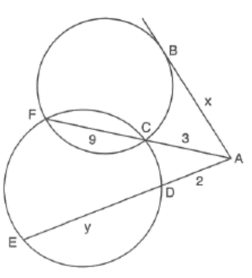
C and F lie on both circles, so AC × AF = 3 × 12 = 36 is A’s power with respect to each circle.
Upper circle (tangent-secant): x2 = 36, so x = 6.
Lower circle (secant-secant): AD × AE = 36, so 2(2 + y) = 36 and y = 16.
y − x = 16 − 6 = 10.
Correct: 0 · Wrong: 0 · Accuracy: 0%
Keep the streak alive. See you tomorrow for Day 30.