CAT 50 Day Streak – Day 23
30 questions across VARC, DILR & QA · +3 for a correct answer · −1 for a wrong MCQ · no negative marking for TITA
VARC · Verbal Ability & Reading Comprehension
Great apes seem to lack the physical development of the larynx, or the neural capability, to learn human speech. Scientists debate the matter. However, with well-evolved articulating hands and arms, gorillas, chimpanzees, orangutans, and bonobos can master complex gestures. Researchers have harnessed this capability to teach them various forms of sign language. Occasionally, non-signing forms of communication, like pointing at pictograms, have also been used.
Stories of ape sign language can feel shockingly human. Washoe was the first signing ape. When the chimp’s handler disclosed that her baby had died, Washoe reportedly signed back cry. The bonobo Kanzi learned to point to various symbols that represented about 350 words. The Koko project released a video of the namesake gorilla delivering a message about climate change. The animals appear to form thoughts and express them in one of our languages to meaningfully convey their ideas to us. Among these experiments, the story of one researcher and his chimpanzee stands out.
That researcher is Herbert Terrace, a professor of psychology at Columbia University. Nim Chimpsky — the name is a pun referring to the prominent linguist Noam Chomsky, then known for his groundbreaking research on linguistics — was his personal research study subject. Nim was raised like a human baby in a Manhattan apartment. His foster mother, Terrace’s student Stephanie LaFarge, taught him ASL. She also breastfed the chimp and supposedly taught him to smoke weed. One of Nim’s handlers reported that the animal requested the substance. Nim was also taught more than 100 signs. Terrace rode the results of Project Nim to academic stardom in the 1970s. At the end of the study, he wrote a 1979 article in the prestigious journal Science. This paper became the seminal work in the field — and likely the source of its complete undoing.
Terrace carefully reviewed video footage of human-ape interactions. Specific frames and traced images from them are demonstrated in the paper. He noticed that the researchers prompted the apes by displaying signs to them, in English grammatical order, before recording the same signs repeated back by the ape. The animal was essentially mimicking the human’s behavior. The ape was aping it.
What about the heart-warming stories of human-ape understanding? Human handlers interacted with the apes for thousands of hours, and occasionally the human interpretation of a string of signs would stand out as interesting. But, this makes the interesting sign combinations look more like generous interpretations of anecdotes that were cherry-picked, or fed to the ape by human handlers, and not a conscious thinking pattern.
What’s more, the meaning of the signs was very easy to over-interpret. Is water bird the intellectual combination of two concepts to indicate a waterfowl? Or is it just rote repetition that a lake and a bird are nearby, combined with generous and wishful human interpretation? Studies in the field generally focused on picking unusual instances out of thousands of hours footage, rather than systematically studying whether apes expressed meaningful ideas. When Terrace did this, he found that interesting sentences began to look like drops in the ocean.
The passage moves from “shockingly human” anecdotes (Washoe, Kanzi, Koko) to Terrace’s analysis, which showed mimicry, cherry-picking and over-interpretation. That is the field’s “complete undoing”.
B: the experiments are only examples; their methods aren’t documented. C overstates the article’s importance. D: ethics is never discussed.
The passage speaks of “generous interpretations”, “cherry-picked” anecdotes and “wishful human interpretation”. Handlers were prone to reading meaning into gestures.
A: there is no evidence of deliberate concealment. B is the opposite; systematic review was Terrace’s contribution. C: the focus was clearly cognitive.
The passage asks whether “water bird” is “the intellectual combination of two concepts” or “just rote repetition that a lake and a bird are nearby.” That is the contrast between a novel combination and associative repetition.
A is the prompting issue from paragraph 4. C and D are not what the example contrasts.
Terrace’s key finding was that apes signed only after being prompted, i.e. mimicry. Thousands of instances of Nim signing first, in the same footage, would directly undercut that.
A concerns speech, not signing. B concerns welfare. D shows vocabulary size, which says nothing about meaningful, unprompted use.
- While most surrenders during the American Civil War met a standard, on a few occasions officers surrendered prematurely or without cause.
- Another noted that ‘I have never seen ten thousand men all terribly angry in my life but this once’.
- When Union Colonel Dixon Miles surrendered Harpers Ferry to Confederate General Stonewall Jackson in September 1862, many of his soldiers believed that they had not been given adequate opportunity to fight.
- When under fire, one could surrender honourably once it became evident that continuing to fight would prove fruitless.
- One soldier recalled that the indignation of Union men and officers at the surrender was terrible.
The coherent paragraph is 1 → 3 → 5 → 2:
- 1: Some officers surrendered prematurely.
- 3: The example of Harpers Ferry, where soldiers felt denied a fight.
- 5: “One soldier” recalled terrible indignation.
- 2: “Another” noted ten thousand angry men.
Sentence 4 defines when surrender was honourable. Sentence 1 already refers to that standard, and the paragraph is about the anger at one premature surrender, so 4 adds a general rule that isn’t needed.
- But this epic journey is complicated for most salmon today, and especially for California’s Central Valley Chinook, which travel through the nation’s largest water delivery system.
- They grow to maturity in the Pacific Ocean and then, as adults, use their sight, smell, and geomagnetic cues to return home.
- A salmon’s lifecycle is often described as heroic — their youthful adventure to the sea followed by a fateful return to spawn, and then die, at their place of birth.
- Often born in hatcheries or in the shallows below dams, juvenile salmon swim through altered rivers and canals and are trucked around reservoirs and pumping plants on their way to the Sacramento-San Joaquin Delta and then San Francisco Bay.
The order runs like this:
- 3: The salmon’s heroic lifecycle.
- 1: “But this epic journey” is complicated for Central Valley Chinook.
- 4: Juveniles travel through altered rivers to San Francisco Bay.
- 2: “They” then mature in the Pacific and return home.
“However” turns away from the popular view (“many others share my view”) towards the author’s change of mind. The research evidence that follows (“Over the past 10 years, numerous studies…”) backs up that “shift in thinking”.
At 1, “however” has nothing to contrast with. At 3 and 4, the evidence would come before the claim it supports.
- In 2017, Parliament passed The Enemy Property (Amendment and Validation) Bill, 2016, which amended the 1968 Act and The Public Premises (Eviction of Unauthorised Occupants) Act, 1971.
- This amendment significantly expanded the definition of “enemy subject” and “enemy firm” to include legal heirs and successors, regardless of their nationality.
- This ensures the property’s status doesn’t change due to a successor being an Indian citizen.
- The amended law also stipulated that enemy property would remain vested in the Custodian, even if the original enemy changed nationality or died.
- Uttar Pradesh holds the maximum number of such properties, with 4,991, followed by Bengal with 2,735, and Delhi with 487.
- These changes aim to solidify the government’s control over these assets.
The order runs like this:
- A: The 2017 amendment is passed.
- 1: “This amendment” widened “enemy subject” to include heirs.
- 3: The law “also” keeps property vested in the Custodian.
- 2: “This ensures” status doesn’t change because of an Indian successor.
- 4: Figures on “such properties” by state.
- F: “These changes” solidify government control.
- Young people themselves are aware of the limits, if not also the dangers, of A.I.
- Hovaghimian, who is 17, felt as though a lot of adults were weighing in on A.I., but she wanted to know what her fellow teens thought about the technology.
- We should aggressively discourage parents and children from using smart toys as replacements for human interaction.
- “We’re the first generation that’s going to have to actually live with it,” she told me.
- After I wrote about what will happen to critical thinking if artificial intelligence is carelessly incorporated in K-12 schools, I heard from a rising high school senior in San Francisco named Fira Hovaghimian.
The coherent paragraph is 1 → 5 → 2 → 4:
- 1: Young people know AI’s limits.
- 5: The author heard from a high-school senior, Fira Hovaghimian.
- 2: She wanted to know what teens thought.
- 4: “We’re the first generation…”, she told me.
Sentence 3 is a policy recommendation about smart toys. It shifts away from teens’ views on AI.
“Paleolithic emotions, medieval institutions, and godlike technology”: we lack the capacity to manage nuclear weapons safely, as the missile-crisis mistakes show. D captures this.
A: LeMay is cited as one of those who made mistakes. B is the opposite of the passage. C is never argued.
DILR · Data Interpretation & Logical Reasoning
Charles, Adam, Robin, David and Shawn played a game of cards that consisted of six rounds. In each round, the first-ranked person got 10 points, the second got 7, the third got 5, the fourth got 2, and the fifth-ranked person got no points.
The table below gives the rank of the players based on the overall points scored in all the rounds till that round. It also gives the final score of the players. If two participants had the same total, both would get the same rank, with no one getting the next rank. For example, David and Shawn had the highest number of points at the end of the 5th round and were both ranked 1, and no one was ranked 2.
| Player | R1 | R2 | R3 | R4 | R5 | R6 | Points after 6th round |
|---|---|---|---|---|---|---|---|
| Charles | 2 | 1 | 1 | 2 | 3 | 2 | 30 |
| Adam | 4 | 3 | 2 | 5 | 3 | 4 | 28 |
| Robin | 1 | 2 | 3 | 3 | 5 | 5 | 20 |
| David | 5 | 5 | 4 | 1 | 1 | 3 | 29 |
| Shawn | 3 | 4 | 5 | 4 | 1 | 1 | 37 |
- R1. The ranks give the points directly: Robin 10, Charles 7, Shawn 5, Adam 2, David 0.
- R2. Matching the order C > R > A > S > D leaves three options, all with Charles 10 and Adam 7.
- R3 and R4. David must jump from 4th to 1st in R4. Only the option R2 = (C10, A7, R5, D2, S0) followed by R3 = (C2, A7, R0, D10, S5) brings David close enough to Charles. Then R4 = (D10, C2, R5, S7, A0).
- R5 and R6. The ties in R5 (D = S, C = A) force S10, D5, A7, C2, R0. R6 then follows from the final totals.
| Points | R1 | R2 | R3 | R4 | R5 | R6 | Total |
|---|---|---|---|---|---|---|---|
| Charles | 7 | 10 | 2 | 2 | 2 | 7 | 30 |
| Adam | 2 | 7 | 7 | 0 | 7 | 5 | 28 |
| Robin | 10 | 5 | 0 | 5 | 0 | 0 | 20 |
| David | 0 | 2 | 10 | 10 | 5 | 2 | 29 |
| Shawn | 5 | 0 | 5 | 7 | 10 | 10 | 37 |
Adam scored 7 in Round 3.
From the table in Q11, Adam never scored 10 in a round (his best was 7).
Robin scored 0 in R3, R5 and R6, so he came 5th in 3 rounds.
In Round 3, Adam scored 7.
0 + 2 + 10 + 10 = 22.
Adam scored 0 in R4, Shawn in R2 and David in R1. Charles never scored 0.
A coaching institute has 6 batches of students: A through F. The bar graph below shows the percentage of girls among the students during the years 2017 and 2018.
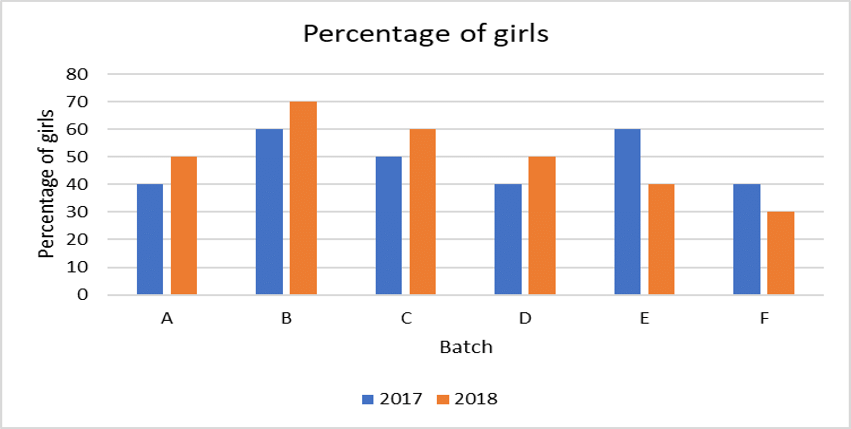
From the graph, girls in batch D were 40% (2017) and 50% (2018).
| Batch | A | B | C | D | E | F |
|---|---|---|---|---|---|---|
| Girls % 2017 | 40 | 60 | 50 | 40 | 60 | 40 |
| Girls % 2018 | 50 | 70 | 60 | 50 | 40 | 30 |
Take 100 students in 2017 and 150 in 2018. Boys = 60 + 75 = 135 out of 250 = 54%.
Girls in 2018 (180 per batch): A 90, B 126, C 108, D 90, E 72, F 54. Total 540, so the average is 90 and boys are exactly 50%.
- A: the average is 90, not 89 ✗
- B: boys are 50% ✗
- C: boys and girls are equal ✗
- D: B (126 vs 54) and F (54 vs 126) both differ by 72, the maximum ✓
Take 60 girls per batch. Totals: A, D, F (40% girls) = 150 each; B, E (60%) = 100 each; C (50%) = 120. Total = 770.
Girls = 360, boys = 410. Boys exceed girls by 50/360 = 13.89%.
Let F = 5k and E = 7k. E has 40% girls (2.8k girls, 4.2k boys) and F has 30% girls (1.5k girls, 3.5k boys). Boys − girls = 7.7k − 4.3k = 3.4k.
For whole numbers of students, F must be a multiple of 50 (k a multiple of 10), so the difference is a multiple of 34. Of the options, only 102 works (F = 150, E = 210).
QA · Quantitative Ability
For 16 shirts, the customer pays for 12, each at 80% of MRP: 12 × 0.8M = 9.6M.
Cost of 16 shirts = 16C. A 25% profit means 9.6M = 20C, so M = 2.0833C, a markup of 108.33%.
(x + 1)(y + 1) = 330 = 2 × 3 × 5 × 11, which has 16 divisors.
Both factors must be at least 2, so exclude (1, 330) and (330, 1). That leaves 14 ordered pairs.
Let Ramdeep’s speed be 6k: 108/(6k) − 108/(9k) = 1, so 6/k = 1 and k = 6. That makes Ramdeep 36 km/h and Sukhwinder 42 km/h.
84/42 = 2 hours = 120 minutes.
∠BCD = 90° makes BD a diameter, so ∠BAD = 90° as well. With CD = 5 and BC = b:
BD2 = 25 + b2 and AB2 = BE2 = 9 + b2.
AD2 = BD2 − AB2 = 16, so AD = 4 cm.
Bhavin’s money triples in 5 years, so the rate is 40% p.a. and his interest is 2P over 5 years.
Arjun: half-yearly CI at 20% for 4 periods gives 1.24P = 2.0736P. SI at 40% for the remaining 3 years then gives 2.0736P × 2.2 = 4.56192P, so his interest is 3.56192P.
Difference = 1.56192P = 156192, so P = 100000. Total lent to both = Rs. 200000.
Fix the tens digit t. The hundreds digit can be 1 to t − 1 (t − 1 choices). The units digit can be 0 to t − 1, excluding the hundreds digit (t − 1 choices). That gives (t − 1)2 numbers.
Sum for t = 2 to 9: 12 + 22 + … + 82 = 204.
Let there be c copper pairs and s steel pairs. With prices in the ratio 2 : 1, the correct bill ∝ 2c + s and the swapped bill ∝ 2s + c.
2s + c = 1.75(2c + s), so 0.25s = 2.5c and s = 10c. The ratio is 1 : 10.
Chain rule: log34 × log45 × log58 = log38, and log29 × log911 × log1181 = log281.
log38 × log281 = 3 log32 × 4 log23 = 12.
143 = 11 × 13. Mod 11: 710 ≡ 1, so 7123 ≡ 73 = 343 ≡ 2. Mod 13: 712 ≡ 1, so 7123 ≡ 73 ≡ 5.
The number that is ≡ 2 (mod 11) and ≡ 5 (mod 13) is 57.
Inside the square: everything except the central 3 × 3 square, i.e. 25 − 9 = 16.
Outside: four 5 × 1 strips (20) plus four quarter-circles of radius 1 at the corners (π).
Total = 36 + π ≈ 39.14 ≈ 39 sq km.
Correct: 0 · Wrong: 0 · Accuracy: 0%
Keep the streak alive. See you tomorrow for Day 24.