CAT 50 Day Streak – Day 19
30 questions across VARC, DILR & QA · +3 for a correct answer · −1 for a wrong MCQ · no negative marking for TITA
VARC · Verbal Ability & Reading Comprehension
Picture yourself on a bus. You’ve had a terrible day, and your mood is far from ideal. Suddenly, you feel a sharp pain in your foot: someone has just stepped on it with a pair of heavy hiking boots. Annoyed, you immediately look towards the person who did it, but you can’t see their facial expression or hear what they have to say. You feel unsettled. A short while later, the bus stops and the driver approaches you. They reassure you that the person who stepped on your foot has been promptly removed from the bus and won’t be allowed back on again for a year. This is the approach of the traditional penal system.
It is based on retributivism, the idea that wrongdoers deserve to be punished for their crimes. Under this system, justice is served when proportionate suffering is imposed on the offender. Prison is not just a place where offenders are secluded to keep society safe; it also carries the symbolic meaning of deserved social rejection. The whole process of achieving justice through punishment involves little or no real communication between wrongdoers and victims, who are instead required to delegate the management of their conflict to third parties (professionals, state institutions, etc). As highlighted by the criminologist Nils Christie, the parties involved are ‘robbed’ of their conflicts, which are instead left in the hands of those who are not directly involved. This system rests on a fundamental premise, rooted in both psychology and anthropology: individuals are intrinsically unable to resolve disputes without external intervention, and this external intervention must be punitive to meet society’s demands. A wrongdoer must pay for the harm caused, and our culture assumes that the only way to achieve that end is through imposing suffering. As a matter of fact, traditional criminal justice expresses the human drive for revenge.
Now, let’s return to the bus. But this time, imagine that, after having your foot stepped on, you can immediately identify the person responsible. You see the worry and embarrassment on their face, and you hear their words of concern and regret: ‘I’m so sorry. I didn’t do it on purpose. Are you all right?’ This genuine expression of remorse will cause your nerves – previously as taut as violin strings – to relax, perhaps even allowing for an understanding smile. No need to rely on the driver. The situation is resolved, and nobody is removed from the bus. This is the approach of restorative justice (RJ).
The core of RJ has little to do with classical theories of punishment. In fact, its justification lies beyond the concept of punishment, as it seeks primarily to address harms, resolve conflicts and repair relationships. RJ is about healing, mutual communication and empathy; it focuses on needs more than deserts. There is no place for punishing wrongdoers in the restorative paradigm, because the very idea of crime takes another meaning: it is not the result of an evil mind freely choosing to commit evil actions. Rather, it is a damaged relationship. As a result, justice itself is understood as relational and implies restoring social connections, healing social wounds.
Scenario 1 (“the traditional penal system”) removes the offender through a third party, with no communication. Scenario 2 (“restorative justice”) resolves the conflict through direct apology and remorse. The contrast models the two systems.
A: mood is a scene-setting detail, not the point. B is too narrow; the apology is also spoken. D: the author doesn’t call third-party intervention unjust or disproportionate.
“Healing social wounds” is how the passage describes restorative justice in its last paragraph, not retributivism.
A (“proportionate suffering”), B (“deserved social rejection”) and C (“individuals are intrinsically unable to resolve disputes without external intervention … punitive”) are all stated features of the retributive system.
The system is impersonal (conflicts are delegated to third parties; the parties are “robbed” of them). It also imposes suffering as payment (“a wrongdoer must pay for the harm caused … through imposing suffering”).
B: victims’ needs are a feature of RJ instead. C: the author says the system expresses the drive for revenge rather than replacing it. D: there is “little or no real communication”.
RJ means mutual communication between victim and offender, a focus on harm and repairing the relationship. B has all three.
A is a state penalty with no victim–offender contact. C is punishment (suspension). D still ends in a punitive prison sentence handed down by a third party.
- The students in the high-score group said that they thought they had, in fact, done quite well—significantly better than the average student.
- Conversely, those who’d been assigned to the low-score group said that they thought they had done significantly worse than the average student.
- At this point, something curious happened.
- Both conclusions were equally unfounded, even though they’d just been told they had zero grounds for believing their self-assessments.
The order runs like this:
- 3: “At this point, something curious happened.”
- 1: The high-score group thought they had done well.
- 2: “Conversely”, the low-score group thought they had done worse.
- 4: “Both conclusions” were unfounded.
- During my 2025 trip, my passport was scanned not only to cross China’s border, but every time I entered or exited a train.
- We foreigners can temporarily live with that level of surveillance, but it’s constant for Chinese citizens.
- China knew exactly where I was and when.
- With the arrival of video surveillance over the last 10 years, all that minor criminal activity has disappeared.
- For foreigners, passports are scanned at hotels, museums, and similar places.
The coherent paragraph is 1 → 5 → 3 → 2:
- 1: His passport was scanned at the border and on every train.
- 5: For foreigners, it is also scanned at hotels and museums.
- 3: So China knew exactly where he was.
- 2: Foreigners can live with “that level of surveillance” briefly, but it is constant for citizens.
Sentence 4 refers to “all that minor criminal activity”, which nothing introduces, and it talks about video surveillance and crime rather than passport tracking.
“These stories” points back to anecdotes from before this paragraph, so the sentence works as an opening summary. The next sentence then explains the psychological shift: “AI is beginning to participate in thought.”
At 2 or 3 it would break the build-up from “participate in thought” → “just assistance?” → “something deeper”. At 4 the point has already been made.
The author’s claim has two parts. Wokeness is an epiphenomenon (secondary effect) of demographic feminization. And the problem is a mismatch with institutional goals, not inferiority, which endangers what those institutions are for. A captures both, including the mismatch framing.
B drops the central cause (demographic change). C says “inherently inferior”, which the author explicitly denies. D blurs the causal chain and misses the author’s explicit “not inferior, but ill-suited” distinction.
- But the serenity Einstein experienced while sailing was unparalleled, giving him a mental freedom that we should all aspire to for ourselves.
- While many of Einstein’s passions extended far beyond physics, perhaps the one he enjoyed the most was sailing.
- By focusing on something mundane, Einstein’s mind was free to wander, frequently leading him to exciting new ideas.
- His second wife, Elsa, added that “There is no other place where my husband is so relaxed, sweet, serene, and detached from routine distractions; the ship carries him far away.”
- As Einstein wrote, “A cruise in the sea is an excellent opportunity for maximum calm and reflection on ideas from a different perspective.”
The coherent paragraph is 2 → 5 → 4 → 3:
- 2: Sailing was Einstein’s favourite passion.
- 5: His own words: a cruise allows calm reflection.
- 4: Elsa “added” that he was most relaxed on the ship.
- 3: Focusing on something mundane let his mind wander to new ideas.
Sentence 1 opens with “But” with nothing to contrast, and it shifts to advising the reader (“we should all aspire”) instead of describing Einstein.
After the image of things passing through the pinhole and “vanishing into the past”, the sentence applies that idea to language: it is “fleeting”. The next sentence’s “The information it contains” needs “language” as its referent, which this sentence supplies.
At 1 or 2 the pinhole metaphor isn’t yet complete. At 4, “it” in the preceding sentence would have no clear referent.
DILR · Data Interpretation & Logical Reasoning
Shivam is a security guard at the reception of an office and keeps track of the number of people who visit the office. On a weekend, the office register got misplaced, and the data about the number of people who visited the office from Monday to Friday remained undisclosed.
However, Shivam was learning to add numbers and managed to remember some information that showed the sum of the number of people who visited the office in each group of 3 days. He also remembered that a different number of people visited the office every day. The table given below shows the sum obtained by Shivam for all the different combinations of every 3 days. It is known that no combination is repeated, and every day is counted exactly once in each of the given combinations. The different combinations are disguised as A, B, C, ... J. He gave a couple of hints to the HR:
- The number of people who visited the office on Friday was equal to the average number of people who visited the office on Monday and Wednesday together.
- The number of people who visited the office on Tuesday was 15 fewer than that on Friday.
| A | B | C | D | E | F | G | H | I | J |
|---|---|---|---|---|---|---|---|---|---|
| 300 | 345 | 330 | 305 | 285 | 290 | 310 | 265 | 325 | 305 |
- Total. Each day appears in 6 of the 10 three-day groups, so the sum of all ten values (3060) = 6 × total. Total = 510.
- Pair sums. Each three-day sum = 510 − (the other two days). The pair sums are 165, 180, 185, 200, 205, 205, 210, 220, 225, 245.
- Days. With days a < b < c < d < e: a + b = 165, a + c = 180, d + e = 245, c + e = 225, and c = 510 − 165 − 245 = 100. So the counts are 80, 85, 100, 120, 125.
- Assigning days. Friday = average of Monday and Wednesday. The only option is 100 = (80 + 120)/2. Tuesday = 100 − 15 = 85, so Thursday = 125.
| Mon | Tue | Wed | Thu | Fri |
|---|---|---|---|---|
| 80 / 120 | 85 | 120 / 80 | 125 | 100 |
From Q11, the daily counts are 80, 85, 100, 120 and 125. The smallest is 80.
Monday and Wednesday are 80 and 120, Friday is 100 and Tuesday is 85, so Thursday = 125.
85 + 125 + 100 = 310, which appears only once in the table, as G.
Monday + Wednesday = 80 + 120 = 200 whichever way round, plus Tuesday 85, gives 285. That is combination E.
Wednesday = 305 − 125 − 100 = 80, so Monday = 120.
Three boys, Jatin, Karun, and Lalit, and two girls, Meera and Nidhi, took a different coloured pen for rough work to a CAT mock. Each of them solved exactly one reading comprehension passage on a different theme among Economics, History, Medicine, Technology, and Philosophy. Each took a different amount of time to finish their passage - 6 minutes, 7 minutes, 8 minutes, 9 minutes, and 10 minutes.
- Jatin, who did the Economics passage, took 1 minute longer than Nidhi, but 1 minute less than the person who did the History passage.
- Meera took longer than the person who used a blue pen, and she didn’t use a black pen.
- Karun, who didn’t use a blue pen, took less time than the person who used a red pen.
- The person who used a pencil didn’t solve their passage in the least amount of time, but did solve it in less time than the boy who solved the passage about Technology.
- The person who used a red pen solved their passage in less time than the person who used a black pen.
- The girl who used a green pen did the Philosophy passage, but did not take the longest amount of time.
- Karun’s pen. Karun < red < black, so Karun has neither red nor black. He isn’t blue (clue 3), and green belongs to a girl, so Karun uses the pencil. The pencil isn’t the fastest, so Karun ≠ 6 min.
- Technology. The Technology boy is slower than the pencil (Karun), and Jatin does Economics, so Lalit does Technology.
- History. History = Nidhi + 2 and is done by Karun or Meera. If Meera did History, every arrangement of times breaks clue 3 or clue 4. So Karun does History: Nidhi 6, Jatin 7, Karun 8.
- Red and black. Red and black must be slower than Karun (8), so red = 9 and black = 10. Meera isn’t black, so Meera is red (9) and Lalit is black (10).
- Blue and green. These remain for Jatin and Nidhi. Green is a girl’s, so Nidhi is green (Philosophy) and Jatin is blue. Meera does Medicine.
| Person | Time (min) | Pen | Theme |
|---|---|---|---|
| Nidhi | 6 | Green | Philosophy |
| Jatin | 7 | Blue | Economics |
| Karun | 8 | Pencil | History |
| Meera | 9 | Red | Medicine |
| Lalit | 10 | Black | Technology |
Meera used the red pen.
From the table in Q17, Nidhi took 6 minutes.
Jatin took 7 minutes and used the blue pen.
Lalit is the boy slower than the pencil user (Karun), so he did Technology.
QA · Quantitative Ability
Let Xing = ak and Yuan = 3k, with k(3 − a) = 9. Try a = 2: k = 9, so Xing = 18 and Yuan = 27.
Check: in 3 years, 21 : 30 = 7 : 10 = (2 + 5) : 10 ✓.
Xing : Zen = 6 : 7, so Zen = 21. Average = (18 + 27 + 21)/3 = 22 years.
Base: x + 3 > 0 and x + 3 ≠ 1, so x > −3 and x ≠ −2.
Argument: (x + 1)(x + 2) > 0, so x < −2 or x > −1.
Domain = (−3, −2) ∪ (−1, ∞). This contains no negative integers (−2 and −1 are excluded). Answer: 0.
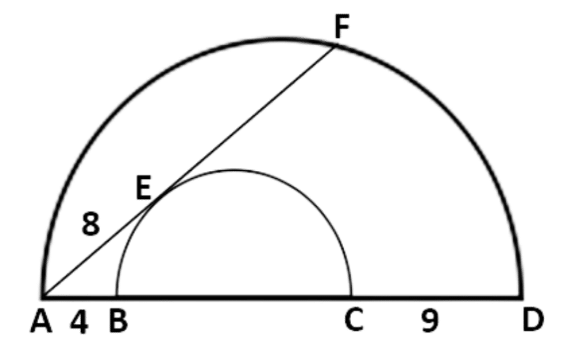
Tangent–secant: AE2 = AB × AC, so 64 = 4 × AC and AC = 16. Then BC = 12 (inner radius 6, centre 10 from A) and AD = 16 + 9 = 25.
In the right triangle from A to the inner centre, sin θ = 6/10 and cos θ = 0.8, where θ is the angle between AF and AD.
AF is a chord of the outer semicircle from the end of its diameter, so AF = AD cos θ = 25 × 0.8 = 20. EF = 20 − 8 = 12.
Detailed solution coming soon.
Running a distance d at 5/7 speed adds 2d5v hours.
Moving the defect 700 km later saves 4 hours: 2 × 7005v = 4, so v = 70 km/h.
Delay of 12 hours: 2d350 = 12, so d = 2100. Total = 700 + 2100 = 2800 km.
n(n + 1)2 + 99 = (n − 2)2, which gives n2 − 9n − 190 = 0, so (n − 19)(n + 10) = 0 and n = 19.
Balls = 19 × 20/2 = 190.
Capital × time: Arjun 14700 × 12 = 176400, Bhavesh 24500 × 12 = 294000, Chetan 28000t.
Bhavesh’s share: 294000 / total = 15750 / 38700, so total = 722400.
28000t = 722400 − 294000 − 176400 = 252000, so t = 9 months.
Diagonals = n(n − 3)2 > 170, so n(n − 3) > 340.
n = 20 gives exactly 340 (not more). n = 21 gives 378 ✓. Least n = 21.
f(x) = a(x + 2)2 + 24. f(4) = 36a + 24 = 60, so a = 1.
f(0) = 4 + 24 = 28.
20240/25000 = 0.8096 = (1 − d)(1 − d + 0.04).
d = 12%: 0.88 × 0.92 = 0.8096 ✓. So the discounts are 12% and 8%, and the higher is 12%.
Correct: 0 · Wrong: 0 · Accuracy: 0%
Keep the streak alive. See you tomorrow for Day 20.