
CAT 50 Day Streak – Day 18
30 questions across VARC, DILR & QA · +3 for a correct answer · −1 for a wrong MCQ · no negative marking for TITA
VARC · Verbal Ability & Reading Comprehension
“Luxury beliefs” are trendy, expensive, and often impractical for the average person, but deeply satisfying for those who can afford them. And, on rare occasions, sickening. The term, coined by writer Rob Henderson, describes a set of ideas that he believes confer status on elites while imposing costs on everyone else. In his accounting, these include: academic elites advocate prison abolition while living in low-crime neighborhoods; Silicon Valley billionaires declare that college is a scam, ignoring the elite-education connections that got them their first venture capital meetings; and urban intellectuals claim homeownership is overrated—right up until they buy a brownstone in Brooklyn.
While this critique is more often levied against progressives, luxury beliefs are fascinatingly transpartisan. Like “virtue signaling” before it, the term is often used too loosely, simply indicating a set of beliefs with which the speaker disagrees and would like to associate with a villainous or hypocritical overdog. But what if luxury beliefs—frivolous, far-fetched, and sometimes downright wrong—actually serve a useful function? What if they’re not (or not only) a maladaptive status signal, but also a mechanism by which new ideas emerge, social status gets reshuffled, and intellectual progress happens?
Perhaps luxury beliefs function as a kind of social R&D department. The powerful and well-insulated play around with new norms, experiment with weird ideas, and sometimes—accidentally?—stumble into something valuable. Another way of understanding the way this process works with beliefs is to examine how it happens with stuff. Many essentials of modern life—indoor plumbing, refrigeration, cellphones—began as indulgences available only to the wealthy. Over time, markets and technology transformed these once-extravagant luxuries into affordable, widely available necessities. It’s not unreasonable to think that some of today’s elite-only beliefs about governance, education, or social structures might go through a similar process, becoming first popular, then normalized, then indispensable.
Just as with luxury goods, the democratization of ideas can be unpredictable. The first automobiles were expensive playthings for the rich before Henry Ford figured out how to mass-produce them for the everyman. What starts as a status flex can turn into a social good. Historically, many ideas that once seemed to be eccentric elite fixations eventually became mainstream. Some of them fundamentally improved human civilization. The abolition of slavery, religious tolerance, gay rights, free markets—each of these can trace at least part of their genealogy to a fringe belief held by a small, educated, and often elite minority before gaining wider acceptance.
In the early 19th century, abolitionists were often portrayed as disconnected from the broader populace’s economic interests and social norms. Critics argued that their calls for immediate emancipation threatened the established economic order. George Fitzhugh, one of President Abraham Lincoln’s least favourite people, wrote of the dire consequences of “liberty and equality” in 1854’s Sociology for the South. “Crime and pauperism have increased. Riots, trades unions, strikes for higher wages, discontent breaking out into revolution, are things of daily occurrence, and show that the poor see and feel quite as clearly as the philosophers that their condition is far worse under the new than under the old order of things.”
Plumbing, refrigeration and cellphones went from rich-only indulgences to necessities. The author suggests “some of today’s elite-only beliefs” might follow the same path. The analogy offers a model for how ideas spread.
B: the author says “some”, not “all”. C: the whole point is that luxury beliefs may be “not only” a status signal. D: the author welcomes democratization rather than criticising it.
The hypothesis says elites act as society’s experimental lab, from which valuable ideas filter down. If beneficial change mainly comes from grassroots movements instead, the elite “R&D department” is not where progress originates.
A: recycled ideas could still be tested and spread by elites. B concerns how the term is used, not whether the mechanism exists. C concerns the speed of diffusion, which the author already calls unpredictable.
The author hedges throughout (“some”, “might”, “sometimes”, “unpredictable”) and even calls such beliefs “sometimes downright wrong”. So “all luxury beliefs are destined” to go mainstream cannot be inferred.
A: the term “is often used too loosely”. B: “What starts as a status flex can turn into a social good.” D: abolition, religious tolerance and others began as elite fringe beliefs.
Through the “social R&D” lens, an impractical elite idea is an experiment that might later become normal. B matches the author’s tentative, hopeful framing.
A dismisses the idea, which the author resists. C is Henderson’s critique, not the author’s new angle. D makes a claim the passage never supports.
D captures both parts. Unprepared people can die at lower wet-bulb temperatures, and the new study looks for that lower bound for an average person who doesn’t take every precaution.
A and B say only high (upper) thresholds matter, the opposite of the passage. C distorts it: the passage says people not accustomed to hot climates are vulnerable, not that only hot-climate residents are at risk.
- That is what drove me, writing a recent popular-level account of astrobiology’s frontiers called The Little Book of Aliens, to stare hard into the entangled history of UFOs, the scientific search for life beyond Earth, and the all-important question of standards of evidence.
- At the time, I was reading both hard-science books and speculative works about UFO-related topics.
- This served as a kind of training ground for dealing with questions facing me and my colleagues about proper standards of evidence in astrobiology.
- It’s also why, as a public-facing scientist, I must work to understand how people not trained in science come to questions surrounding UFOs as aliens.
- Early on, as a teenager reading both Carl Sagan and Erich von Däniken, I had to figure out how to separate the wheat from the chaff.
The coherent paragraph is 5 → 3 → 1 → 4:
- 5: As a teenager reading Sagan and von Däniken, he learned to separate wheat from chaff.
- 3: “This served as a training ground” for standards of evidence.
- 1: “That is what drove me” to write the book.
- 4: “It’s also why” he must understand how non-scientists approach UFOs.
Sentence 2 just repeats sentence 5’s point (reading science and speculation), and its “At the time” has no clear time to refer back to.
“This pragmatic perspective” refers to the view just described, that non-fiction is a direct route to actionable insights. The sentence turns that view against fiction. The next sentence, “The goal, in this framework…”, then explains why a novel loses out to a business biography.
At 1 and 2 the pragmatic view hasn’t been laid out yet. At 4 the sentence would come after the framework has already been fully explained and would delay the “However” turn.
The passage uses addiction to show cravings overwhelming a person’s efforts, regardless of devastating consequences and even when the drug is no longer pleasurable. A says exactly this.
B contradicts “no longer pleasurable”. C contradicts “adamantly they want and try to … stop”. D reverses the problem: cravings are present and overpowering, not absent.
- It has a Swiss cheese-like texture, creating an internal filtration system that provides clean water for neighbouring communities.
- The fragile rock also makes the area particularly susceptible to landslides and sinkholes.
- It also moves through karst terrain; a landscape made of soft limestone.
- The path of the pipeline tears through steep hills, crossing hundreds of waterways.
- The pipeline becomes a necropolitical zone of violence and death, where human depravity is inseparable from the landscape that human bodies inhabit.
The coherent paragraph is 4 → 3 → 1 → 2:
- 4: The pipeline crosses steep hills and hundreds of waterways.
- 3: “It also” moves through karst (soft limestone) terrain.
- 1: “It” (the karst) has a Swiss-cheese texture that filters water.
- 2: “The fragile rock also” makes landslides and sinkholes likely.
Sentence 5 shifts from a physical, geographic description into abstract theory (“necropolitical zone of violence”) that nothing else sets up.
The paragraph calls for curiosity “in classrooms, laboratories and public life”, then gives a concrete demand for each arena. Education (classrooms) comes first, then bureaucracies (public life). So the education sentence fits at blank 2.
At 1 it would come before the curiosity idea it illustrates. At 3 and 4 the paragraph has moved on to bureaucracy and competition.
DILR · Data Interpretation & Logical Reasoning
There are 600 students in a music school. They play 5 different musical instruments among Piano, Guitar, Violin, Flute and Drum. Each student plays at least one of the 5 instruments. Any student who plays Piano also plays Guitar, and any student who plays Violin also plays Flute. Any student who plays Drum also plays Piano, and no student who plays Flute plays Piano. Further, it is known that:
- The number of students who play Drum is thrice the number of students who play only Flute.
- The number of students who play only Guitar is 40 less than the number of students who play exactly 1 instrument.
- The number of students who play Piano is 6 less than the number of students who play Violin.
- The number of students who play at most 2 instruments is 310.
- The number of students who play only Flute is 180 fewer than the number of students who play Piano.
- The number of students who play only Guitar and Flute is half of the number of students who play only Guitar.
- Possible groups. Drum ⊂ Piano ⊂ Guitar, Violin ⊂ Flute, and Piano never goes with Flute. So the only possible groups are: only G, G+P, G+P+D, only F, F+V, G+F, and G+F+V.
- Only Flute. Exactly one instrument = only G + only F, and only G is 40 less than this, so only F = 40. Then Drum = 3 × 40 = 120.
- Piano and Violin. Piano = 40 + 180 = 220, so G+P only = 220 − 120 = 100. Violin = 226.
- Total. 600 = only G + G+F + 100 + 120 + 40 + 226, so only G + G+F = 114. With G+F = only G/2: only G = 76, G+F = 38.
- At most 2 = 310. 76 + 40 + 100 + 38 + F+V = 310, so F+V = 56 and G+F+V = 226 − 56 = 170.
| Group | Students |
|---|---|
| Only Guitar | 76 |
| Only Flute | 40 |
| Guitar + Piano | 100 |
| Flute + Violin | 56 |
| Guitar + Flute | 38 |
| Guitar + Piano + Drum | 120 |
| Guitar + Flute + Violin | 170 |
| Total | 600 |
Exactly one instrument = 76 + 40 = 116.
Every Piano player also plays Guitar, so this equals all Piano players: 100 + 120 = 220.
Flute = only F + F+V + G+F + G+F+V = 40 + 56 + 38 + 170 = 304.
These students are in only G, G+P and G+P+D: 76 + 100 + 120 = 296 (equivalently 600 − 304).
The exactly-two pairs are G+P (100), F+V (56) and G+F (38). A Drum player must also play Piano and Guitar, so nobody plays exactly Drum and Piano.
A calculator does all the operations correctly, but it does not necessarily take the same digit as entered. For example, if you enter 1+1, it might not answer 2, as the calculator might be inputting a different value when the key for 1 is pressed. Although it will certainly keep inputting the same digit for the same keystroke, i.e. if on pressing 1 it enters 6, then if you press 1 again, it will again enter 6. All keystrokes enter a different digit from 0 to 9. Given below is the summation of two six-digit numbers done on this calculator:
| 2 | 6 | 7 | 6 | 4 | 1 | |
| + | 1 | 4 | 8 | 6 | 5 | 2 |
| 3 | 8 | 3 | 2 | 3 | 4 |
Let f(k) be the digit entered when key k is pressed, and read every row (including the result) as keys.
- Outer columns. The units column and the leftmost column both add f(2) + f(1). Since the answer has no 7th digit, the units column can’t carry. So f(4) = f(1) + f(2), the leftmost column receives a carry, and f(3) = f(4) + 1.
- Tens. f(4) + f(5) = f(3) = f(4) + 1, so f(5) = 1 with no carry.
- Hundreds. 2f(6) = f(2) + 10c, so f(2) is even.
- Cases. Trying f(2) = 4 or 6 always clashes with a digit already used. f(2) = 2 forces f(6) = 6 (with carry), f(1) = 5, f(4) = 7 and f(3) = 8.
- Remaining columns. Ten-thousands: 6 + 7 + c = f(8) + 10. Thousands: f(7) + f(8) + 1 = 8 + 10c. Only c = 0 works, giving f(8) = 3 and f(7) = 4.
| Key pressed | 1 | 2 | 3 | 4 | 5 | 6 | 7 | 8 |
|---|---|---|---|---|---|---|---|---|
| Digit entered | 5 | 2 | 8 | 7 | 1 | 6 | 4 | 3 |
Check: 264675 + 573612 = 838287, which matches keys 3 8 3 2 3 4 ✓.
Key 2 enters 2, so press 2.
From the table in Q16, key 5 enters 1.
From the table in Q16, key 8 enters 3.
From the table in Q16, key 7 enters 4.
Pressing 6, 2 enters 62 (6 → 6, 2 → 2). Pressing 4, 5 enters 71 (4 → 7, 5 → 1).
The calculator computes 62 + 71 = 133.
QA · Quantitative Ability
Let A = 8k and B = 3k. Removing 11 L takes out 8 L of A and 3 L of B.
Replacing with A: (8k + 3) : (3k − 3) = 41 : 15, so 120k + 45 = 123k − 123 and k = 56. That gives A = 448, B = 168.
Replacing with B instead: A = 440, B = 176, so the ratio is 440 : 176 = 5 : 2.
For coprime pack sizes a and b, the largest amount that can’t be made is ab − a − b.
5 × 9 − 5 − 9 = 31. (Check: 32 = 5 + 27, 33 = 15 + 18, 34 = 25 + 9, 35 = 7 × 5, 36 = 4 × 9, and every larger number follows by adding 5s.)
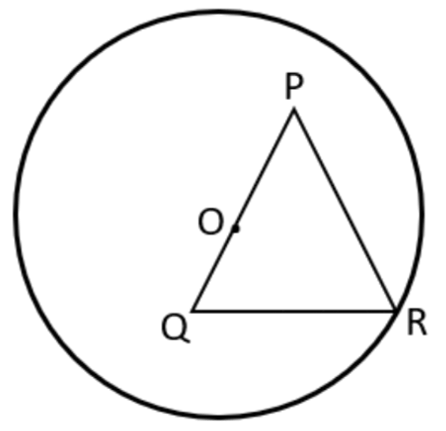
O lies on PQ with OP = 3, so OQ = 2. The circle passes through R, so the radius is OR.
In triangle OQR, ∠Q = 60°: OR2 = 22 + 52 − 2 × 2 × 5 × cos 60° = 4 + 25 − 10 = 19.
Area = π × OR2 = 19π sq cm.
Equal thirds of the distance: 348 = 140 + 160 + 1X, so 1X = 116 − 124 = 148 and X = 48.
Return with equal time at 48 and 72: average = 60 km/h.
The round trip covers equal distances at 48 and 60: 2 × 48 × 60108 = 53.33 km/h.
log2 y → −∞ only as y → 0, so log3 log4 log5 x = 0.
Then log4 log5 x = 1, so log5 x = 4 and x = 54 = 625.
Let there be N seats. Actual results: P1 = 0.2N + 4, P2 = 100, P3 = N − 0.2N − 104 = 0.8N − 104.
N = 280: P1 = 60, P2 = 100, P3 = 120. P3 beats its nearest rival (P2) by 20 ✓. Larger N widens the margin (e.g. N = 300 gives 136 vs 100).
Total seats = 280.
Let y = x2 − 7x. The equation becomes 1y − 8 + 1y − 24 = 2y − 48.
Combining the left side: 2(y − 16)(y − 8)(y − 24) = 2y − 48, so (y − 16)(y − 48) = (y − 8)(y − 24).
Expanding: y2 − 64y + 768 = y2 − 32y + 192, so 32y = 576 and y = 18.
x2 − 7x − 18 = 0 gives (x − 9)(x + 2) = 0, so x = 9 or −2. None of the denominators is zero (10, −6, −30). Sum of roots = 7.
The half-diagonals are 16 and 24, so the side = √(256 + 576) = √832 = 8√13.
The inradius is the height from the centre to a side in the right triangle formed by the half-diagonals: r = 16 × 248√13 = 48/√13 cm.
First merchant: 8c × 56 × 0.8 × 0.75 = 4c.
Second merchant: (7c − 900) × 0.8 = 5.6c − 720.
Setting them equal: 4c = 5.6c − 720, so 1.6c = 720 and c = Rs 450.
T5 + T17 = 2T11, so 3T11 = 192 and T11 = 64.
T11 is the middle term of the 21 terms, so the sum = 21 × 64 = 1344.
Correct: 0 · Wrong: 0 · Accuracy: 0%
Keep the streak alive. See you tomorrow for Day 19.







