
CAT 50 Day Streak – Day 13
30 questions across VARC, DILR & QA · +3 for a correct answer · −1 for a wrong MCQ · no negative marking for TITA
VARC · Verbal Ability & Reading Comprehension
In principle, a cohesive group—one whose members generally agree with one another and support one another’s judgments—can do a much better job at decision making than it could if it were noncohesive. When cohesiveness is low or lacking entirely, compliance out of fear of recrimination is likely to be strongest. To overcome this fear, participants in the group’s deliberations need to be confident that they are members in good standing and that the others will continue to value their role in the group, whether or not they agree about a particular issue under discussion. As members of a group feel more accepted by the others, they acquire greater freedom to say what they really think, becoming less likely to use deceitful arguments or to play it safe by dancing around the issues with vapid or conventional comments. Typically, then, the more cohesive a group becomes, the less its members will deliberately censor what they say out of fear of being punished socially for antagonizing their fellow members.
But group cohesiveness can have pitfalls as well: while the members of a highly cohesive group can feel much freer to deviate from the majority, their desire for genuine concurrence on every important issue often inclines them not to use this freedom. In a highly cohesive group of decision makers, the danger is not that individuals will conceal objections they harbor regarding a proposal favored by the majority, but that they will think the proposal is a good one without attempting to carry out a critical scrutiny that could reveal grounds for strong objections. Members may then decide that any misgivings they feel are not worth pursuing—that the benefit of any doubt should be given to the group consensus. In this way, they may fall victim to a syndrome known as “groupthink,” which one psychologist concerned with collective decision making has defined as “a deterioration of mental efficiency, reality testing, and moral judgment that results from in-group pressures.”
Based on analyses of major fiascoes of international diplomacy and military decision making, researchers have identified groupthink behavior as a recurring pattern that involves several factors: overestimation of the group’s power and morality, manifested, for example, in an illusion of invulnerability, which creates excessive optimism; closed-mindedness to warnings of problems and to alternative viewpoints; and unwarranted pressures toward uniformity, including self-censorship with respect to doubts about the group’s reasoning and a concomitant shared illusion of unanimity concerning group decisions. Cohesiveness of the decision-making group is an essential antecedent condition for this syndrome but not a sufficient one, so it is important to work toward identifying the additional factors that determine whether group cohesiveness will deteriorate into groupthink or allow for effective decision making.
The first paragraph praises cohesion for freeing members to speak frankly. The second turns with “But group cohesiveness can have pitfalls”, i.e. groupthink. The third describes groupthink and notes that cohesion is necessary for it. A captures both halves.
B: the passage never says that understanding cohesion prevents groupthink. C: diplomacy and military affairs are only where the evidence comes from. D covers only the final sentence.
The author says cohesiveness is “an essential antecedent condition” for groupthink. If groups whose members distrust one another (i.e. non-cohesive groups) never show groupthink, that directly supports the claim.
A says nothing about the conditions. B supports the first paragraph’s point about frank discussion, not the conditions for groupthink. D links groupthink to factions, which points to low cohesion and cuts against the author.
The listed factors include “overestimation of the group’s power and morality”, “excessive optimism” and “a shared illusion of unanimity”. All of these amount to a strong belief that the group’s decisions are right.
A: suspicion of adversaries is never mentioned. C: stress is not mentioned; the illusion of invulnerability comes from overestimating the group. D is the opposite of groupthink.
The author defines groupthink as “a deterioration of mental efficiency, reality testing, and moral judgment”. The researchers found it behind “major fiascoes”. Both treat it as harmful, which is D.
A contradicts “not a sufficient one”: cohesion doesn’t always lead to groupthink. B contradicts the idea of a “recurring pattern” with identifiable factors. C contradicts the call to keep looking for those factors.
Blank 3 follows a note describing “the chosen typeface, its history, and the circumstances of its choosing”. The missing sentence explains that typophilic publishers care about such nuances. The next line, “And admittedly, some take it too far”, needs “some” to refer to those publishers. So the sentence belongs at blank 3.
At blanks 1 and 2 typefaces haven’t come up yet. At blank 4, “some” would have no antecedent.
- They found and publicized patterns of ethical lapses and improperly vetted research, even in the face of insults and lawsuits.
- It also highlights the dogged work of outside scientists, teachers, and journalists who questioned the institute’s research history.
- As a result, the research institute was investigated and the research director barred from practicing medicine.
- This Science investigation unravels the systematic problems at the research hospital where the hydroxychloroquine study took place.
The order runs like this:
- 4: Introduces “This Science investigation”.
- 2: “It also highlights” the outside scientists, teachers and journalists.
- 1: “They” (those outsiders) exposed the lapses despite lawsuits.
- 3: “As a result”, the institute was investigated.
A covers all three parts: historians agree on the railroad’s impact, they disagree about public attitudes, and Stilgoe’s attempt to settle this is unconvincing.
B: historians actively debate the issue rather than dismissing it. C: the author finds Stilgoe unconvincing, not widely accepted. D: there is “considerable disagreement”, so the topic has had plenty of attention.
- If you encounter a snake while out on a hike, fear will lead you to back away and exercise caution.
- By contrast, the fears that dominate political discourse are less concrete.
- In ordinary life, fear is often a fitting response to danger.
- If the snake is poisonous, fear will have saved your life.
- Citizens face real dangers from failed political leadership, as lethal to our livelihood as snake bites.
The coherent paragraph is 3 → 1 → 4 → 2:
- 3: Fear is often a fitting response to danger.
- 1: Example: a snake on a hike.
- 4: If it is poisonous, fear saved your life.
- 2: “By contrast”, political fears are less concrete.
Sentence 5 says political dangers are as real and lethal as snake bites. That contradicts the contrast in sentence 2.
- This seems like just atheism repackaged.
- There are pantheists, who think that ‘God’ and ‘the universe’ are simply different words for the same thing.
- However, there are versions of the God hypothesis that don’t see things in such binary terms.
- There is a fit with the conviction of many mystics, as well as the English Romantic poets, that the Divine is present in all things.
- The idea of God I received as a child was of something completely separate from the universe.
The coherent paragraph is 5 → 3 → 2 → 1:
- 5: The childhood idea of a God separate from the universe.
- 3: “However”, some versions are less binary.
- 2: Example: pantheists, for whom God and the universe are the same.
- 1: “This seems like just atheism repackaged”, an objection to pantheism.
Sentence 4 praises the idea’s fit with mystics and poets. Placed after 2 it would break the link between pantheism and “This” in sentence 1, and placed after 1 it has nothing to attach to.
“The flesh” needs the flesh to have been mentioned. It is introduced just before blank 2 (“milky-white flesh”), and the missing sentence adds another quality of it.
At blank 1 the flesh hasn’t been mentioned. At blanks 3 and 4 the paragraph has moved on to uses in desserts and sherbet.
DILR · Data Interpretation & Logical Reasoning
Four friends, A, B, C and D, played a game of Poker. Initially, they had chips in the 60s, 40s, 50s, and 70s, respectively, such that each one of them had a prime number of chips. They played 6 rounds of the game such that the chips were transferred among them. It is also known that:
- A lost 10 chips in each round.
- The number of chips with B after every round formed an increasing arithmetic progression.
- The chips with D were all numbers between 71 and 77 (both inclusive) but not in any specific order.
- B ended up with as many chips as A had at the start of the game.
- The number of chips with D was even after rounds 1, 3 and 5.
- The number of chips with C was a perfect square after rounds 1 and 4.
- Both C and D had 74 chips at the end of round 3.
- All except D ended up with a prime number of chips.
- A. A starts with 61 or 67 and ends with 60 fewer, which must be prime. 61 − 60 = 1 isn’t prime, so A starts at 67 and ends at 7. B therefore ends at 67.
- D. D’s seven counts (start plus six rounds) are exactly 71 to 77. The counts after rounds 1, 3 and 5 are the three even ones: 72, 74 and 76, with 74 after round 3. The start and rounds 2, 4 and 6 are odd. D starts on a prime, 71 or 73.
- B. B gains the same d chips every round, so B starts at 67 − 6d, which must be a prime in the 40s. Only d = 4 works, giving 43.
- Total. After round 3: A 37 + B 55 + C 74 + D 74 = 240. Then C + D at the start = 240 − 67 − 43 = 130, which gives C = 59 and D = 71.
- Round 1. A 57, B 47, so C + D = 136. D is 72 or 76, and C must be a perfect square, so C = 64 and D = 72.
- Round 4. A 27, B 59, so C + D = 154. D is odd and C a perfect square, so C = 81 and D = 73. Round 5 then has D = 76 and C = 84.
- Round 6. A 7, B 67, so C + D = 166, with D 75 or 77 and C prime. So C = 89 and D = 77, which leaves D = 75 and C = 67 in round 2.
| After | A | B | C | D | Total |
|---|---|---|---|---|---|
| Start | 67 | 43 | 59 | 71 | 240 |
| Round 1 | 57 | 47 | 64 | 72 | 240 |
| Round 2 | 47 | 51 | 67 | 75 | 240 |
| Round 3 | 37 | 55 | 74 | 74 | 240 |
| Round 4 | 27 | 59 | 81 | 73 | 240 |
| Round 5 | 17 | 63 | 84 | 76 | 240 |
| Round 6 | 7 | 67 | 89 | 77 | 240 |
A total of 240 chips were used in the game.
From the table in Q11, D leads after rounds 1 and 2, and C and D tie after round 3. C leads alone after rounds 4, 5 and 6 (81, 84, 89): 3 rounds.
|A − B| after each round: Round 1 = 10, Round 2 = 4, Round 3 = 18, Round 4 = 32. The least is after Round 2.
From the table in Q11, D had 75 chips at the end of Round 2.
Detailed solution coming soon.
100 people each were surveyed by Apple in three months: Jan, Feb and Mar, to find out the likelihood of people buying a MacBook or an iPhone. The results of the survey are given in the following table.
| Response | MacBook Jan | MacBook Feb | MacBook Mar | iPhone Jan | iPhone Feb | iPhone Mar |
|---|---|---|---|---|---|---|
| Very unlikely | 50 | 46 | 22 | 17 | 18 | 21 |
| Somewhat unlikely | 24 | 26 | 29 | 14 | 13 | 8 |
| Undecided | 10 | 12 | 15 | 4 | 5 | 7 |
| Somewhat Likely | 5 | 6 | 11 | 46 | 36 | 34 |
| Very Likely | 2 | 4 | 7 | 16 | 21 | 25 |
| No Response | 9 | 6 | 16 | 3 | 7 | 5 |
Note: No. of persons likely to buy = somewhat likely to buy + very likely to buy. No. of persons unlikely to buy = somewhat unlikely to buy + very unlikely to buy.
In Jan, 50 + 24 = 74 are unlikely to buy a MacBook and 17 + 14 = 31 are unlikely to buy an iPhone.
Out of 100 people, the overlap is at least 74 + 31 − 100 = 5.
In Mar, 11 + 7 = 18 are likely to buy a MacBook and 34 + 25 = 59 are likely to buy an iPhone.
The union is smallest when all 18 MacBook buyers are among the 59, so at least 59.
In Feb, 12 were undecided about the MacBook and 5 about the iPhone, and 14 were undecided about at least one.
Undecided about both = 12 + 5 − 14 = 3, i.e. 3% of 100.
For each response, at most the smaller of the Feb and Mar counts could have answered the same way in both months:
- Very unlikely: min(18, 21) = 18
- Somewhat unlikely: min(13, 8) = 8
- Undecided: min(5, 7) = 5
- Somewhat likely: min(36, 34) = 34
- Very likely: min(21, 25) = 21
- No response: min(7, 5) = 5
Maximum = 18 + 8 + 5 + 34 + 21 + 5 = 91.
Detailed solution coming soon.
QA · Quantitative Ability
Let n be the initial number of boxers. The new total is 72n − 780 + 320 = 72n − 460, shared among n − 6 boxers at an average of 71.3:
72n − 460 = 71.3(n − 6) = 71.3n − 427.8, so 0.7n = 32.2 and n = 46.
A number with exactly 4 factors is either pq (two distinct primes) or p3.
- N = pq: we need p + q = 132. The prime pairs are (5, 127), (19, 113), (23, 109), (29, 103), (31, 101), (43, 89), (53, 79), (59, 73) and (61, 71): 9 values.
- N = p3: we need p + p2 = 132, so p = 11 and N = 1331: 1 value.
Total = 10 values.
Let f(x) = ax2 + bx + c. Roots of opposite sign mean their product c/a < 0.
f(x) + f(−x) = 2ax2 + 2c = 0, so x2 = −c/a > 0. The roots are x = ±√(−c/a): real, equal in magnitude, opposite in sign.
If a team wins its 5th match in match n (n = 5 to 9), it won 4 of the first n − 1 matches. That gives C(4,4) + C(5,4) + C(6,4) + C(7,4) + C(8,4) = 1 + 5 + 15 + 35 + 70 = 126 ways.
Either team can win: 2 × 126 = 252.
Let there be s shelves with b books each. Removing 10 shelves: (s − 10)(b + 1) = sb, so s = 10b + 10.
Removing 25 shelves in total: (s − 25)(b + 3) = sb, so 3s = 25b + 75. Substituting: 30b + 30 = 25b + 75, so b = 9 and s = 100.
Books = 100 × 9 = 900.
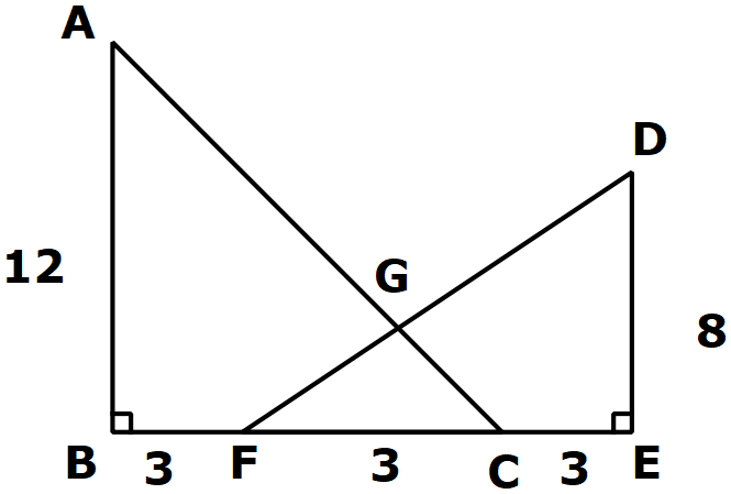
Place B at (0, 0). Then A = (0, 12), F = (3, 0), C = (6, 0), E = (9, 0) and D = (9, 8).
Line AC: y = 12 − 2x. Line FD: y = (4/3)(x − 3). Solving these gives G = (4.8, 2.4).
Area of CFG = ½ × FC × height of G = ½ × 3 × 2.4 = 3.6 sq units.
Rearrange: 10x2 + y2 − 6xy − 8x + 16 ≤ 0, which is (y − 3x)2 + (x − 4)2 ≤ 0.
A sum of squares can’t be negative, so both are 0: x = 4 and y = 12. Then y2 − x2 = 144 − 16 = 128.
Take 12 kg: cost = 3 × 100 + 4 × 80 + 5 × 60 = Rs 920. A sixth is rotten, so 10 kg can be sold.
Required revenue = 1.35 × 920 = Rs 1242, so the price is 1242 ÷ 10 = Rs 124.2 ≈ Rs 124 per kg.
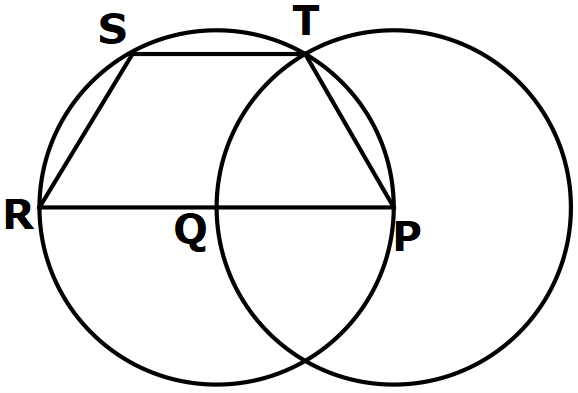
Each circle passes through the other’s centre, so QP = 1. Place Q at (0, 0): then R = (−1, 0) and P = (1, 0), and RP = 2 is a diameter.
The circles meet at T = (½, √3/2). S is its mirror image on the circle centred at Q: (−½, √3/2). So ST = 1 and the height is √3/2.
Area = ½ × (2 + 1) × √3/2 = 3√3/4.
Let the daughter be d. The father is 5d and the mother 4d. At her birth they were 4d and 3d, with average 3.5d = 28, so d = 8 and the mother is 32.
8 + t = (32 + t)/2 gives t = 16 years.
Correct: 0 · Wrong: 0 · Accuracy: 0%
Keep the streak alive. See you tomorrow for Day 14.







