
CAT 50 Day Streak – Day 12
30 questions across VARC, DILR & QA · +3 for a correct answer · −1 for a wrong MCQ · no negative marking for TITA
VARC · Verbal Ability & Reading Comprehension
In 1177BC, Amurapi, the last king of Ugarit in modern-day Syria, wrote in cuneiform on baked clay to the Hittite emperor Suppiluliuma II: “My father behold, the enemy’s ships have come; my cities were burned, and they did evil things in my country.” Soon, both the Hittite and Ugaritic kingdoms were lost to history.
More than 2,000 years later, in AD822, an artisan was carving Altar L, a monument of succession as Yax Pasaj Chan Yopaat passed the rulership of the Maya kingdom of Copan in modern Honduras to Ukit Took. At some point, he dropped his chisel and left his work of political art unfinished. Within the next eight years, the institutions of government in Copan would dissolve. And by the 10th century, the last few squatters had abandoned the ghost city, with its palaces and temples swallowed by the forest. Jumping forward to 1521, Cuauhtemōc, the last Aztec emperor, sent a desperate emissary to the Tarascan empire to the west, an archenemy of the Aztecs. They went to raise reinforcements to battle the army of the Spanish conquistador Hernán Cortés, which had laid siege to the Aztec capital, Tenochtitlan.
The first emissaries were sacrificed and sent to the afterlife. The second diplomatic mission came bearing gifts for the new Tarascan emperor, Tangaxuan II, such as crossbows and swords captured from the conquistadors. The weapons piqued the emperor’s curiosity, so he sent a delegation to Tenochtitlan to see if the untrustworthy Aztecs were telling the truth. But the Tarascans never arrived. They were met by refugees who told them to turn back as there was nothing but the smell of death in the Aztec city. Both Cuauhtemōc, Tangaxuan II, and their empires met horrific deaths at the hands of Cortés. Like the bronze age people of the Middle East, the great empires of Mesoamerica, and thousands of other peoples whose lives and nations now lay buried in the earth, we too are failing to react to the warning signs that could make the difference to whether humanity survives. As the Union of Concerned Scientists, a non-profit consortium based in the US, announces: “Climate change is one of the most devastating problems that humanity has ever faced – and the clock is running out.”
In September 2024, a report compiled by the World Meteorological Organization stated: “The science is clear – greenhouse gas emissions are rising, global temperatures are shattering records and extreme weather is wreaking havoc with our lives and our economies … The decisions we make today could mean the difference between a future of breakdown or a breakthrough to a better world for people and the planet.” This report came nine months after a World Economic Forum model indicated that the world is on track for 14.5 million deaths and US$12.5 trillion in economic losses due to the climate crisis by 2050. In fact, since at least the 1970s, when my father was working with Jia-Yin Wang at San Jose State University on instruments used for monitoring the environment, we should have been heeding the warnings that it was time to begin to adjust our behaviour.
The passage describes the fall of the Hittite and Ugaritic kingdoms (“lost to history”), the Maya kingdom of Copan, and the Aztec and Tarascan empires. The Roman Empire is never mentioned.
The historical collapses build up to the key line: “Like the bronze age people… we too are failing to react to the warning signs”. The rest of the passage covers climate warnings. The history serves as a precedent for today’s inaction.
A: the passage doesn’t analyse the specific causes of each collapse. B: it never compares invasion with other causes. C: it doesn’t blame ancient leaders; it uses them to warn us.
The dropped chisel and the half-carved monument of succession make a vivid picture: a society that stopped mid-task, followed by government dissolving within eight years. It is symbolic, not explanatory.
A: there is no suggestion of an artistic rebellion. B: the date is a side detail, not the purpose. D: the passage sets up no contrast between gradual and sudden collapse.
Amurapi wrote when the enemy ships had already burned his cities. The Aztecs sought help while their capital was under siege. Today, “the clock is running out” and warnings have been ignored since the 1970s. In each case the warnings came when the crisis was already advanced.
B: the passage says “the science is clear”, not esoteric. C: divine protection is never mentioned. D: the warnings cite both 14.5 million deaths and economic losses.
“These design and marketing choices” sums up the design (touchscreens, steering-wheel buttons) and the marketing (advertising campaigns) described so far. The next sentence begins “This suggestion is amplified…”, which needs the word “suggest” just before it. So the sentence belongs at blank 3.
At blanks 1 and 2 the marketing hasn’t been mentioned yet. At blank 4, “This suggestion” would have no antecedent.
- Out of all these people, there must be at least one who is living the worst possible version of my life, and there will be countless more living very bad lives.
- What’s more, suffering will be in each of our futures, even if we don’t know which future and which version of us will have to endure it.
- Many-Worlds interpretation claims that there are multiple versions of me, each of whom shares parts of my past but not my present, nor my future.
- In other words, there is much more suffering in the Everettian multiverse than there is in a singular universe.
The order runs like this:
- 3: Introduces the Many-Worlds claim of multiple versions of me.
- 1: “Out of all these people”, at least one lives the worst version.
- 4: “In other words”, there is more suffering in the multiverse.
- 2: “What’s more”, suffering lies in each of our futures.
A joking tweet went unexpectedly viral and grew into a following for her detailed “biscuit art”. B captures this arc without adding anything.
A invents an “academic setback”, when the caption was a joke. C claims she left academia, which the passage never says. D turns one person’s success into “artistic movements”.
- The result: more motor neurons survived on that side of the spinal cord.
- Why were there more neurons in an embryo than actually needed and why did some die off?
- Hamburger had been studying central nervous system development in the 1930s.
- Hamburger’s idea was that the muscles targeted by those neurons supplied a limited amount of trophic, or nutrient, factors.
- Using chicken embryos and those spinal cord motor neurons, he showed that there were more neurons in the developing embryo than there would be in the adult chicken.
The coherent paragraph is 3 → 5 → 2 → 4:
- 3: Hamburger studied nervous system development in the 1930s.
- 5: He showed embryos have more neurons than adults.
- 2: The question: why the excess, and why did some die?
- 4: His idea: target muscles supply limited trophic factors.
Sentence 1 reports “the result” on “that side of the spinal cord”. It refers to an experiment (one side treated differently) that none of the other sentences describes.
- However, the modern world makes this denial increasingly difficult, and in some cases impossible.
- In some cases, trying to avoid them creates bigger problems.
- While we can vaccinate against the COVID-19 virus, or avoid crocodile-infested waters, many of our permeabilities can’t be avoided.
- Understanding ourselves as ‘people’ rather than ‘food’ requires us to deny or ignore our entanglement with the natural world.
The order runs like this:
- 4: Seeing ourselves as “people” requires denying our entanglement with nature.
- 1: “However”, the modern world makes “this denial” hard.
- 3: Some permeabilities can be avoided, but many can’t.
- 2: “Trying to avoid them” (the permeabilities) can create bigger problems.
The paragraph ends by introducing “conversational norms”. The missing sentence explains what those norms are (pause length, turn-taking, topics), so it belongs at blank 4.
At blanks 1–3, norms haven’t been mentioned yet, so the sentence would come before the idea it explains.
DILR · Data Interpretation & Logical Reasoning
There are seven coaches in a goods train, C1, C2, C3, C4, C5, C6 and C7. Each coach had a different weight (in tons) of goods among 33, 37, 42, 48, 53, 56 and 59. Before departure, some goods from coaches C3, C4 and C7 were shifted to the remaining four coaches, such that the total weight of the goods before and after shifting was equal. The weight of goods shifted was a positive integral multiple of 1 ton.
- Weight of goods in C6 was more than C2 before shifting.
- C4 contained 11 tons more goods than C3 before shifting.
- 15 tons of goods were shifted from C3 to coach C2, and no other shifting was done from/to these two coaches.
- 20 tons of goods were added to C1.
- After shifting, the maximum weight of a coach was 57 tons.
- C5 contained more goods than C6, but less than C7, before shifting.
- 18 and 14 tons of goods were shifted from C7 and C4, respectively.
- Weight of goods in C6 after shifting was at least 53 tons.
- Goods moved. C3, C4 and C7 give 15 + 14 + 18 = 47 tons. C2 gets 15 and C1 gets 20, so C5 + C6 together get 12.
- Limits from the 57-ton maximum. C1 + 20 ≤ 57, so C1 is 33 or 37. C2 + 15 ≤ 57, so C2 ≤ 42. The order before shifting is C2 < C6 < C5 < C7.
- C4 = C3 + 11. The possible pairs are (37, 48), (42, 53) and (48, 59).
- (37, 48): C1 = 33, so C2, C6, C5, C7 = 42, 53, 56, 59. C6 can gain at most 4 (to stay ≤ 57), so C5 gains at least 8, reaching 64 ✗.
- (42, 53): C6 = 48 and C5 = 56. C6 needs at least 5 more to reach 53, but C5 can take at most 1, so C6 gains at least 11 and reaches 59 or more ✗.
- (48, 59): The rest are 33, 37, 42, 53 and 56, so C6 = 42, C5 = 53 and C7 = 56. C6 needs at least 11 more to reach 53. Each receiving coach gets some goods, so C6 gets 11 and C5 gets 1. The 57-ton maximum must be reached, so C1 = 37 and C2 = 33 ✓.
| Coach | Before | Change | After |
|---|---|---|---|
| C1 | 37 | +20 | 57 |
| C2 | 33 | +15 | 48 |
| C3 | 48 | −15 | 33 |
| C4 | 59 | −14 | 45 |
| C5 | 53 | +1 | 54 |
| C6 | 42 | +11 | 53 |
| C7 | 56 | −18 | 38 |
C4 held 59 tons before the shifting.
From the table in Q11, the weights after shifting are 57, 48, 33, 45, 54, 53 and 38. The least is C3 (33 tons).
C5 and C6 share 12 tons. C6 needs at least 11 to reach 53, and C5 must receive some goods. So C5 gets 1 ton (53 → 54).
After the transfer, C2 (48) and C4 (45) lie between 40 and 50 tons: 2 coaches.
Before: 33, 37, 42, 48, 53, 56, 59, so the median is 48.
After: 33, 38, 45, 48, 53, 54, 57, so the median is again 48. The difference is 0.
A company operates in six states. In 2024, the company was at a loss in all six states. The pie charts show the state-wise distribution of sales and expenses.
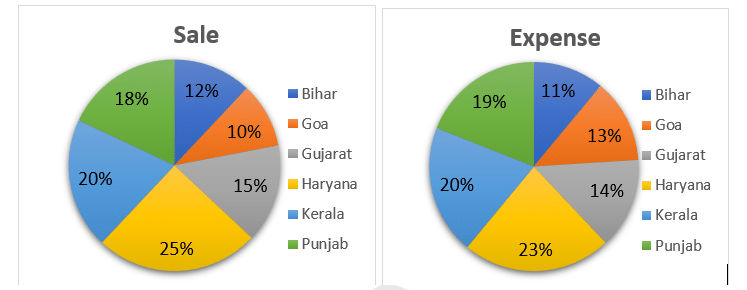
- Profit = Sales − Expenses (if Sales > Expenses)
- Loss = Expenses − Sales (if Expenses > Sales)
- Profit Margin % = Profit/Sale × 100
- Loss Margin % = Loss/Sale × 100
Let k = total expenses ÷ total sales. A state’s loss margin is k × (expense share ÷ sales share) − 1.
| State | Sales share | Expense share | Expense ÷ Sales share |
|---|---|---|---|
| Bihar | 12% | 11% | 0.917 |
| Goa | 10% | 13% | 1.300 |
| Gujarat | 15% | 14% | 0.933 |
| Haryana | 25% | 23% | 0.920 |
| Kerala | 20% | 20% | 1.000 |
| Punjab | 18% | 19% | 1.056 |
A loss in every state needs k × 11/12 > 1 (Bihar is the tightest case), so k > 12/11. The total loss margin, k − 1, must therefore exceed 1/11 ≈ 9.09%.
8% is impossible.
Detailed solution coming soon.
Each state’s loss margin is k × (expense share ÷ sales share) − 1, with the same k for every state. So the state with the highest ratio has the highest margin, whatever the value of k. From the table in Q16, that is Goa (13/10 = 1.3).
A 25% total loss margin means k = 1.25. Each state’s margin = 1.25 × ratio − 1:
- Bihar: 1.25 × 11/12 − 1 = 14.58%
- Goa: 1.25 × 1.3 − 1 = 62.5%
- Gujarat: 1.25 × 14/15 − 1 = 16.67%
- Haryana: 1.25 × 23/25 − 1 = 15%
- Kerala: 1.25 × 1 − 1 = 25%
- Punjab: 1.25 × 19/18 − 1 = 31.94%
33.33% doesn’t appear.
Let 2024 sales = S, so expenses = 1.25S. Every state breaks even once the worst state does. Goa needs 10% of the new sales to be at least 13% of the expenses, so new sales = 1.3 × expenses.
New sales = 1.3 × 1.25S = 1.625S, an increase of 62.5%.
QA · Quantitative Ability
Measure positions clockwise from the start (in metres):
- Ajay–Charan (same direction, 5 : 2): 5 − 2 = 3 points, at multiples of 400: {0, 400, 800}.
- Ajay–Bimal (opposite, 5 : 3): 5 + 3 = 8 points, at multiples of 150: {0, 150, …, 1050}.
- Bimal–Charan (opposite, 3 : 2): 3 + 2 = 5 points, at multiples of 240: {0, 240, 480, 720, 960}.
Only the start point 0 is shared. Distinct points = 8 + 2 (400, 800) + 4 (240, 480, 720, 960) = 14.
- All three-digit numbers (100–999): 900 × 549.5 = 494550
- Divisible by 3 (102–999, 300 terms): 150 × 1101 = 165150
- Divisible by 5 (100–995, 180 terms): 90 × 1095 = 98550
- Divisible by 15 (105–990, 60 terms): 30 × 1095 = 32850
Neither = 494550 − 165150 − 98550 + 32850 = 263700.
Detailed solution coming soon.
n7 − n = n(n6 − 1) = n(n2 − 1)(n4 + n2 + 1). So each term simplifies to 1/((n − 1)n(n + 1)).
Since 1/((n − 1)n(n + 1)) = ½[1/((n − 1)n) − 1/(n(n + 1))], the sum from n = 2 to 2025 telescopes to ½[1/2 − 1/(2025 × 2026)] = 1/4 − 1/(2 × 2025 × 2026).
Adding the last term 1/(2 × 2025 × 2026) cancels the remainder. Total = 1/4 = 0.25.
15,43,347 = 1.5 × 10,28,898, so income : expenditure : savings = 3 : 2 : 1. Take them as 3k, 2k and k.
New savings = 3k × 1.14 − 2k × 1.07 = 3.42k − 2.14k = 1.28k, an increase of 28%.
Each new triangle has 1/4 the area of the previous one. The sum of the areas is (√3/4)p2 ÷ (1 − 1/4) = (√3/3)p2.
(√3/3)p2 = 36√3 gives p2 = 108, so p = 6√3.
Let the common value be k. Then 5 = k1/x, 3 = k1/y and 45 = k1/z.
45 = 5 × 32 = k1/x + 2/y, so 1/z = 1/x + 2/y.
Milk fractions: P = 5/7, Q = 4/5, target = 3/4.
By alligation, P : Q = (4/5 − 3/4) : (3/4 − 5/7) = 1/20 : 1/28 = 28 : 20 = 7 : 5.
Let the sphere (radius r) be inscribed in a cone of height h. The cone’s base radius R satisfies R2 = r2h/(h − 2r), so its volume is πr2h2/(3(h − 2r)).
This is smallest at h = 4r, giving (8/3)πr3 = 2 × (4/3)πr3 = 2V.
Total = 7 × 55 = 385. The first 3 innings total 3 × 41 = 123. Innings 6 and 7 total 2 × (41 + 32.5) = 147.
Innings 4 + 5 = 385 − 123 − 147 = 115. With I4 = I5 + 21: 2 × I5 + 21 = 115, so I5 = 47 and I4 = 68.
Correct: 0 · Wrong: 0 · Accuracy: 0%
Keep the streak alive. See you tomorrow for Day 13.







