
CAT 50 Day Streak – Day 11
30 questions across VARC, DILR & QA · +3 for a correct answer · −1 for a wrong MCQ · no negative marking for TITA
VARC · Verbal Ability & Reading Comprehension
Jordan Peterson’s ambitious new work, We Who Wrestle with God, is, by his own admission, a direct "response to the brilliant Nietzsche." For the Canadian psychologist and leading voice of the counter-cultural right, the crisis afflicting Western civilization isn't fundamentally caused by the "woke" movements he so often critiques. Instead, he diagnoses a far deeper malady of the West: the collapse of meaning that occurs when human values are completely unmoored from any transcendental order—the very condition Nietzsche termed nihilism.
The remedy Peterson proposes is not easy: it requires a fearless, agonizing struggle of self-examination against despair, a spiritual ascent that points to a realm beyond the self. But this raises a central question: Is the realm Peterson ultimately discovers a truly separate, objective truth? Or is it a form of therapeutic fiction, an internal structure invented to rebuild a self-shattered by traumatic encounters with the "madness of the age"?
This compendious volume—the first of two planned books, taking thirteen years to create—largely consists of commentaries on Jewish and Christian scripture. Peterson takes readers through reflections on the Genesis story of the Fall, the meaning of sacrifice, the tragedy of Cain and Abel, and a sprawling, one-hundred-page-plus meditation on Moses. The book concludes with the tale of Jonah, swallowed by a whale after failing his instruction to convert Nineveh.
In his analysis of the Exodus narrative, Peterson references the Israelites who "regressed to the paganism of possession by instinct" by worshipping the golden calf while Moses communed with God. He extracts a key philosophical principle from this: "The narrative here... indicates the fundamental problem of truth or even social agreement arising from mere consensus, in the absence of any true correspondence with an intrinsically structured reality or a priori cosmic order."
The use of terms like an "a priori cosmic order" introduces a crucial tension. This concept suggests something far more impersonal than the specific creator God of the Abrahamic tradition; it could just as easily be Plato’s timeless realm of "forms" or, as Peterson himself acknowledges through citation, the impersonal "Way" of Taoist thought. Why, then, does he choose to anchor this "intrinsically structured reality" exclusively to the God of the Bible?
Peterson attempts to justify this in his introduction, or "Foreshadowing," stating: "The Bible is the library of stories on which the most productive, freest and most stable and peaceful societies the world has ever known are predicated—the foundation of the West, plain and simple."
This perspective, however, risks undermining his own argument. Reducing Christianity to a collection of inspiring legends and a bulwark for a particular civilization fails to exorcise the very spectre of nihilism it is meant to combat. If the Christian religion is merely a cultural foundation to be shored up, it ceases to be a universal truth, dangerously skirting the very cultural relativism Peterson condemns in "woke" thinkers.
The author points to a “crucial tension”: Peterson’s “a priori cosmic order” is impersonal and could just as easily be Plato’s forms or the Taoist “Way”, yet he anchors it “exclusively” to the God of the Bible. Admitting that this order isn’t tied to one tradition would remove the inconsistency.
A narrows his project in a way the author doesn’t endorse. B would confirm the “therapeutic fiction” worry and weaken his claim to objective truth. D is about scope, not logical consistency.
The central critique is that Peterson justifies the Bible by its usefulness to one civilisation. That reduces Christianity to a cultural foundation and slides into the relativism he condemns. If he had claimed the Bible holds universal, divinely revealed truth, his justification would no longer be cultural, and the critique would lose its force.
B would answer a side question (why only the Bible) but not the relativism charge. C changes the diagnosis rather than defending it. D makes the “therapeutic fiction” reading stronger.
The author summarises Peterson’s work fairly and calls it “ambitious”. He then identifies a specific logical tension and explains why it “risks undermining his own argument”. That is reasoned criticism.
The tone has no contempt, so it isn’t scornful. It takes a clear critical position, so it isn’t neutral. And it shows no hope for the project, so it isn’t optimistic.
The last paragraph spells out the paradox. Peterson defends the Bible as “the foundation of the West”, i.e. by its value to one civilisation, and that is the same cultural relativism he condemns in “woke” thinkers.
A is not the tension the passage identifies. B is no contradiction, since a right-wing voice critiquing “woke” movements is consistent. C is a fact about the book, not a paradox.
- Some parasites have also evolved thicker-shelled eggs that are less likely to crack when hastily dropped.
- “They swoop into the nest and they squeeze out an egg in three seconds flat,” says Rosalyn Gloag, an evolutionary biologist from the University of Sydney.
- And while nonparasitic birds take about 20 minutes to lay an egg, parasites like cuckoos and honeyguides are fast.
- When a parasite makes it into another family’s nest, it usually will nudge out one or two of the host’s eggs to make space for its own.
The order runs like this:
- 4: Sets the scene: the parasite enters a host nest and nudges out eggs.
- 3: “And” adds the next adaptation: parasites lay eggs fast.
- 2: The quote (“three seconds flat”) illustrates that speed.
- 1: “Also” adds a related adaptation: thick shells that survive a hasty drop.
The passage moves from the contestable claim about Vedanta (“For precisely this reason”) to the scholarly question of whether India has an analytic discipline that corresponds to Greek-derived “philosophy”. A captures that link.
B links Thilly and Vedanta in a way the passage doesn’t. C presents Thilly’s claim as a settled conclusion. D adds a “rivals Western thought” side that the passage never mentions.
- In all of these settings, officials introduced mandatory posture exams, which became a rudimentary surveillance technique for sorting the healthy from the unhealthy.
- At the same time, the rising rates of back and neck pain through the 20th century were blamed on individuals not doing enough to prevent these issues.
- If you wished to pass as nondisabled and gain entry to schools, universities and the workplace, you needed to keep your posture in check.
- One can understand why the market for posture correction bloomed in the first two-thirds of the 20th century.
- Those who missed out on the gospel of good posture or could not afford to spend the time or money on such improvement measures were further marginalised.
The coherent paragraph is 4 → 3 → 2 → 5:
- 4: Topic: why the market for posture correction bloomed.
- 3: Reason one: good posture was needed to pass as nondisabled.
- 2: “At the same time”, reason two: pain was blamed on individuals.
- 5: Result: those who couldn’t afford the time or money for correction were marginalised.
The paragraph explains individual pressure and the market for correction. Sentence 1 shifts to officials and institutional surveillance through posture exams, which is a different angle on the topic.
- Being virtuous is not a one-time thing for Aristotle; it’s a state of character.
- Aristotle highlights the importance of hexis, often translated as “habit.”
- A person must not only do the right thing when required but also have the right motivations and feelings about it.
- One should aim for, say, courage and be wise enough to be courageous at the right time.
The order runs like this:
- 2: Introduces the concept: hexis, or “habit”.
- 1: Explains it: virtue is a lasting state of character, not a one-time act.
- 3: Adds what that requires: the right action plus the right motives and feelings.
- 4: Gives an example: courage, shown at the right time.
“Either terrifies us or amuses us” sets up two reactions. The missing sentence illustrates the alarmed one (policymakers fearing a collapsing population). “There’s also a burgeoning market for exotica” then illustrates the amusing one, and “The extremes are unhelpful” sums up both. So the sentence belongs at blank 2.
At blank 1 the reactions haven’t been introduced yet. Blanks 3 and 4 come after the amusing example or after “the extremes” have already been dismissed.
- So, if you ask us not to think about a pink elephant, we won’t visualise one, because we can’t.
- When people first learn they have aphantasia, they are often upset, as they realise other people can do things they cannot.
- People with aphantasia cannot voluntarily imagine seeing things in your mind’s eye.
- Where aphantasics have no capacity, most people would have an average ability.
- Aphantasia is typically described as a deficit.
The coherent paragraph is 5 → 3 → 1 → 2:
- 5: Aphantasia is usually described as a deficit.
- 3: What it means: no voluntary mental imagery.
- 1: “So” gives the pink-elephant illustration.
- 2: The emotional response on learning one has it.
Sentence 4 brings in a comparison of ability levels across the general population. It doesn’t connect to the definition, the example or the personal reaction.
DILR · Data Interpretation & Logical Reasoning
Six batchmates, Ajay, Balwant, Cyrus, Dev, Ezra and Farhan got engaged on the same day. They had invited a total of 80 guests. The total number of guests attending their engagement was 150. The graph below shows the number of people who attended two, three, four or five functions.
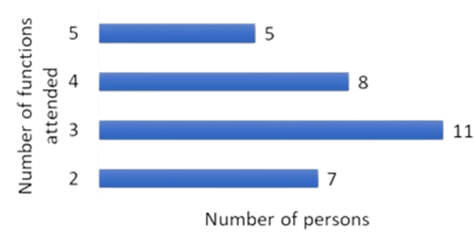
The 150 counts attendances: a guest at 3 functions is counted 3 times. The graph covers guests at 2–5 functions, but some guests could also have attended all 6.
| Functions attended | Guests | Attendances |
|---|---|---|
| 2 | 7 | 14 |
| 3 | 11 | 33 |
| 4 | 8 | 32 |
| 5 | 5 | 25 |
| Total | 31 | 104 |
Let a guests attend exactly one function and s attend all six. Then a + 6s = 150 − 104 = 46. The number attending none is n = 80 − 31 − a − s = 49 − a − s.
| s (all six) | 0 | 1 | 2 | 3 | 4 | 5 | 6 | 7 |
|---|---|---|---|---|---|---|---|---|
| a (exactly one) | 46 | 40 | 34 | 28 | 22 | 16 | 10 | 4 |
| n (none) | 3 | 8 | 13 | 18 | 23 | 28 | 33 | 38 |
The minimum number attending exactly one function is 4 (when s = 7).
From Q11, n = 49 − a − s = 3 + 5s. This is largest at s = 7, giving 38.
Guests attending at most 3 functions = 80 − 8 − 5 − s, which is largest when s = 0. Then a = 46 and n = 49 − 46 − 0 = 3.
At most 31 + s multi-function guests can be at Farhan’s engagement: all 31 from the graph plus the s who attended everything. So “only Farhan” ≥ 50 − 31 − s = 19 − s.
But “only Farhan” guests are among the a = 46 − 6s single-function guests. So 19 − s ≤ 46 − 6s, which gives s ≤ 5.
The minimum is 19 − 5 = 14, with s = 5 and a = 16.
Of Farhan’s 50 guests, those who attended another function = 50 − (only Farhan). To minimise this, maximise “only Farhan”, which can be at most a = 46 − 6s. That is largest at s = 0, giving 46.
So at least 50 − 46 = 4 of his guests attended another function.
Seven people – Amba, Bina, Chhaya, Diya, Ekta, Fatima, and Gurmeet live in a building that has no more than 15 floors. Only one person lives on each floor. The floors are numbered from 1, starting from the lowermost floor. There are two lifts, P and Q, in the basement. Lift P stops at the even-numbered floors and Lift Q stops at the odd-numbered floors. The lifts take 10 seconds to cross one floor and halt on the selected floor for 10 seconds.
Amba's floor number is twice that of Diya's floor number. Chhaya lives below Diya, and her floor number is a multiple of three. There is one floor between Amba's floor and Fatima's floor. Bina's floor number is exactly half of Fatima's floor number. There are four floors between the floors on which Bina and Gurmeet live. Fatima lives on the topmost floor. Not more than two people live on consecutive floors. The number of persons living between Ekta and Fatima is the same as the number of floors between Chhaya and Gurmeet. Ekta does not live on an odd-numbered floor.
Fatima is on the top floor F, and Bina = F/2, so F is even. Amba is two floors below Fatima, so A = F − 2 and Diya = A/2.
- F = 14: A = 12, D = 6, B = 7, C = 3, and G = 2 (since 12 is taken). There are no floors between C and G, so no one can be between Ekta and Fatima. Ekta would have to be on 13, which is odd ✗.
- F = 12: A = 10, D = 5, B = 6, C = 3, and G = 1 or 11.
- G = 11 puts 7 floors between C and G, but at most 5 people can be between Ekta and Fatima ✗.
- G = 1 puts 1 floor between C and G, so exactly one person is between Ekta and Fatima. Ekta = 8, with Amba (10) in between ✓.
- F = 10: A = 8, D = 4, B = 5, C = 3. Floors 3, 4 and 5 are three consecutive occupied floors ✗.
- F ≤ 8: Diya ≤ 3, so there is no multiple of 3 below her for Chhaya ✗.
| Floor | 1 | 3 | 5 | 6 | 8 | 10 | 12 |
|---|---|---|---|---|---|---|---|
| Person | Gurmeet | Chhaya | Diya | Bina | Ekta | Amba | Fatima |
| Lift | Q | Q | Q | P | P | P | P |
Ekta lives on floor 8.
From the table in Q16, Bina = 12/2 = 6. Bina lives on the 6th floor.
Gurmeet (1), Chhaya (3) and Diya (5) live on odd floors: 3 people.
Detailed solution coming soon.
Bina (floor 6) should take Lift P, but she boards Lift Q with Chhaya (3) and Diya (5). Ekta (8) takes Lift P.
- Lift Q: reaches floor 3 at 30 s and halts until 40 s. Reaches floor 5 at 60 s and halts until 70 s. Back in the basement at 120 s.
- Lift P: reaches floor 8 at 80 s and halts until 90 s. Back in the basement at 170 s.
- Bina: boards Lift P, which halts 10 s in the basement (180 s). It then climbs 6 floors (60 s) and reaches floor 6 at 240 s.
QA · Quantitative Ability
Let Som’s capital-months be s = 18000 × 11 = 198000 and Mangal’s be m = 12M. Of the remaining 80% of the profit, Som gets the fraction s/(s + m) and Mangal gets m/(s + m).
Equal totals: 0.2 + 0.8 × s/(s + m) = 0.8 × m/(s + m). Multiplying by (s + m) gives s = 0.6m, so m = 330000.
12M = 330000, so M = Rs. 27,500.
720 km/h = 200 m/s, so in 15 s the jet covers 3000 m = 3 km.
h cot 30° − h cot 60° = 3, so h(√3 − 1/√3) = 3, i.e. h × 2/√3 = 3.
h = 3√3/2 ≈ 2.6 km.
f(f(0)) = f(b) = b(a + 1) = 0, so b = 0 or a = −1.
If b = 0, then f(f(f(4))) = 4a3 = 9, which has no integer solution. So a = −1 and f(x) = b − x. Applying f twice gives back x.
So f(f(f(4))) = f(4) = b − 4 = 9, giving b = 13. Then f applied five times to 8 equals f(8) = 13 − 8 = 5.
Let M and W be the daily work of one man and one woman. 2M + 3W = 0.6(6M + W) gives 2.4W = 1.6M, so W = (2/3)M.
With n men and the whole task = 1: in 2 days, 2nM = 0.2, so nM = 0.1. In the next 3 days, 3(nM + 5W) = 0.8.
So 0.1 + 5W = 0.8/3, giving W = 1/30 and M = 1/20. Then n = 0.1 ÷ (1/20) = 2.
- 342x+7: 4 raised to an odd power ends in 4.
- 23x+17 × 17x+22 = (23 × 17)x+17 × 175. Since 23 × 17 = 391 ends in 1, this ends in the same digit as 75, which is 7.
- 492x = 2401x, which ends in 1.
4 × 7 × 1 = 28, so the unit’s digit is 8, whatever the value of x.
Let the wholesale price be ₹100 per kg. The dealer pays ₹80 but receives 1.2 kg, so his cost is 80/1.2 = ₹66.67 per kg.
The marked price is 80% above ₹100, i.e. ₹180. After the 25% discount the customer pays ₹135, but receives only 0.9 kg. So the dealer gets 135/0.9 = ₹150 per kg actually delivered.
Profit = (150 − 66.67)/66.67 × 100 = 125%.
Square x + y + z = 3: 9 = 9 + 2(xy + yz + zx), so xy + yz + zx = 0.
Over the common denominator xyz, the expression becomes (x2y2 + x2z2 + y2z2)/xyz.
(xy + yz + zx)2 = x2y2 + y2z2 + z2x2 + 2xyz(x + y + z), so x2y2 + y2z2 + z2x2 = 0 − 2xyz × 3 = −6xyz.
Expression = −6xyz/xyz = −6.
There are 88 possible outcomes in total. Outcomes where all 8 spins differ are arrangements of the 8 numbers: 8! of them.
Probability = 8!/88.
CI on 4300 for 2 years at 10% = 4300 × (1.21 − 1) = 903. Twice that is 1806.
P × 8 × 3/100 = 1806, so 0.24P = 1806 and P = Rs. 7,525.
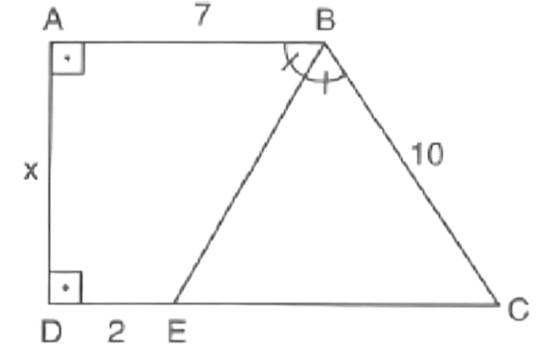
Since AB ∥ DC, ∠ABE = ∠BEC (alternate angles). BE bisects ∠ABC, so ∠ABE = ∠EBC. Hence ∠BEC = ∠EBC, triangle BEC is isosceles, and EC = BC = 10.
DC = DE + EC = 2 + 10 = 12. Drop a perpendicular from B to DC at F: DF = AB = 7, so FC = 5.
AD = BF = √(102 − 52) = √75 = 5√3.
Correct: 0 · Wrong: 0 · Accuracy: 0%
Keep the streak alive. See you tomorrow for Day 12.