CAT 50 Day Streak – Day 10
30 questions across VARC, DILR & QA · +3 for a correct answer · −1 for a wrong MCQ · no negative marking for TITA
VARC · Verbal Ability & Reading Comprehension
My own escape was fairly mild: I borrowed a friend’s studio flat in Hong Kong, where I’d finished my last underwhelming freelance job, and used it as a resting place. An urbanite’s monastic cell at 200 square feet, the unit was a short walk from the Hong Kong Central Library, where I went daily, with my notebook and thermos of Nescafé. I was desperate to reform myself. I had always wanted to write, but wasn’t exactly sure why, and recently my notebooks had begun filling with characters and literary images instead of ideas for articles. It seemed important to understand the nature of this impulse: was it passion or ambition? I had read the philosopher Byung-Chul Han’s The Burnout Society (2010), and accepted that I was a hopeless ‘achievement-subject’ like the rest of my peers, chasing money and grants and degrees. For purity’s sake, I’d need to retreat, to ‘unplug’ and ‘go off the grid’, to pursue what Han and others have called the vita contemplativa.
But how? The need to unplug had already been co-opted by an unrelenting corporate wellness industry, with its call to ‘redefine success’ and create a life of ‘wellbeing, wisdom and wonder’, to quote from the movement’s prophet-in-chief, the aforementioned Huffington. Then I spotted a creased and faded paperback copy of The Asian Journal of Thomas Merton (1968) on the shelf of a used bookstore along Hennessy Road. I hesitated, then bought the book.
Merton had been important to me in my teenage years, ever since a priest had recommended him as the apotheosis of poetic sensibility: a Catholic monk and social critic, he’d used his imagination well by drawing himself closer to God. Though I wasn’t sure about God, I loved Merton’s sensibility, his warmth, his raw theology. But I worried that he wouldn’t hold up to the scrutiny of adult malaise, that his spiritual writing might betray a fatal innocence. I had recently braved a tragic reunion with Aldous Huxley, who’d failed the test – his journey proving how easily the path of Western mystic leads to the castle of psychedelics or a bungalow in the Hollywood Hills. Merton was the more serious pilgrim. He corresponded with Thich Nhat Hanh and D T Suzuki on the principles, methods and challenges of Buddhist meditation at a time when Huxley and others were more interested in LSD. Merton studied Islamic scholarship. He read Sufi poetry with a seriousness that set him apart from the Western beatnik. He’d joined a Trappist monastery in rural Kentucky, where he lived for 27 years in admirable solitude. Still, I knew executives who quoted Merton in PowerPoints on inspiration and leadership, and I feared his Journal might fall into the Westerner-travels-to-Asia-to-find-himself genre, which was overrepresented in the bookshops of Hong Kong. In the end, curiosity won out, and I spent several days immersed in Merton’s journey of 1968.
The author calls himself a hopeless “achievement-subject”. He wants to retreat into the vita contemplativa, then asks “But how?”: even the urge to unplug has been co-opted by the corporate wellness industry. His doubt that real contemplation can survive an achievement culture is closest to A. “Impossible” is strong, but A is the only option in line with his view.
B: he is critical of the wellness industry, not asking it to market better. C: Huxley “failed the test”, and Merton’s seriousness is shown through his engagement with Eastern thinkers. D: he is uneasy that executives quote Merton in PowerPoints.
The author says the opposite of D: “Merton was the more serious pilgrim”, studying Buddhist meditation while Huxley and others were drawn to LSD. So D was not a reason for hesitating.
A matches his worry that Merton’s writing “might betray a fatal innocence” under “adult malaise”. B matches his fear of the “Westerner-travels-to-Asia-to-find-himself genre”. C matches the executives quoting Merton in PowerPoints.
The author is “desperate to reform” himself and wants to strip away the drive for money, grants and degrees to find out whether his writing comes from passion or ambition. Retreating “for purity’s sake” is a kind of self-cleansing, as B says.
A adds a judgment (“pretentious”) the passage doesn’t make. C: religion enters only later, with Merton; the retreat itself is from achievement culture. D turns a personal motive into a general belief the author never states.
The author “feared his Journal might fall into the Westerner-travels-to-Asia-to-find-himself genre”, which was “overrepresented” in Hong Kong bookshops. That is an expectation of a shallow, derivative romanticising of Asia.
B: he hesitated and only read it because “curiosity won out”, so there was no confident hope of answers. C: the passage values Merton’s engagement with Buddhist and Sufi thought, not Western superiority. D: he is wary of executives using Merton for business.
- Hannah Arendt, a leading 20th-century political theorist, found resonance in Camus’s exploration of rebellion and human dignity.
- Both thinkers emphasised the importance of collective resistance against tyranny and the preservation of human freedom.
- Arendt’s idea of “natality,” the potential for new beginnings through human action, mirrors Camus’s notion of defying absurdity through creative acts.
- In her seminal work The Origins of Totalitarianism, Arendt analysed the dehumanising effects of totalitarian regimes, themes that Camus also examined in The Plague and The Rebel.
The order runs like this:
- 1: Introduces Arendt in full and her link to Camus.
- 4: “In her seminal work” gives the first parallel: totalitarianism, also examined by Camus.
- 2: “Both thinkers” stressed collective resistance against tyranny, which follows on from totalitarianism.
- 3: A further parallel, natality and creative defiance of absurdity, closes the comparison.
B covers all three ideas: consciousness is more than a way of knowing, it is a cosmic reality synthesised in the Supermind, and it descends into the physical body as the next step in evolution.
A reduces it to Hegelian stages ending in knowledge and drops the cosmic dimension and the descent. C contradicts “beyond the human mind”. D contradicts the descent of consciousness into the body.
- Companies push agents toward empathy-heavy, problem-solving work, yet churn remains high.
- AI co-pilots now shoulder routine tasks, boosting efficiency but eroding entry-level roles.
- By 2025, this sector, still worth hundreds of billions, sits at a crossroads.
- India’s midnight economy is not only a tale of grit and exhaustion; it is measurable output.
- India’s call-centres and BPOs are the original face of time-zone arbitrage, matching New York’s mornings with Gurgaon’s nights.
The coherent paragraph is 5 → 3 → 2 → 1:
- 5: Introduces India’s call-centres and BPOs.
- 3: “This sector” now sits at a crossroads.
- 2: The crossroads: AI co-pilots take over routine work and erode entry-level roles.
- 1: Companies push agents toward empathy-heavy work, yet churn stays high.
Sentence 4 makes a broad claim about India’s “midnight economy” as measurable output. It doesn’t fit the paragraph’s focus on the BPO sector and the pressures it faces.
- It is not coincidental that Noor Jahan and Razia Sultan have gone missing from the new textbooks.
- Despite the remarkable achievements of these two women, their legacy was never safely anchored in the public imagination.
- Through this act of chicanery, two inspirational queens have disappeared, almost negligently.
- When they are introduced in the new textbooks, it is to present these empires as eras of ‘darkness’ in a completely ahistorical and regressive assessment reminiscent of old colonial prejudices.
- In a nimble sleight of hand, the new books omit the Delhi Sultanates and the Mughal empire entirely.
The coherent paragraph is 1 → 5 → 4 → 3:
- 1: Claim: the queens’ disappearance from the new textbooks is “not coincidental”.
- 5: How it happened: a “sleight of hand” that omits the Sultanates and the Mughals.
- 4: “When they are introduced”, these empires are cast as eras of darkness.
- 3: “Through this act of chicanery”, the two queens disappear.
Sentence 2 says the queens’ legacy was never secure in public memory. That shifts the blame away from the textbooks, which is the paragraph’s subject.
The last sentence ends with “rivers, and trees”. The forest sentence builds on trees as natural fractals, so it belongs at blank 4.
At blank 1 the two types haven’t been introduced yet. Blank 2 sits inside the discussion of exact fractals, and blank 3 comes before any natural examples are given.
The paragraph opens with a question about “the extra”. The missing sentence is a follow-up question, with “it” referring to “the extra”. The pair of questions then leads into the author’s earlier attempt to answer them (“I have tried elsewhere…”), so it belongs at blank 1.
At blank 2 the author has already started answering, so a fresh question would break the flow. Blanks 3 and 4 fall in the move to the Robinson Crusoe example.
DILR · Data Interpretation & Logical Reasoning
The table given below shows the performance of five students – Amba, Bhanu, Charan, Dhanvi and Erina – in their exams in four semesters.
- The maximum marks that could be scored in each of the semesters are different multiples of 100.
- Amba scored equal marks in two of the four semesters.
- The difference between the marks scored by Bhanu in two of the four semesters was 120.
- The difference between the marks scored by Charan in two of the four semesters was 70.
- The difference between the marks scored by Erina in two of the four semesters was 20.
- Only the top two students scored more than 800 marks in the 2nd semester, and the top three students scored more than 1000 marks in the 3rd semester.
| Semester | Amba | Bhanu | Charan | Dhanvi | Erina |
|---|---|---|---|---|---|
| 1st | 65% | 60% | 55% | 50% | 45% |
| 2nd | 55% | 65% | 60% | 70% | 50% |
| 3rd | 65% | 60% | 50% | 70% | 55% |
| 4th | 50% | 60% | 55% | 65% | 70% |
Let the maximum marks be M1, M2, M3 and M4.
- 2nd semester. Only Dhanvi (70%) and Bhanu (65%) score above 800, so 0.65M2 > 800 and Charan’s 0.6M2 ≤ 800. That gives 1231 < M2 ≤ 1333, so M2 = 1300.
- 3rd semester. The top three (Dhanvi 70%, Amba 65%, Bhanu 60%) score above 1000, but Erina (55%) doesn’t. So 0.6M3 > 1000 and 0.55M3 ≤ 1000, which means M3 = 1700 or 1800.
- Charan (difference 70). Of all his pairs, only 0.5M3 − 780 = 70 works with multiples of 100. So M3 = 1700.
- Amba (two equal scores). 0.65M1 = 0.55 × 1300 = 715 gives M1 = 1100. The other possible pair, 0.65M1 = 0.5M4, needs M1 = 1000, 2000, … with M4 = 1.3M1, and none of those fits Erina’s condition.
- Erina (difference 20). Her scores are 495, 650, 935 and 0.7M4. Only 0.7M4 = 630, i.e. M4 = 900, works.
- Check Bhanu. 660 − 540 = 120 ✓
| Semester (Max) | Amba | Bhanu | Charan | Dhanvi | Erina |
|---|---|---|---|---|---|
| 1st (1100) | 715 | 660 | 605 | 550 | 495 |
| 2nd (1300) | 715 | 845 | 780 | 910 | 650 |
| 3rd (1700) | 1105 | 1020 | 850 | 1190 | 935 |
| 4th (900) | 450 | 540 | 495 | 585 | 630 |
| Total | 2985 | 3065 | 2730 | 3235 | 2710 |
The maximum marks in the 1st semester were 1100.
The maximum marks are 1100, 1300, 1700 and 900. The highest is the 3rd semester (1700).
From the totals in Q11: Dhanvi 3235, Bhanu 3065, Amba 2985, Charan 2730, Erina 2710. The second-highest is Bhanu.
Charan scored 60% of 1300 = 780 in the 2nd semester and 55% of 900 = 495 in the 4th. The difference is 285.
- Amba: 450 in the 4th ✗
- Bhanu: 660, 845, 1020, 540 ✓
- Charan: 495 in the 4th ✗
- Dhanvi: 550, 910, 1190, 585 ✓
- Erina: 495 in the 1st ✗
2 students (Bhanu and Dhanvi).
A society has three phases: Phase 1, Phase 2 and Phase 3. The following table gives the information about the average age of the security guards in three phases as on the last day of different years from 2016 to 2020. Whenever a guard attains the age of 60 years, he retires. All the guards were recruited at the age of 25 years. The number of guards in phases 1, 2 and 3 in 2016 was 6, 5 and 4, respectively. At most one guard retires or joins any phase in any year, but not both simultaneously. No guard can be shifted from one phase to another phase.
| Year | Phase 1 | Phase 2 | Phase 3 |
|---|---|---|---|
| 2016 | 44 | 39 | 38 |
| 2017 | 42 | 35 | 39 |
| 2018 | 43 | 28 | 37 |
| 2019 | 40 | 28 | 38 |
| 2020 | 41 | 29 | 39 |
Each year, every guard ages by 1, so a phase’s total age rises by the number of guards. A retirement then removes 60 from the total and a new recruit adds 25. For each phase and year, only one of “no change / retire / join” matches the given average.
Example, Phase 1 in 2017: with no change the average is 270/6 = 45 ✗; with a joiner it is 295/7 ≈ 42.1 ✗; with a retirement it is (270 − 60)/5 = 42 ✓.
| Year | Phase 1 (guards, total age) | Phase 2 | Phase 3 | All guards |
|---|---|---|---|---|
| 2016 | 6, 264 | 5, 195 | 4, 152 | 15 |
| 2017 | 5, 210 (1 retired) | 4, 140 (1 retired) | 4, 156 | 13 |
| 2018 | 5, 215 | 3, 84 (1 retired) | 5, 185 (1 joined) | 13 |
| 2019 | 4, 160 (1 retired) | 4, 112 (1 joined) | 5, 190 | 13 |
| 2020 | 4, 164 | 4, 116 | 5, 195 | 13 |
Retirements: 2 in Phase 1 and 2 in Phase 2, a total of 4.
From the table in Q16, one guard joined Phase 3 in 2018 and one joined Phase 2 in 2019: 2 guards.
The total number of guards was 15 in 2016 and 13 in every year from 2017 to 2020. The minimum is 13.
2016: (264 + 195 + 152)/15 = 611/15 ≈ 40.73.
2020: (164 + 116 + 195)/13 = 475/13 ≈ 36.54.
Difference ≈ 4.19, i.e. about 4.2 years.
Phase 1 only had retirements and Phase 3 only had a recruitment. Phase 2 had both: retirements in 2017 and 2018, and a recruitment in 2019.
QA · Quantitative Ability
After the first transfer, vessel 2 holds X litres of milk in a total of 50 + X litres.
Pouring X litres back returns X · X/(50 + X) litres of milk. So milk in vessel 2 = X − X2/(50 + X) = 50X/(50 + X).
Milk in vessel 1 = 50 − 50X/(50 + X) = 2500/(50 + X).
The ratio is 2500/(50X) = 50/X = 5, so X = 10.
Let the side parallel to the river be x and the two perpendicular sides be y each, so xy = 800.
Cost = 120x + 2 × 30y = 120x + 60y. By AM–GM, this is at least 2√(120x × 60y) = 2√(7200 × 800) = 2 × 2400 = 4800.
Equality holds when 120x = 60y = 2400, i.e. x = 20 and y = 40 (xy = 800 ✓). Minimum cost = Rs. 4800.
Since k × k! = (k + 1)! − k!, the sum telescopes: S = 2026! − 1.
112 = 24 × 7 divides 2026!, so S ≡ −1 (mod 112). The remainder is 111.
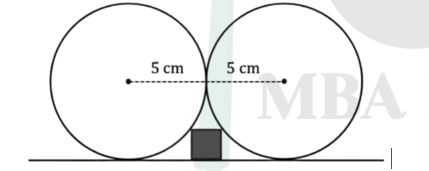
Put the origin on the ground directly below the point where the circles touch. The centres are then at (±5, 5). A square of side s stands on the ground centred at the origin, so its top corner (s/2, s) lies on the right circle:
(s/2 − 5)2 + (s − 5)2 = 25, which simplifies to 1.25s2 − 15s + 25 = 0, i.e. s2 − 12s + 20 = 0.
s = 2 or 10, and only s = 2 fits in the gap. Area = 4 cm2.
Detailed solution coming soon.
Each box appears in three of the four weighings, so 174 + 170 + 165 + 163 = 672 is three times the total weight. The total is 224 kg.
The heaviest reading (174) leaves out the lightest box, so the lightest box weighs 224 − 174 = 50 kg.
Composites in S: 4, 6, 8, 9, 10, 12, 14, 15 (8 numbers). Primes: 2, 3, 5, 7, 11, 13 (6 numbers). The number 1 is neither.
Non-empty subsets: (28 − 1) − (26 − 1) = 255 − 63 = 192. The difference is the same if empty sets are counted.
Multiply the denominator by x2026: each 1/xk becomes x2026 − k, which gives x + x2 + … + x2025, the same as the numerator.
So the denominator = numerator ÷ x2026, and the expression = x2026.
A × 1.052 = B × 1.053, so A = 1.05B.
A + B = 2.05B = 71750, which gives B = 35000.
B’s interest for 2 years = 35000 × (1.1025 − 1) = Rs 3587.50.
Surface area = 6732 ÷ 8.5 = 792 cm2.
2(15 × 12 + 12a + 15a) = 792 gives 180 + 27a = 396, so a = 8.
Volume = 15 × 12 × 8 = 1440 cm3.
Correct: 0 · Wrong: 0 · Accuracy: 0%
Keep the streak alive. See you tomorrow for Day 11.