Every year, nearly 3 lakh MBA aspirants register for the Common Admission Test (CAT) to compete for admission into the Indian Institutes of Management (IIMs) and several other leading B-schools.
CAT 2026 will be conducted by IIM Indore on 29 November 2026 in three sessions. The exam consists of 68 questions to be solved in 120 minutes, with 40 minutes allotted to each section.
Each correct answer carries 3 marks, while 1 mark is deducted for every incorrect MCQ. If you are starting your CAT preparation from scratch, you still have enough time to become CAT-ready with a structured approach.
Join MBA KARO Whatsapp Community For Daily Updates
Beginner to CAT Ready: Know the CAT 2026 Exam First
Beginners should first understand what the CAT exam is all about. The key highlights of the CAT 2026 exam are shared below:
| CAT 2026 Highlights | Details |
| Exam Date | 29 November 2026 |
| Conducting Institute | IIM Indore |
| Total Questions | 68 |
| Total Duration | 120 Minutes |
| Sections | VARC, DILR, QA |
| Marking Scheme | +3 marks for correct answers and -1 mark for incorrect answers in MCQs |
| VARC | 24 Questions |
| DILR | 22 Questions |
| QA | 22 Questions |
What Does “CAT Ready” Actually Mean?
A CAT-ready candidate is someone who can solve questions accurately under time pressure. Attempt all three sections confidently and analyse mistakes after every mock test.
Maintain consistency instead of studying only before the exam. Score enough percentile to target their preferred MBA colleges.
You do not need to know advanced mathematics or have exceptional English from Day 1. CAT preparation is about building concepts gradually and improving problem-solving speed.
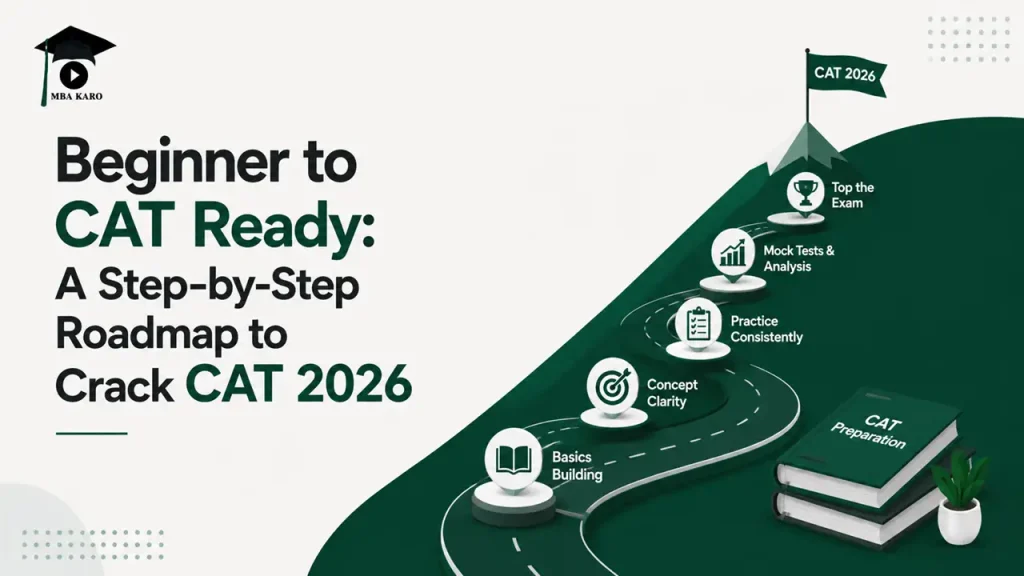
Stage 1: Build Strong Fundamentals (First 30-40 Days)
The first phase should focus entirely on understanding concepts instead of solving difficult questions.
Quantitative Aptitude (QA)
Start with topics that appear regularly in CAT. Understand why each formula works. Concept clarity makes difficult questions easier later.
- Number System
- Arithmetic
- Algebra
- Geometry
- Modern Maths
Verbal Ability and Reading Comprehension (VARC)
Develop reading habits from the beginning. Reading speed and comprehension improve gradually, not overnight. Focus on:
- Reading editorials daily
- Learning new vocabulary through context
- Understanding sentence structure
- Practising Reading Comprehension passages
Data Interpretation & Logical Reasoning (DILR)
Many beginners ignore DILR initially. That is a mistake. Initially, accuracy matters more than speed. Start practising:
- Tables
- Charts
- Arrangements
- Games and Tournaments
- Puzzles
- Venn Diagrams
Stage 2: Strengthen Problem Solving (Next 40-50 Days)
Once concepts become comfortable, shift your focus towards application. At this stage, solve sectional practice questions daily.
You can learn multiple approaches to the same problem and maintain an error notebook. Revise previously solved questions.
Avoid jumping directly to advanced-level questions. Increase the difficulty level gradually.
Stage 3: Improve Speed Without Losing Accuracy
CAT rewards candidates who solve the right questions rather than attempting every question. A higher number of attempts does not always result in a better percentile.
Accuracy plays an equally important role because of negative marking. During this phase:
- Set timers while practising.
- Skip lengthy questions initially.
- Learn question selection.
- Improve calculation speed.
CAT Section-Wise Strategy for Beginners
Here is the CAT section-wise strategy for beginners shared below:
CAT VARC Strategy
VARC has the highest number of questions in CAT. To improve your score, read for at least 30-45 minutes daily.
Solve one RC passage every day and practise Para Jumbles regularly. Focus on inference rather than memorisation. Consistency matters more than reading many books.
CAT DILR Strategy
Many candidates find DILR unpredictable. A better approach is to solve one complete set daily. Learn to identify easy sets first and practise different puzzle types.
Analyse every unsolved question. Pattern recognition improves only through regular practice.
CAT QA Strategy
QA becomes easier when concepts are revised repeatedly.
Create separate revision notes for important formulas, frequently used concepts and shortcut techniques. Revision should become part of your weekly schedule.
When Should Beginners Start CAT Mock Tests?
Many aspirants wait until they finish the syllabus before taking CAT mocks. This delays improvement. A better plan is to start sectional tests after completing basic concepts.
Take full-length mocks regularly and spend more time analysing the mock than writing it.
Mock analysis helps identify weak topics, time management issues, accuracy problems, and wrong question selection. These insights improve your score faster than solving random questions.
Common Mistakes Beginners Should Avoid in CAT Preparation
Many candidates lose valuable preparation time because of avoidable mistakes. Some common ones include:
- Ignoring one section completely.
- Studying without a timetable.
- Taking too many study materials.
- Not revising concepts.
- Skipping mock analysis.
- Comparing preparation with others.
- Focusing only on shortcuts.
Beginner’s Weekly CAT Preparation Plan
Modify the CAT exam schedule according to your strengths and weaknesses.
However, ensure that every section receives equal attention throughout the week. A balanced weekly schedule helps maintain progress.
| Day | Focus Area |
| Monday | Arithmetic + RC Practice |
| Tuesday | Algebra + DILR Set |
| Wednesday | Geometry + Verbal Ability |
| Thursday | Number System + DILR |
| Friday | Mixed QA Practice |
| Saturday | Sectional Tests + Revision |
| Sunday | Full-Length Mock + Analysis |
CAT Resources Beginners Should Focus On
Build mastery over limited resources. Quality practice consistently delivers better results than solving thousands of random questions.
This is where MBA KARO CAT free resources help you. Your CAT 2026 preparation should include:
- Concept learning
- Topic-wise practice
- Sectional tests
- Full-length mock tests
- Weekly revision
- Error notebook
How Long Does It Take to Become CAT Ready?
The CAT exam timeline varies, but daily practice and regular mock analysis remain the biggest factors influencing your final percentile. The answer depends on your current level.
| Starting Level | Approximate Preparation Time |
| Complete Beginner | 8-12 Months |
| Basic Aptitude Knowledge | 5-7 Months |
| Repeat CAT Candidate | 3-5 Months |
Conclusion
Becoming CAT-ready is not about solving the hardest questions from the beginning. It is about mastering concepts, practising regularly, improving accuracy, and learning from every mock test. Your preparation should cover all three sections equally while following a disciplined study plan.
If you want expert guidance throughout your preparation, MBA KARO CAT Online Coaching offers recorded classes, concept-building sessions, doubt support, practice questions, and exam-level mock tests designed around the latest CAT pattern.
MBA KARO also goes beyond academics with its official Mental Wellbeing Partner, Manotwam.
Led by a practising psychologist, the initiative provides evidence-based mental wellness support to help you manage exam stress, anxiety, and pressure throughout your CAT preparation.
A calm mind makes better decisions, and staying mentally prepared can be just as important as mastering the syllabus.