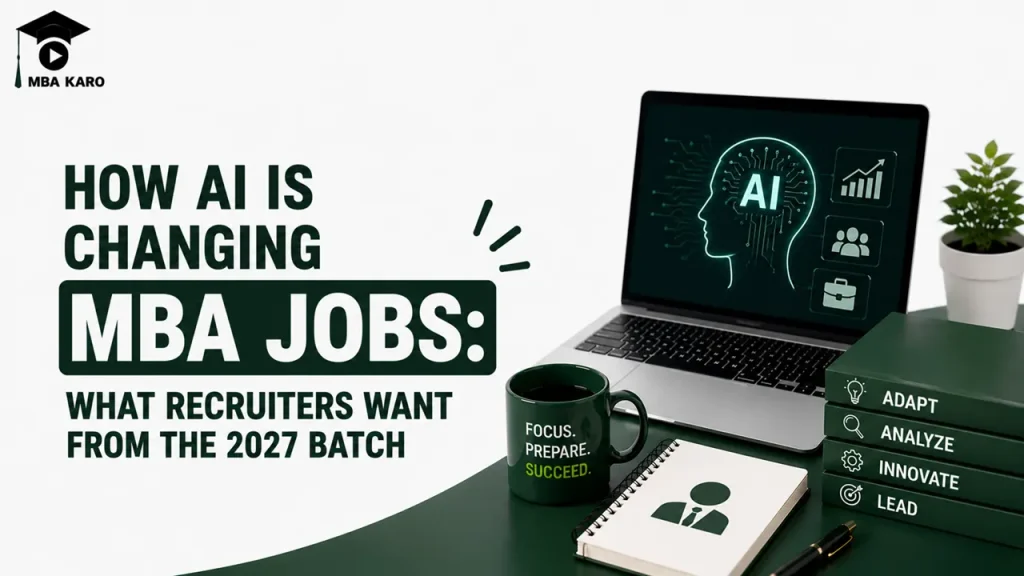
Artificial intelligence is changing the way businesses hire MBA graduates. Recruiters are no longer looking only for candidates with strong communication, leadership, and analytical skills.
They now expect future managers to understand how AI can improve business decisions, automate repetitive work, and increase productivity.
The change is happening quickly. As per a 2026 industry report, 73% of professionals in India now use generative AI at work, compared to 47% just two years earlier. This sharp rise shows that AI is no longer a future technology. It has become a daily workplace tool across industries.
The demand is equally visible in hiring. Reports show that 75% of employers are actively hiring, while 90% have increased their hiring budgets.
More importantly, 64% of employers now value AI and data skills more than the reputation of an MBA institute.
For students preparing through an MBA Entrance Test, this trend carries an important message. Cracking a top business school is only the first step.
Recruiters for the 2027 MBA batch will also expect graduates to understand AI-driven business processes, data interpretation, automation, and digital strategy.
AI Is No Longer an Optional Skill for MBA Graduates
Until recently, AI knowledge was considered useful only for technology professionals. That is no longer true. As per a 2026 hiring report, AI has become part of everyday business functions across organisations.
Many recruiters now expect candidates to know how AI tools can:
- Analyse business data
- Create market reports
- Build presentations faster
- Improve customer insights
- Support strategic decision-making
The expectation is not to become a programmer. Recruiters want MBA graduates who understand when AI should be used, how to interpret AI-generated insights, and where human judgement is still necessary.
AI Adoption Is Strongest in Core MBA Functions
One of the biggest misconceptions is that AI mainly affects software jobs. Recent industry data shows otherwise.
| Business Function | AI Adoption |
| Product Development | 62% |
| Strategy & Operations | 56% |
| Marketing & Sales | 55% |
These are among the most popular career paths chosen by MBA graduates.
For example:
- Marketing teams use AI to predict customer behaviour.
- Operations managers use AI for demand forecasting.
- Strategy teams analyse market trends with AI-powered dashboards.
- Sales managers identify high-conversion customers using predictive models.
Will AI Replace MBA Jobs?
The short answer is no. But it will definitely change them. As per employer surveys conducted in 2026, around 40% of organisations believe AI will improve productivity by redesigning work rather than replacing employees.
This means routine tasks are likely to be automated, including:
- Preparing standard reports
- Data collection
- Meeting summaries
- Basic financial analysis
- Initial market research
However, companies still need managers who can:
- Make strategic decisions
- Negotiate with clients
- Lead teams
- Solve business problems
- Handle uncertainty
- Build long-term business plans
AI can generate information quickly, but business leaders must decide which recommendations are practical and commercially viable.
Therefore, the answer to “will AI replace MBA jobs“ is that AI is more likely to replace repetitive work than managerial decision-making.
What Recruiters Want from the MBA Batch of 2027
Recruiter expectations have changed over the past few years. Now, recruiters increasingly assess whether candidates can work effectively with AI.
Some of the most valued abilities include:
AI-assisted decision-making: Managers are expected to combine business knowledge with AI-generated insights before making decisions.
Data interpretation: Recruiters prefer candidates who can explain what business data actually means instead of simply presenting charts.
Problem-solving: Companies value professionals who know when AI can solve a problem and when human judgement is required.
Digital transformation awareness: Businesses are investing heavily in AI implementation. Managers who understand digital adoption often become valuable contributors to transformation projects.
Productivity using AI: Recruiters appreciate candidates who can complete research, presentations, documentation, and analysis more efficiently with AI tools while maintaining accuracy.
AI Skills for MBA Students That Recruiters Value
Students often ask what technical skills they should learn. Recruiters now expect practical business applications. Some of the most useful AI skills for MBA students include:
| Skill | Business Use |
| Prompt writing | Faster research and content generation |
| Data analysis | Better business insights |
| Dashboard interpretation | Performance tracking |
| Business analytics | Decision support |
| AI presentation tools | Faster communication |
| Automation tools | Higher productivity |
| Market intelligence | Competitor analysis |
MBA Careers in AI Era Are Expanding
AI is creating new management roles. Industry estimates indicate that India now has nearly 9.2 lakh AI professionals.
This creates a strong demand for managers who can bridge technology and business teams. Some fast-growing MBA careers in AI era include:
- AI Product Manager
- Digital Transformation Consultant
- Business Strategy Manager
- Data Analytics Manager
- Operations Excellence Manager
- AI Adoption Lead
- Customer Experience Manager
- Business Intelligence Consultant
Consulting Jobs and AI Are Becoming Closely Connected
Consulting firms have always helped organisations improve efficiency and business performance. Today, AI has become one of the biggest consulting opportunities.
Companies need advice on questions such as:
- Which business processes should be automated?
- Where can AI improve customer experience?
- How should AI projects be implemented?
- What risks should organisations manage?
This has increased demand for professionals who understand both business strategy and AI applications. This is why many candidates want to pursue an MBA in Consulting.
The future of consulting jobs and AI is expected to focus more on digital transformation than traditional process improvement alone.
Recruiters Now Prefer Skills Alongside MBA Brand Value
Business schools continue to play an important role in placements. However, employer expectations are evolving.
According to a 2026 employer survey:
- 64% of employers prioritise AI and data capabilities alongside, or even above, the brand value of IIMs and other MBA institutes.
- 75% are actively hiring new talent.
- 90% have expanded their hiring budgets.
How MBA Students Can Prepare Before Placements
Students entering MBA programmes in 2027 can strengthen their profiles by focusing on practical learning. Some effective preparation strategies include:
- Learn business analytics and data visualisation.
- Use AI tools for case studies and market research.
- Build presentations with AI while validating every output.
- Develop strong communication and leadership skills.
- Work on live consulting or business projects involving digital transformation.
- Stay updated with AI trends affecting finance, marketing, operations, and HR.
Key Takeaways
| Trend | What It Means for MBA Students |
| 73% of professionals use generative AI | AI has become a regular workplace tool. |
| AI adoption is highest in product, operations and marketing | Core MBA functions are becoming AI-enabled. |
| 64% of employers value AI skills highly | Practical skills matter alongside an MBA degree. |
| India has nearly 9.2 lakh AI professionals | AI-related management careers are expanding. |
| Around 40% expect AI to redesign work | MBA roles are evolving rather than disappearing. |
Conclusion
Artificial intelligence is reshaping MBA careers. But it is not making management education irrelevant. Instead, it is changing the skills recruiters expect from graduates. Reports from 2026 show that AI adoption is rising rapidly across business functions.
Employers are increasing hiring budgets, and practical AI capabilities are becoming an important part of recruitment.
For students aiming to join the 2027 MBA batch, success will depend on combining traditional management strengths with AI literacy.
Business schools will continue to teach strategy, finance, marketing, and leadership. But recruiters will increasingly look for candidates who can use AI to analyse data, improve productivity, and support better business decisions.
Those who build these capabilities early are likely to be better prepared for the next generation of MBA careers.