
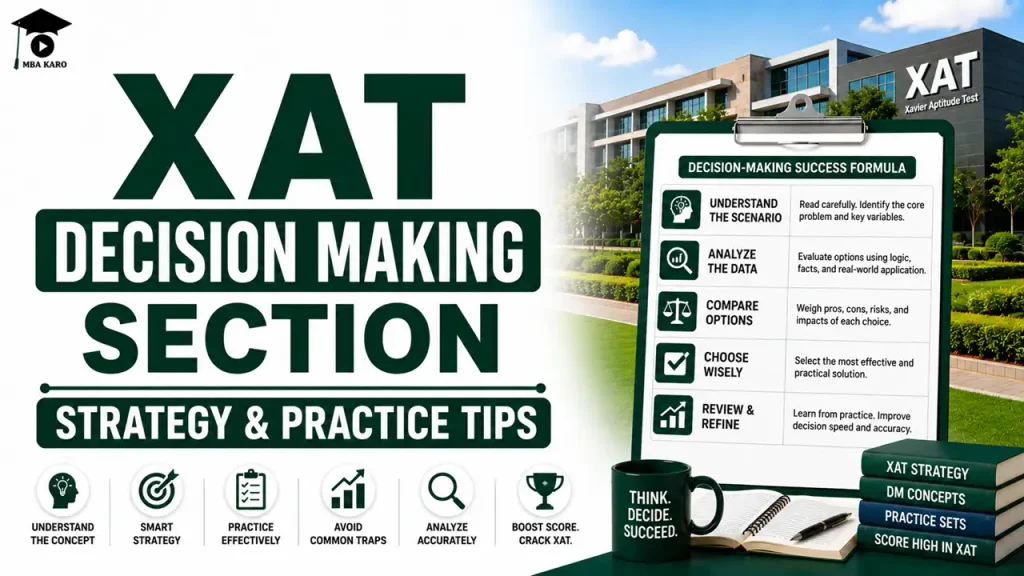
The XAT Decision Making section is expected to have around 21 questions, and yet most test-takers say it is the section that surprised them the most.
Unlike Quantitative Aptitude or Verbal Ability, DM does not test a formula or a grammar rule. It will present scenarios drawn from both personal and professional lives.
Candidates will be required to apply critical thinking, problem-solving skills, and prioritisation to make informed decisions.
With XAT 2027 is expected to follow a similar pattern. Part 1 exam duration will be 170 minutes, covering VA & LR, DM, and QA & DI together.
Your performance on DM can quietly pull your overall score up or drag it down. A score of +1 for each correct answer and -0.25 for each wrong one means you cannot afford to guess blindly.
There is also a -0.10 penalty for each un-attempted question beyond the first 8 in Part 1, which makes the “skip everything” strategy just as risky.
The good news? XAT DM is actually the most learnable section if you approach it with the right mindset.
What Is the XAT Decision-Making Section About?
The XAT DM section presents real-world scenarios from both personal and professional life. You are stepping into a situation and choosing the most reasonable, ethical, and effective course of action.
A typical XAT Decision Making question might describe a workplace conflict, an ethical dilemma, a business decision under uncertainty, or a situation where two equally important values are in tension.
Then it asks you: What should the person in this situation do? The answer choices are rarely “one obviously right and three obviously wrong.” That is what makes XAT DM genuinely tough.
5 Core XAT Decision Making Strategies
Here are the 5 core strategies to excel in the XAT decision making section shared below:
Read the Scenario Twice Before Looking at Options
This sounds basic, but most students make their biggest mistakes here. The scenario contains the context and the role of the person, the constraints they are operating under, the relationships involved, and what is at stake.
Rush through it once, and you will miss a detail that changes everything. Read it once for the big picture. Read it again to catch the specific constraints.
Eliminate Options That Are Too Extreme
DM answer choices that involve extreme actions such as firing someone immediately, publicly calling out a colleague, escalating to the CEO on Day 1 are almost always wrong.
XAT values balanced, proportionate responses. When in doubt, the right answer tends to involve communication, fact-finding, or measured action rather than drastic steps.
Think About the Role
Ask yourself: who is the person making this decision? A junior employee making a decision that only a senior manager should make is a red flag.
A manager going over their team’s heads without first speaking to them is another. The appropriateness of an action is tied to the role of the person in the scenario.
Watch Out for Options That Sound Good But Ignore a Key Constraint
XAT setters are clever. They will give you an option that is a perfectly reasonable action in the real world, but one that ignores a specific fact mentioned in the scenario.
Maybe the person does not have the authority to do it. Maybe the timeline does not allow for it. Maybe it violates a policy mentioned two lines earlier.
Go back to the scenario if an option feels right, but something seems off.
Handle Your Time Like a Portfolio
You have 170 minutes for all of Part 1. DM is one of three sections competing for that time. Spend roughly 35-45 minutes on DM.
Within that, flag questions you are unsure about and come back to them. Never spend more than 3 minutes on a single DM question in your first pass.
What Kind of Questions to Practise
To prepare for XAT 2027 DM, you need to train your judgment. Here is what works:
Ethical dilemma cases: Read short ethical case studies (Harvard Business School publishes free summaries) and practise identifying stakeholders, trade-offs, and consequences.
- XLRI past papers: XAT DM questions from previous years (2019–2026) are the gold standard. The style, language, and difficulty level are consistent. Do not skip these.
- Group Discussion topics: DM and GD preparation overlap more than people think. If you regularly read about business ethics, corporate governance, and workplace issues, you will find XAT DM scenarios much more familiar.
- Timed mock tests: The most important practice is attempting DM under real test conditions, with the scoring penalty in mind. Get comfortable with the discomfort of not being 100% sure of your answer.
Common Mistakes to Avoid in the XAT Decision Making Section
Here are a few common mistakes to avoid in the XAT 2027 Decision Making section given below:
- Applying personal bias: What you would do in real life is not always what XAT expects. Stick to what is rational, ethical, and appropriate for the role described.
- Guessing beyond your first 8 skips: Remember the -0.10 penalty per un-attempted question after 8. Plan your attempts intentionally.
- Ignoring the relationship dynamics: DM questions often hinge on who reports to whom, who has authority, and what the existing relationship is between people in the scenario.
- Treating DM as a shortcut section: Some students under-prepare for DM because it feels more “subjective.” That is a mistake. With the right practice, DM is highly scorable.
Conclusion
The best thing you can do for XAT 2027 Decision Making is to start thinking in scenarios right now. When you read a business news story, ask yourself what you would do if you were the manager in that situation.
When you face a real-life dilemma, slow down and think about what a fair, reasonable, and role-appropriate response would look like. XAT Decision Making is not a test of your knowledge.
It is a test of your judgment. And judgment, unlike formulas, can be built with consistent practice over time. This is where MBA Karo XAT online coaching helps you. It offers recorded lectures, personalised mentorship and doubt-solving sessions to help you excel in this section.